
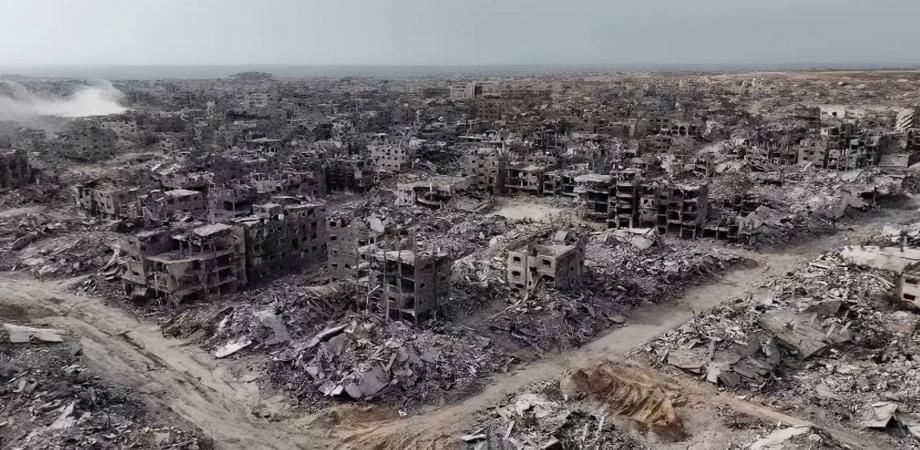
SAFA — For more than three years, Israel’s genocidal war on Gaza has done far more than destroy homes, hospitals, and civilian infrastructure. It has contaminated the land, air, and water upon which Palestinian survival depends.
Environmental experts and humanitarian organizations warn that the widespread destruction of civilian infrastructure has transformed Gaza into a toxic environment, exposing Palestinian families to potentially deadly health hazards.
A new report by Oxfam, titled “Environmental War Crimes: How Israel’s Military Assault Has Turned Gaza into a Toxic Land Threatening Human Survival,” warns that Israel’s military campaign has deliberately undermined the conditions necessary for life, turning large parts of the besieged territory into hazardous areas where even breathing, drinking water, and rebuilding homes carry serious health risks.
The findings expose another devastating dimension of Israel’s assault: environmental destruction that continues to endanger Palestinian lives long after the bombs have fallen.
Toxic Dust and Rubble Threaten Palestinian Lives
Wim Zwijnenburg, an expert on the environmental impact of warfare at the Dutch peace organization PAX, said the widespread destruction of residential and industrial areas had released enormous quantities of cement and construction dust into the atmosphere.
The danger does not end with the initial explosions. Demolition and rubble removal operations can release contaminated particles back into the air, exposing residents and cleanup workers to additional health risks.
Pollutants can also enter open wounds, potentially contributing to infections, antimicrobial resistance, and other serious medical complications.
Zwijnenburg called for urgent, independent field investigations and soil testing, urging Israel to allow UN agencies and international environmental experts access to Gaza to determine the scale and geographical spread of contamination.
Previous investigations by Oxfam and other humanitarian organizations have identified multiple potential pollution hotspots, particularly around displacement camps, water sources, solid waste dumps, and sites where accumulated waste is burned.
He stressed that heavily contaminated areas must be cleaned and made safe before Palestinians can return to their communities, rebuild their homes, or resume agricultural activities.
Israel, he said, bears responsibility for addressing the environmental damage caused by its military operations.
Palestinians Must Lead Gaza’s Recovery
Martin Butcher, Oxfam’s senior global policy adviser, said more than three years of Israeli bombardment and military operations had devastated civilian, agricultural, and industrial facilities, including water treatment plants, allowing toxic substances and untreated sewage to spread throughout the environment.
He noted that 99% of Gaza’s territory had been affected in some way, highlighting the urgent need for environmental assessments, the removal of hazardous materials, and medical treatment for exposed residents.
Butcher also stressed that Palestinians must lead the recovery and reconstruction of their homeland rather than have decisions about Gaza’s future imposed upon them.
Lama Abdel Samad, an Oxfam water and sanitation specialist, warned that Israel’s military assault had left approximately 61 million metric tons of rubble across Gaza.
The debris may contain explosive remnants of war, heavy metals, and hazardous organic pollutants capable of contaminating the air, groundwater, soil, and food chain.
Laboratory testing to determine the precise concentrations of these substances remains extremely difficult amid widespread destruction and restrictions on the entry of essential equipment.
Toxic Pollution Is Already Taking a Deadly Toll
Levels of fecal bacterial contamination have increased tenfold during the war, Abdel Samad said.
In January and February 2026 alone, Gaza recorded 81,000 cases of acute watery diarrhea, half of them involving children under the age of five.
Israeli restrictions on the entry of water purification equipment have further undermined efforts to provide safe drinking water to a population already exhausted by years of bombardment, displacement, and deprivation.
Approximately 1.9 million cases of respiratory illness have been recorded since the beginning of the war. In another disturbing case, a child died from lead poisoning linked to exposure to battery components.
The long-term health consequences of environmental contamination could be even more devastating.
Prolonged exposure to hazardous substances may increase the risk of cancer, cardiovascular disease, and liver and kidney disorders, while children face potential developmental complications.
Workers involved in rubble removal and sewage network repairs are particularly vulnerable because of their direct exposure to hazardous dust, contaminated water, and toxic waste.
Potential Pollution Sources Across Nearly All Affected Areas
Oxfam’s report, prepared in collaboration with the Conflict and Environment Observatory and supported by satellite imagery and other collected data, found that Israeli ground operations had affected approximately 283 square kilometers, equivalent to 78% of Gaza’s total area.
When different sources of pollution were combined, researchers identified at least one potential source of contamination in more than 99% of the assessed affected area.
The destruction of sewage infrastructure has created an additional environmental and public health emergency.
Approximately 40,000 cubic meters of untreated sewage flow into the Mediterranean Sea every day, while another 15,000 cubic meters enter cesspits or escape through leakage pathways, threatening soil and groundwater.
Gaza’s waste management system has also nearly collapsed. The number of operational garbage collection trucks has fallen from 261 to just 48, forcing communities to rely on temporary dumping sites that often lack adequate systems to prevent contaminated liquids from leaking into the surrounding environment.
By April 2026, an estimated 1.45 million Palestinians were living in areas affected by rodents and pests, compounding the territory’s deteriorating public health conditions.
The Gaza Municipalities Union estimates that between 700,000 and 800,000 metric tons of solid waste are scattered across the territory.
More than two million Palestinians generate approximately 2,000 metric tons of additional waste every day, while contaminated runoff and toxic leakage threaten underground water reserves.
Groundwater accounts for approximately 85% of Gaza’s water resources, making its contamination particularly dangerous for a population already struggling to secure safe drinking water.
A Poisoned Environment Compounds Gaza’s Human Catastrophe
UN Special Rapporteur Francesca Albanese has previously described conditions in Gaza as horrific, warning that Palestinians trapped in the territory are being subjected to a slow death.
She also highlighted the enormous destructive force of Israeli bombardment, comparing the explosive power unleashed on Gaza to that of six nuclear bombs.
According to figures from Gaza’s Government Media Office, Israel has dropped approximately 223,000 metric tons of explosives on the territory since the beginning of the war.
The office’s figures indicate that around 75,000 Palestinians have been killed and 176,000 wounded, with thousands more still missing.
The environmental destruction adds another devastating dimension to this human catastrophe.
Palestinian families who have survived years of bombardment now face contaminated water, polluted air, hazardous rubble, and collapsing sanitation systems. Even returning to their damaged homes or clearing debris can expose them to substances capable of causing serious and potentially long-term illnesses.
Without urgent environmental assessments, comprehensive decontamination, unrestricted humanitarian access, and the restoration of essential infrastructure, the consequences of Israel’s military assault could continue to endanger Palestinian lives for generations.
For Gaza’s population, surviving the bombardment does not mean escaping its deadly consequences. The destruction of the environment threatens the very foundations of Palestinian life, turning the struggle for survival into a daily battle against contamination, disease, and deprivation.
Source : Safa News


