
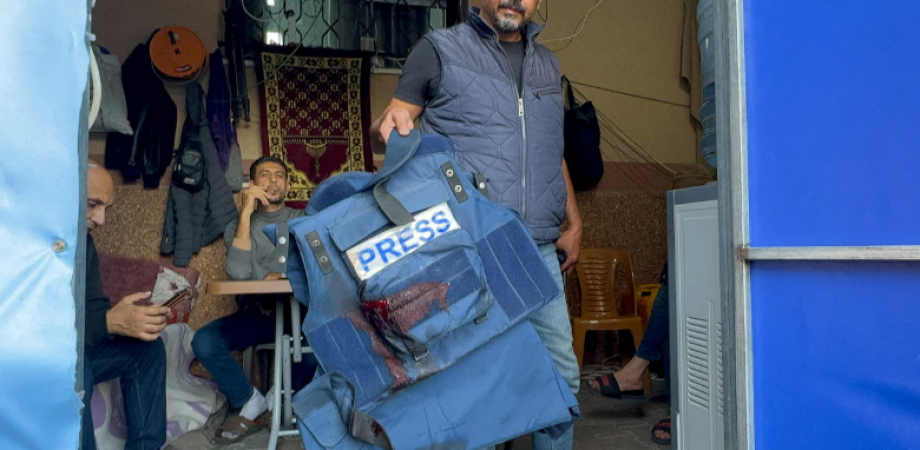
SAFA – More than three years into Israel’s genocidal war on Gaza, Palestinian journalists are struggling to continue reporting as their cameras, computers, smartphones, and other essential equipment deteriorate beyond repair.
Israel’s destruction of media institutions and restrictions on the entry of professional equipment and spare parts have forced journalists to document the devastation using outdated smartphones and damaged devices that barely meet the demands of their profession.
The shortage has turned even basic reporting into a daily struggle. Equipment prices have soared, replacement parts are increasingly unavailable, and journalists who have lost their cameras cannot afford new ones.
Many have been left with no choice but to rely on personal smartphones to document Israeli attacks, capture the suffering of Palestinian civilians, and transmit images from Gaza to the outside world.
The crisis extends far beyond damaged equipment. It reflects the widespread destruction of Gaza’s media infrastructure and the mounting obstacles facing Palestinian journalists as they struggle to make their voices heard.
Photojournalist Amer al-Sultan told Al-Araby Al-Jadeed that he lost his camera while covering events in southern Gaza when Israeli forces bombed the area where he was working. The attack destroyed his camera, depriving him of his primary reporting tool.
He explained that much of the equipment still available to journalists is worn out and urgently needs repair or replacement. However, soaring prices and the shortage of spare parts have made both increasingly difficult.
Unable to afford a replacement camera, Al-Sultan now relies entirely on his smartphone to document events and continue his work.
Reporting From Ruins With Broken Equipment and Limited Basic Services
For journalist and field producer Hussein al-Dash, covering Gaza’s devastation has become a daily struggle to secure even the most basic working conditions.
His work involves reaching reporting locations, identifying human-interest stories, contacting interviewees, coordinating filming with colleagues, reviewing footage, and preparing material for publication.
These tasks require a functioning laptop and a reliable smartphone, but his deteriorating equipment can no longer meet the demands of professional reporting.
Al-Dash explained that journalists must spend valuable time searching for places to charge their devices, securing internet connections, arranging transportation, and contacting interviewees before they can even begin reporting.
His smartphone no longer has the technical capabilities required for professional media work. Israeli restrictions on the entry of modern smartphones and media equipment have made replacements difficult to obtain, while the few devices available in Gaza are sold at prohibitively high prices.
Journalists’ financial circumstances have also deteriorated. Much of their income is consumed by displacement-related expenses, food, and other basic necessities, leaving little money to replace essential professional equipment.
With much of Gaza’s media infrastructure destroyed, journalists have been forced to work from damaged streets, makeshift spaces, and tents near hospitals and other healthcare facilities.
These improvised workplaces have become substitutes for newsrooms and production centers, reflecting the devastating toll of Israel’s war on Gaza’s media sector.
More Than 90% of Gaza’s Journalists Rely on Personal Smartphones
Photojournalist and field reporter Khamis Abu Hasira said Israeli attacks have targeted journalists, media organizations, and their equipment since the beginning of the war, destroying offices, studios, cameras, microphones, and recording devices.
Within the first months of the war, many journalists had already been forced to replace professional cameras with smartphones. Even these alternatives are often outdated, damaged, and unsuitable for demanding field assignments.
The shortage extends to microphones, audio-recording devices, memory cards, and other essential reporting supplies. Israeli restrictions on their entry into Gaza have left many items unavailable in local markets or priced far beyond journalists’ financial means.
Abu Hasira estimated that more than 90% of journalists in Gaza now depend on their personal smartphones to film, document, and transmit events. Even obtaining something as small as a camera memory card has become extremely difficult.
The crisis threatens far more than the quality of news coverage. It undermines journalists’ ability to document attacks, preserve evidence, interview survivors, and deliver timely reports from the ground.
According to Gaza’s Government Media Office, Israeli attacks since October 2023 have destroyed the headquarters of 16 satellite television channels, 11 radio stations, 12 newspapers and magazines, and 23 digital media platforms.
The destruction has also affected 27 printing presses and five media-related professional and human rights organizations.
Israeli Restrictions Deepen Crisis of Independent Reporting
Ahed Farawana, secretary of the Palestinian Journalists Syndicate, said Palestinian journalists are working in one of the world’s most dangerous and challenging media environments as Israel’s genocidal war on Gaza enters its fourth year.
He stressed that the destruction has extended beyond media institutions to advanced technical equipment, live broadcasting vehicles, and journalists’ personal devices. Many media workers have also lost their homes.
The most urgent shortages include modern smartphones, cameras, laptops, live broadcasting equipment, and microphones. Journalists increasingly depend on smartphones not only for filming but also for editing footage, preparing reports, and publishing their work.
The collapse of Gaza’s electricity infrastructure has created another major obstacle. Solar panels, batteries, and power-generation equipment have become essential for keeping phones, computers, and remaining media facilities operational.
The crisis is further compounded by Israel’s continued restrictions on independent access to Gaza for foreign journalists. Despite repeated international calls for unrestricted media access, Palestinian journalists continue to bear much of the responsibility for documenting events on the ground, often at enormous personal risk.
After more than three years of Israeli attacks, Gaza’s media sector has been stripped of much of its infrastructure. Palestinian journalists continue to report despite losing their offices, equipment, homes, and colleagues.
Their struggle is no longer simply about replacing broken cameras or damaged computers. It is about preserving the ability to document Palestinian suffering, safeguard evidence, and ensure that Gaza’s reality is not erased from the world’s view.
Source : Safa News


