
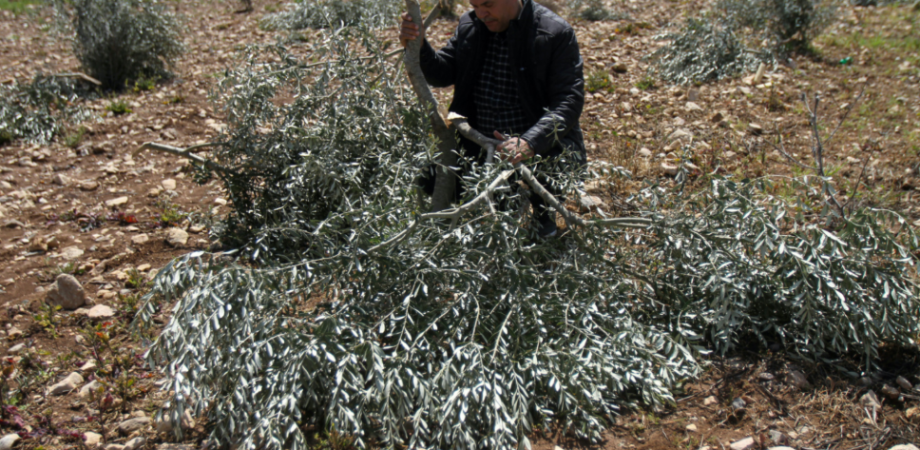
SAFA — Palestinian farmers across the occupied West Bank are facing an escalating wave of Israeli settler attacks during the annual olive harvest, with armed and masked settlers assaulting residents, burning olive trees, destroying crops, and preventing families from reaching agricultural land that has sustained their livelihoods for generations.
The attacks have intensified during one of the most important periods of the Palestinian agricultural calendar, when thousands of families depend on the olive harvest for income, food, and economic stability. What should be a season of gathering crops and working alongside relatives has instead become a struggle to reach farmland safely, protect centuries-old trees, and avoid violent confrontations with settlers.
Recent incidents documented by The Washington Post, The Associated Press, and Al Jazeera reveal the scale of the escalation, with attacks extending beyond Palestinian farmers to journalists and European diplomats visiting communities affected by settler violence.
United Nations figures cited in media reports indicate that more than 200 attacks on Palestinian farmers have been documented since September 1, already exceeding the 185 incidents recorded throughout the 2025 olive harvest season.
The rising number of attacks, coupled with the limited accountability faced by perpetrators, has heightened concerns that Palestinian farmers are being systematically pushed away from their land at the very moment they depend on it most.
Masked Settlers Attack Olive Harvesters and Journalists Near Ramallah
On Friday, October 16, dozens of masked Israeli settlers attacked Palestinians harvesting olives in the village of Abu Falah, northeast of Ramallah, setting trees ablaze, throwing stones, and assaulting farmers and journalists who were documenting the violence.
According to The Washington Post, settlers stormed the olive groves while Palestinians were working on their land, forcing harvesters to flee as attackers pursued residents and members of the press.
Among those assaulted was American photojournalist Heidi Levine, who was covering the olive harvest when settlers knocked her to the ground and repeatedly beat her, despite her wearing a helmet and protective vest clearly identifying her as a journalist.
The attackers also seized her cameras and mobile phone, preventing her from continuing to document the assault.
Levine sustained fractures to four vertebrae and a rib, multiple cuts, and a hand injury requiring surgery, according to the newspaper.
The severity of her injuries drew international attention to the attack, but Palestinian farmers in the area have faced similar threats while attempting to harvest their crops.
The violence in Abu Falah was part of a wider series of attacks that day. The Associated Press reported that Israeli settlers targeted at least eight villages across the northern West Bank, injuring 14 people, including Levine.
The coordinated timing of the incidents highlighted the vulnerability of Palestinian agricultural communities, where farmers often work in isolated groves near Israeli settlements and outposts and have limited means of protecting themselves against groups of attackers.
For Palestinians who depend on the harvest, the consequences are immediate: abandoning the groves can mean losing an entire season's income, while returning to collect the olives can expose families to further attacks.
Palestinian Farmers Forced to Harvest Under Constant Threat
In the village of Turmus Ayya, north of Ramallah, 62-year-old Palestinian farmer Amal Abu Awwad repeatedly interrupted her olive harvest on October 19 after receiving warnings that Israeli settlers were nearby.
Her experience, documented in a video report by The Associated Press, reflects the conditions facing farmers who must remain alert to possible attacks while carrying out agricultural work that would ordinarily bring families together.
For many Palestinians, harvesting olives has become an unpredictable and dangerous undertaking, with farmers forced to assess whether approaching their trees is worth the risk of physical assault, property destruction, or being driven from their land.
The threats are particularly damaging because the olive harvest is concentrated within a limited seasonal window. When farmers are prevented from accessing their groves, the resulting losses cannot always be recovered later.
Olive cultivation is a major source of income for Palestinian households, supporting families through the sale of olives, olive oil, and related products. The trees also represent a connection to land cultivated and inherited across generations, making their destruction both an economic loss and a profound blow to Palestinian agricultural heritage.
When settlers burn trees, damage crops, or force farmers to abandon their harvest, the consequences can extend well beyond a single season. Mature olive trees require years of care, and damage to productive groves can undermine a family's livelihood long after the immediate attack has ended.
UN Records More Than 200 Attacks Since September
The scale of the violence has become increasingly evident in United Nations monitoring of attacks against Palestinian farmers.
According to Al Jazeera, citing the UN Office for the Coordination of Humanitarian Affairs (OCHA), more than 200 Israeli settler attacks against Palestinian farmers have been documented since September 1, 2026, surpassing the 185 attacks recorded during the entire 2025 olive harvest season.
The figures indicate that this year's harvest has already been marked by a higher number of documented attacks than the previous season, even as Palestinian families continue attempting to collect their crops.
The incidents include assaults on farmers, threats that prevent access to agricultural land, and attacks resulting in damage to trees, crops, and property.
The disruption has serious implications for Palestinian communities whose agricultural activities are already constrained by settlement expansion, movement restrictions, and difficulties accessing land near Israeli-controlled areas.
For families who have invested months caring for their trees, being prevented from harvesting means losing the return on an entire year's work while still facing the costs of maintaining their land.
The repeated attacks also create pressure on farmers to reduce or abandon agricultural activities in areas where reaching their groves has become increasingly dangerous.
Settler Attacks Extend to European Diplomatic Delegation
The escalation has also reached foreign visitors attempting to observe conditions in Palestinian communities.
On Saturday, October 17, a European diplomatic delegation visiting the town of Taybeh, east of Ramallah, came under attack, just one day after the assault on Levine in Abu Falah.
According to The Washington Post, the delegation included diplomats from France, Belgium, and Poland, alongside representatives of church organizations.
During the incident, attackers smashed a window of a Belgian consular vehicle and assaulted a French mayor who was participating in the visit.
The attack prompted international condemnation, while Israeli police and military authorities announced an investigation.
The assault on Levine also drew criticism from American officials, who called for an investigation and accountability for those responsible.
Although the attacks on foreign journalists and diplomats attracted considerable international attention, Palestinian farmers and residents have faced repeated violence while attempting to carry out ordinary activities on their own land.
The incidents have intensified scrutiny of the conditions under which settler attacks take place and the ability of Israeli authorities to prevent violence or hold perpetrators accountable.
More Than 1,600 Settler Attacks Recorded in Eight Months
The violence surrounding the olive harvest forms part of a broader pattern of attacks across the occupied West Bank.
The Washington Post, citing United Nations data, reported that more than 1,600 settler attacks resulting in Palestinian injuries or property damage were recorded between January and August 2026.
The figures point to a sustained pattern of violence affecting Palestinian communities throughout the year, with the olive harvest creating additional opportunities for confrontation as farmers return to agricultural land near settlements and outposts.
Concerns about accountability have also grown as attacks continue despite repeated documentation by human rights organizations, journalists, and international agencies.
The Guardian, citing the Israeli human rights organization Yesh Din, reported that 94% of investigations into settler violence were closed without indictments, according to the figures referenced in its reporting.
Such findings have raised serious questions about whether existing enforcement mechanisms provide meaningful protection for Palestinians or sufficient deterrence against further attacks.
For farmers, the lack of effective accountability contributes to a climate of insecurity in which the same communities can face repeated assaults while attempting to cultivate or harvest their land.
Attacks Threaten Palestinian Livelihoods and Their Connection to the Land
Beyond the immediate injuries and destruction, the attacks are placing increasing pressure on Palestinian agricultural communities and their ability to maintain a presence on their land.
Olive cultivation depends on regular access to groves throughout the year, including pruning, maintaining trees, caring for the soil, and collecting crops during the harvest season. Repeated restrictions and threats disrupt this work, reducing productivity and making farming increasingly difficult.
For families who rely on olive production as a primary or supplementary source of income, losing access to their land can deepen financial hardship and threaten their ability to continue agricultural activities.
The damage is particularly severe when trees are burned or uprooted, as replacing mature olive groves requires years of investment before new trees can reach comparable levels of production.
The attacks also carry wider consequences for Palestinian communities, where the olive harvest remains closely connected to family life, local traditions, and the preservation of agricultural land.
As the 2026 harvest continues, Palestinian farmers face a difficult choice between risking further settler attacks to collect their crops or leaving their olives unharvested and absorbing the financial losses.
With documented attacks already exceeding last year's harvest-season total, the growing violence threatens not only the current crop but also the ability of Palestinian families to sustain their livelihoods and continue cultivating land they have worked for generations.
Source : Safa News


