
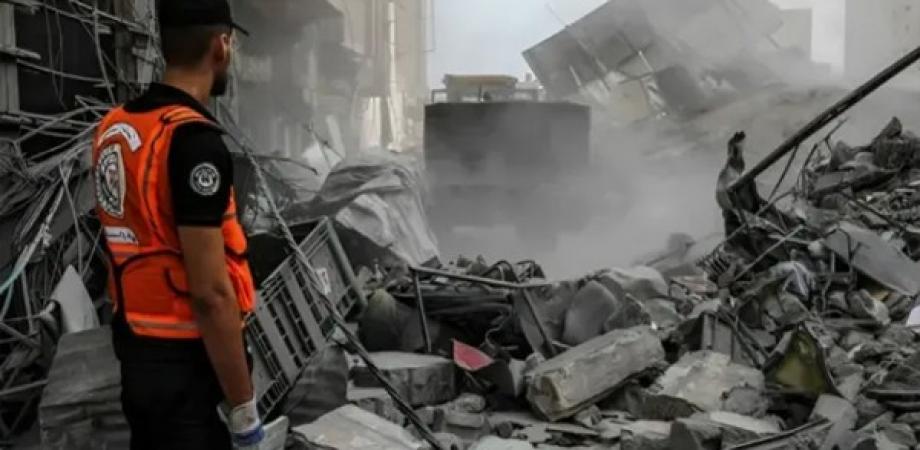
SAFA - From the first hours of the genocidal war, civil defense worker Ahmad Ridwan found himself at the heart of the rubble, using his bare hands to search for lives buried beneath the ruins of homes.
During one of his most difficult missions, a 15-year-old boy was trapped beneath a destroyed home, surrounded by the bodies of his family members. When rescue teams struggled to reach him, they fed a water hose and an oxygen tube through a small opening in the roof, then dug for hours until they managed to pull him out alive.
It was one of dozens of harrowing experiences Ridwan has endured since joining the Civil Defense in 2008, while the Israeli massacres have left indelible scars on both his body and memory.
A Child Trapped Beneath the Rubble
Ridwan says the images that remain most deeply etched in his memory are those of children trapped beneath the rubble. “Every targeted home we went to had children inside.”
In the al-Janina neighborhood of Rafah, in southern Gaza, the boy was trapped beneath the rubble while the bodies of his family members lay around him. His rescue operation continued from the morning until the afternoon prayer, roughly eight to 10 hours, as civil defense workers tried to keep him alive by supplying water and oxygen through a narrow opening.
He told Felesteen newspaper, "The teams were determined to keep going until the very last breath. They eventually managed to pull the child out with their own hands before a bulldozer later stepped in to complete the operation.”
Paramedic and Journalist
Ridwan, 45, joined rescue operations on the first day of the genocidal war, October 7, 2023. He also took on the responsibility of documenting Civil Defense missions and relaying them to the media.
He carried a camera alongside emergency medical equipment, accompanying teams to bombing sites and helping recover the dead, rescue the wounded, and transport them to hospitals.
In the Shaboura neighborhood, he witnessed the first massacre carried out by the Israeli occupation forces: the targeting of the four-story concrete home of the Abu Qouta family. The bombing left dozens dead, wounded, or missing, most of them children, women, and elderly people.
He also witnessed and documented recovery and rescue operations following dozens of Israeli massacres. At Abu Zuhri Tower, search operations continued for days beneath dangerous concrete slabs before one of the bodies was found.
In the Bsheit camp, in southern Gaza, an Israeli warplane bombed the home of the Abu Hilal family. Amid the rubble, rescue teams searched for survivors, including a child named Abdul Rahman.
During the rescue operation, gas leaked and a fire broke out inside the building, turning the rescue site itself into a scene of death. Ridwan was forced to put down his camera and help extinguish the fire and evacuate the wounded from the cramped space, amid a severe shortage of equipment.
In Tal al-Sultan, it took nearly five hours to rescue a child under the age of five after a concrete floor collapsed on top of him. Rescuers used rudimentary tools and simple machinery to make openings in the concrete and stabilize his crushed legs before pulling him out.
In al-Zuhur neighborhood, the rescuers were stunned when they spotted the moving hand of a 17-year-old girl beneath the rubble of the Harb family home, which had been buried inside a six-meter-deep pit. They immediately halted mechanical excavation and began digging by hand until they brought the girl out alive.
Rescuers Under Fire
Civil Defense workers themselves were never far from danger. In January 2024, Ridwan headed to the Abu Naja family home in the Miraj area after it was bombed, killing everyone inside.
About half an hour after the teams arrived, warplanes struck a nearby location. Ridwan suffered severe pain in his ear and continues to experience its effects, while one of his colleagues was wounded in the back. A bulldozer and a fire truck were also damaged by shrapnel.
Ridwan was leading the mission, so he pulled the teams to safety. They then discovered that the strike had hit a nearby tent. They treated two wounded people and transported them to Abu Yusuf al-Najjar Hospital.
Displaced Eleven Times
Civil Defense teams were displaced some 11 times between Rafah and al-Mawasi in Khan Younis in southern Gaza, but they never stopped working, Ridwan said.
They moved between different parts of Rafah, responding to distress calls. At times, they were forced to temporarily leave behind bodies and wounded people because of continued bombardment and repeated strikes on the site, returning only after the area had fallen quiet.
Ridwan says they faced a painful dilemma because of shortages of fuel and equipment: whom should they rescue first, the person closest to them or the one in the greatest danger?
An Ambulance Out of Service
Ridwan describes the equipment shortage as “an old, recurring problem that continues to worsen.” Civil Defense vehicles have been targeted and rendered inoperable, while securing fuel, oil, and spare parts has become increasingly difficult.
Once, an ambulance was out of service for nearly three weeks because of worn-out tires and shortages of oil and spare parts, preventing the teams from reaching wounded people in need of rescue.
In Rafah, the Civil Defense lost 14 members, according to Ridwan, including six who were killed in the Tal al-Sultan massacre while carrying out their duties.
He remembers his colleagues Yousef Khalifa, Fouad al-Jamal, and Anwar al-Attar, saying their mission was always to “help those in distress and those crying out for assistance, including children and women.”
One of the memories that has stayed with him most vividly is Fouad al-Jamal’s determination to save the only fire truck serving Rafah as tanks advanced into the al-Shakoush area. Although he was an ambulance driver with no experience operating a fire engine, he drove it through the gunfire alongside Anwar al-Attar and moved it out of harm’s way. The Israeli forces later destroyed the vehicle, which was buried along with the six Civil Defense workers killed in the Tal al-Sultan massacre.
The War Etched in Memory
The effects of the war remain etched in Ridwan’s body. Since December 2023, he has suffered persistent ringing and buzzing in his ear, along with insomnia, headaches, dizziness, and loss of balance caused by explosions that went off near him while he was carrying out rescue missions.
Even the smell of blood and gunpowder has become an inescapable part of his life. Whenever he catches the scent rising from a bombed site where flames are burning and columns of smoke billow into the sky, his memory takes him back to the brutality of the scenes he witnessed amid the war, leaving him deeply distressed.
He says the images of children and mangled bodies have changed his behavior and the tone of his voice, making him more emotional and intensifying his fear for his own children.
“We Will Keep Our Promise”
Despite all the horrors he has endured, Ridwan does not see retreat as an option. He says, “God chose the Civil Defense workers after they carried out their humanitarian duties, and we will continue despite the danger, the lack of resources, and the absence of regular salaries.”
Ridwan stated that workers receive around 1,000 shekels every 100 days, an amount that does not last a week amid soaring prices and the siege. Yet when a distress call comes in, they have no choice but to move.
He continued, "We may enter dangerous places without knowing whether we will return, but what drives us is the person trapped beneath the rubble and the child waiting for a hand to reach out to him.”
Source : Safa News


