
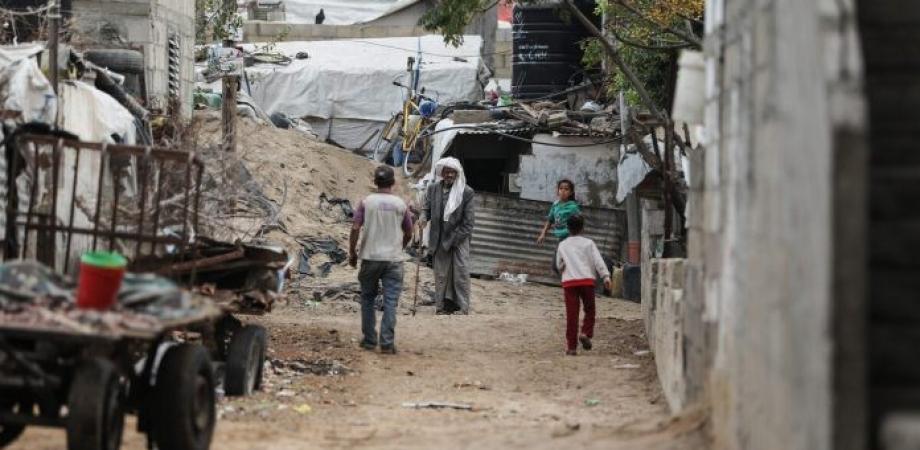
SAFA - Near the Yellow Line, more than 100 families displaced to the Dar al-Salam camp remain just 200 meters away from Israeli military positions and within range of gunfire. The only barrier separating them from the danger is a piece of fabric and an earthen berm erected along the camp’s front in an attempt to shield residents from bullets fired by Israeli vehicles.
Even the two-meter-high earthen barrier has failed to stop bullets from reaching the displaced people’s tents almost every day. Those who proposed building it say they hoped it would block the camp from the view of Israeli positions, whose machine guns are aimed toward the area.
Their goal was to ease the fear and terror experienced by children, women, and other residents, who would otherwise remain exposed with no protective wall between the camp and the military positions after all the homes in front of them were destroyed, leaving every movement visible.
In May 2026, Mustafa Samama was wounded while sitting inside his tent. The bullet severed a nerve, preventing him from continuing the occasional work that had provided an income for his six children.
Standing outside his tent with his injured hand in a medical sling, Samama points to where the bullet came from. Speaking to Felesteen newspaper, with his two children beside him, he says: “The situation here is very difficult.
We are close to the Yellow Line. Every day, the Israeli occupation forces advance with military vehicles, carry out fire sweeping, or move the yellow blocks, which have now reached the Dawla intersection on Salah al-Din Street.”
Recalling the moment he was wounded, he says: “I was sitting inside the tent when suddenly something pierced my hand and it began bleeding. I was taken to the hospital with great difficulty. We have endured the destruction of our homes and living in tents. We deserve to feel at least some sense of safety.”
An Israeli drone flew at low altitude over the camp, monitoring every movement. But Samama says it is only one of many drones of different types that take turns surveilling the camp or firing bullets and missiles at it.
The Yellow Line Moves Closer
The day before yesterday, Israeli vehicles advanced along a clearly visible route used to reach Salah al-Din Street, putting camp residents through terrifying hours. Samama recalls: “As the bulldozers were operating, random gunfire continued for several hours. We spent the entire time lying on the floor of the tent so the bullets would not hit us. We could not even stand up.”
What Samama describes has become a recurring reality for those living near the Yellow Line. Every day, particularly at night, Israeli forces advance the yellow concrete blocks or open fire in what is known as “fire sweeping,” sowing terror among displaced residents and turning the area into what feels like a “ghost town.”
A few days ago, Iyad Abdul Rahman Labad, a camp resident, said a bullet struck one of his neighbors in the foot, fracturing his bones and requiring the insertion of a metal fixation plate. He described the situation as “dangerous.”
Imad Erhaim describes the nighttime conditions: “We are living through moments of sheer terror. This is not something that happens once or for a single day; the attacks are repeated every day. A few days ago, a bullet entered my tent. We were lucky to survive.”
In the al-Manasra camp, located farther behind the Dar al-Salam camp, the greater distance from the Yellow Line has not meant greater safety. Bullets still reach the camp.
Inside his tent, Abdullah al-Zaabout still suffers from injuries caused by an Israeli drone strike nearby. About a month ago, he was walking on a road near the camp when a suicide drone targeted a young man, who was killed. Al-Zaabout narrowly escaped.
Speaking to Felesteen newspaper, he recalls: “When I saw the suicide drone, I started running. I thought it would explode on me, but it exploded nearby. It was a very terrifying moment.” He adds that quadcopter drones fly constantly over the camp.
Two days ago, al-Zaabout again experienced the terror of Israeli bulldozers and vehicles constructing barriers nearby. “We remained under a hail of bullets until dawn,” he says. “The situation was terrifying, and the gunfire reached our camp.”
He and other camp residents experienced an even more severe ordeal when the yellow blocks were moved at the Dawla intersection on Salah al-Din Street, prompting displacement from other nearby camps. Recalling those harsh moments, he says: “The gunfire continued until morning, alongside artillery shelling. We were even unable to flee because we feared being targeted on the road.”
A Constant Toll of Injuries
In another tent in al-Manasra camp, teenager Mohammed Zaki Marish was wounded in an Israeli bombardment that targeted one of the camp’s tents, killing and injuring several people. Sitting inside a tent marked by suffering and loss, the boy has a visible depression in his hand caused by fractures and bone loss resulting from the injury.
His uncle Iyad tells Felesteen newspaper: “The strike was devastating. Shrapnel flew everywhere and my nephew was wounded. He has lost part of the bone in his hand and continues to suffer because he cannot get the treatment he needs.”
The child’s grandmother, Umm Nahid, describes the nights as terrifying. She tells Felesteen newspaper that a bullet nearly struck her daughter-in-law after hitting a stone beside her. “This gunfire keeps reaching us,” she says. “It makes our lives extremely difficult.”
Mohammed Bakir brings a plastic chair out of his tent, showing a hole left by an Israeli bullet that struck it moments after his mother had gotten up and sat on the ground. “If she had waited just a few more seconds, she would have been shot in the foot,” Bakir tells Felesteen, recounting an incident that happened several days ago.
Another child holds an Israeli bullet, a tangible reminder of the fear he experienced when it landed nearby. In nearly every tent across the camp, there is a bullet hole, a story of terror, or someone wounded by gunfire that continues to reach the area. It is a tragedy shared by all the camps in the region. And the danger is not limited to bullets fired from a distance. Quadcopter drones also repeatedly fly over the camp, firing at its passageways and entrance.
Source : Safa News


