
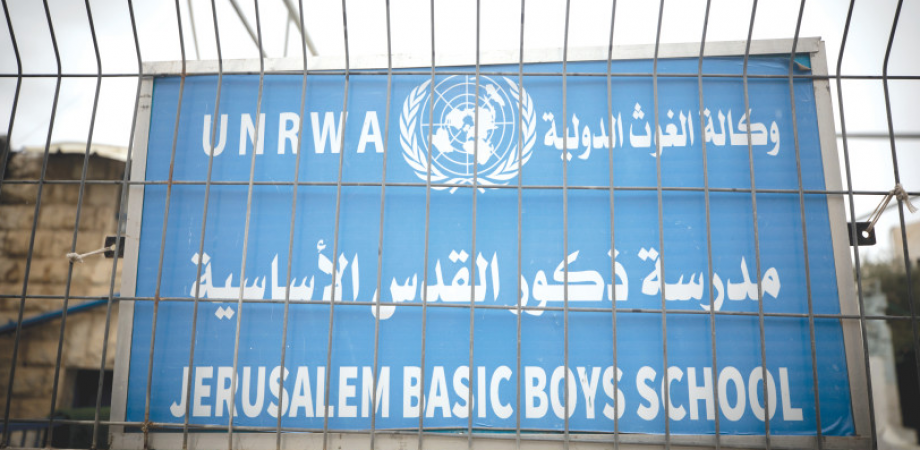
SAFA - Israel’s restrictions on the United Nations Relief and Works Agency for Palestine Refugees (UNRWA) continue to unfold, threatening the UN agency’s presence in occupied Jerusalem and raising fears among millions of Palestinian refugees, both inside and outside Palestine, over the consequences of any suspension of its services and activities.
The latest measure came on Tuesday, August 25, 2026, when Israeli occupation forces raided the UNRWA compound in Qalandia, north of occupied Jerusalem, evacuated its staff, raised the Israeli flag over its buildings, and instructed employees not to return.
The move comes months after the UNRWA’s headquarters in Jerusalem’s Sheikh Jarrah neighborhood was shut down as part of Israeli measures aimed at ending UNRWA’s presence in the city. The measures followed laws passed by the Knesset that ban the agency’s activities and strip it of privileges and facilities it had previously enjoyed.
How the Escalation Began
One of the key turning points in the escalation dates back to January 2025, when UNRWA’s headquarters in Sheikh Jarrah were closed, as Israeli settlers called for celebrations outside the UNRWA’s premises.
Ariyeh King, deputy mayor of the Israeli municipality in Jerusalem, was among the most prominent figures calling for an end to UNRWA’s presence in the city. He urged settlers to gather outside its headquarters and described himself on his Facebook page as an “activist against UNRWA in Jerusalem for years.”
On October 28, 2024, the Israeli Knesset passed, in its second and third readings, two laws targeting UNRWA’s operations. One bans its activities in what Israeli occupation calls “areas under its sovereignty,” while the other revokes the privileges and facilities granted to the UNRWA and prohibits any official contact between Israel and UNRWA.
The first law was approved by 92 Knesset members, with 10 voting against it. It prohibits UNRWA from operating any representation, providing services, or carrying out activities, directly or indirectly, in areas Israeli occupation considers to be under its sovereignty.
The second law was backed by 87 members, with nine voting against it. It calls for the revocation of the privileges and facilities granted to UNRWA under arrangements dating back to 1967 while also barring Israel from maintaining any official contact with the UNRWA or its affiliated bodies.
From 750,000 Refugees to Nearly 5.9 Million
When UNRWA began its operations in 1950, it provided services to around 750,000 Palestinian refugees. Over the decades, however, the number of registered refugees eligible for its services has risen to nearly 5.9 million.
More than 100,000 refugees live in Jerusalem, while the number of refugees in the West Bank stands at around 850,000, according to the figures cited in the report.
The UNRWA provides essential services across sectors, including education, healthcare, relief, and social services, making any reduction in its presence or an end to its operations a direct source of concern for hundreds of thousands of Palestinians who rely on its services.
Who Funds UNRWA?
UNRWA relies on contributions from UN member states, as well as regional governments and the European Union, for its funding. Together, these contributions account for around 92.6% of its financial resources, according to information published by the UNRWA on its website.
At the same time, the UNRWA is facing growing financial challenges, making it increasingly difficult to retain all of its employees if Israeli measures against its premises and activities in Jerusalem continue.
550 Employees Face an Uncertain Future
The repercussions of closing UNRWA’s headquarters extend beyond the refugees who rely on its services, affecting hundreds of employees who depend on UNRWA for their livelihoods.
Around 550 men and women work at UNRWA’s Jerusalem office, roughly half of them holders of the green Palestinian identity cards issued in the West Bank. Since the outbreak of the genocidal war on October 7, 2023, they have been barred from reaching their offices in Jerusalem and have had to carry out their duties from various locations across the West Bank.
With the UNRWA's Jerusalem headquarters now closed, uncertainty is deepening over the future of these employees amid UNRWA’s financial crisis. A limited number may be transferred to workplaces in the West Bank, while others could face termination of their employment.
The concerns extend beyond administrative staff to include UNRWA schoolteachers and healthcare workers, including doctors and nurses at UNRWA’s Al-Zawiya Clinic in Jerusalem’s old city.
What About UNRWA Schools and Its Clinic?
UNRWA staff in Jerusalem are closely watching the impact of the closure on institutions that provide direct services to residents, particularly UNRWA’s schools, where around 1,100 boys and girls receive their education.
Questions are also being raised over whether teachers will be able to reach their schools and whether the Israel will prevent them from entering classrooms, as well as over the fate of the Al-Zawiya Clinic and whether it will be able to continue providing medical services.
Fears are also growing that Israeli forces could interfere with the clinic’s operations, despite the immunities and privileges afforded to UN institutions under international rules and a sign at the clinic’s entrance prohibiting entry with weapons.
The Israeli escalation against UNRWA carries consequences that go beyond the closure of its offices and premises. It directly affects the services the UNRWA provides to Palestinian refugees and raises questions about the future of its presence in Jerusalem and its role in serving refugees.
As Israeli measures against the UNRWA’s institutions continue, refugees and UNRWA employees are facing a new reality that threatens to reduce services or bring some of them to a halt. Meanwhile, UNRWA maintains its UN-mandated role of providing services to Palestinian refugees until a just and lasting solution to their cause is reached.
Source : Safa News


