
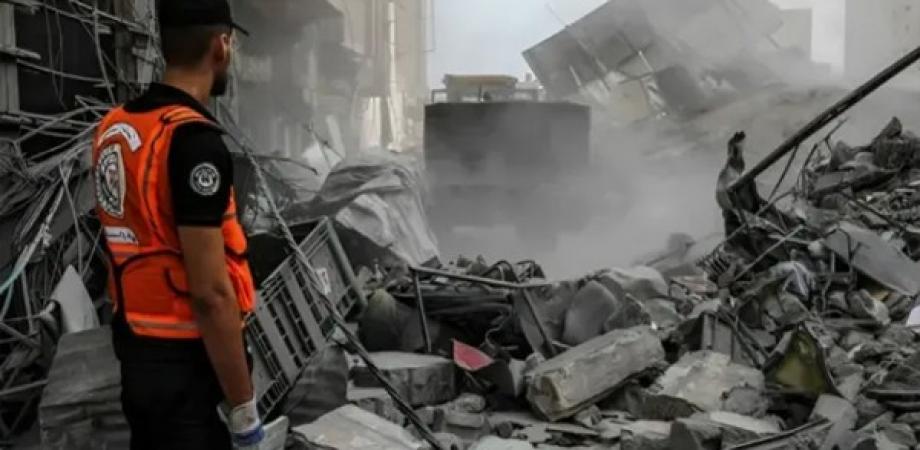
SAFA — Delivering his own baby inside a displacement tent without medical supplies was the last thing Gaza Civil Defense officer Ibrahim al-Sududi expected to face.
After 18 years of responding to distress calls and witnessing devastating scenes, Israel’s genocidal war on Gaza forced him to confront an emergency of a different kind: delivering his own child when his wife went into labor and no medical help was available.
After spending long, uninterrupted hours rescuing survivors and assisting victims of Israeli bombardment, al-Sududi received word that his wife had gone into labor. Unable to contact an ambulance to take her to a hospital, he was left to handle the emergency himself.
“I rushed to my tent and found my wife in the final stages of labor,” al-Sududi told Felesteen newspaper. “There was no way to contact anyone, so I immediately decided to deliver the baby myself, fearing for her life and the life of our unborn child.”
The delivery was successful. An ambulance eventually arrived and transported his wife and newborn daughter, Rateel, to the hospital for post-delivery care.
“The hospital staff were surprised by what I had done,” he recalled. “I told them that the body parts, attacks and horrific scenes I had witnessed during the war as a Civil Defense officer had brought me to a point where I no longer hesitate, even for a moment, before doing anything possible to help someone in need.”
“And this was my wife,” he added. “Any delay could have cost me her life, the life of our child, or both.”
Eighteen Years of Rescue Work
Al-Sududi has worked with Gaza’s Civil Defense since 2008, serving through successive Israeli wars, military escalations and invasions.
“I have lived through Israeli wars, countless rounds of escalation and invasions, but all of them were merely a drop in the ocean compared with what we have witnessed during this genocidal war,” he said.
Since October 2023, al-Sududi has worked under conditions in which rescue missions have repeatedly put his own life at risk.
He said Israeli attacks on ambulance and Civil Defense crews have made every rescue mission potentially deadly.
“Every time I leave on a rescue mission, I say goodbye to my wife and children, fearing that I may never return,” he said. “The Israeli army has targeted my colleagues; many have been killed, wounded or detained. With every mission I join, I know that I may not come back alive.”
During the first 100 days of Israel’s assault, al-Sududi said he did not see his children at all.
“The bombardment was violent and relentless, and there was no chance to get any rest,” he recalled.
As Palestinians were repeatedly displaced by bombardment and Israeli evacuation orders, al-Sududi said he often did not know where his own family was.
“As I went on missions to rescue people trapped beneath bombed homes, I feared that I might find my wife and children among them,” he said.
A Rescue Call Near His Family’s Home
That fear nearly became reality when a distress call came from al-Zawaida in central Gaza after a home was bombed with its residents inside.
“I was in the rescue vehicle when I received a call telling me that the targeted house was next to my family’s home,” al-Sududi said.
“I was in an extremely difficult state until I arrived at the scene and found that my family’s house had suffered severe damage from the strike on the neighboring home.”
His father lost a foot, while his mother and siblings suffered injuries of varying severity.
Yet al-Sududi continued working under increasingly dangerous conditions, compounded by severe shortages of vehicles, fuel, protective equipment and heavy machinery.
“The vehicle we have been using dates back to 1994,” he said. “It is worn out and frequently breaks down on the road, forcing us to carry our equipment and run to the targeted site.”
Fuel shortages also forced Civil Defense crews to travel on foot to nearby attack sites, he said, allowing them to conserve what little fuel remained for more distant missions.
Rescuing Palestinians With Primitive Equipment
Civil Defense crews have also worked without adequate protective gear or basic health and safety equipment.
Al-Sududi said rescuers have sometimes been forced to collect human remains using pieces of cloth, exposing themselves to potential infection and disease.
The lack of heavy machinery has made rescuing Palestinians trapped beneath rubble even more difficult.
“It would take us at least three hours to rescue a single person because we were using primitive tools,” he said. “That made our work even more difficult and reduced the chances of saving victims.”
As Israeli attacks destroyed buildings with residents inside, al-Sududi said rescuers were often unable to reach everyone trapped beneath the rubble in time.
“There is nothing more painful than seeing people alive beneath the rubble, only to watch them die while we are powerless to save them,” he said.
Despite the danger, al-Sududi said he remains determined to continue his work.
“I am afraid during every mission that we will be bombed,” he said. “Civil Defense workers are supposed to be protected during wartime under international law. But nothing can make me stop carrying out my humanitarian work, no matter the cost.”
Source : Safa News


