
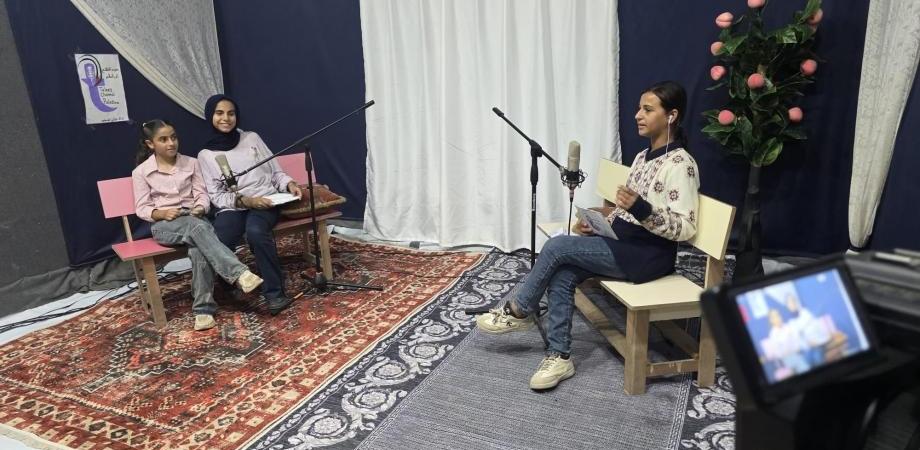
SAFA — Among the tents of displaced families in Al-Mawasi, west of Khan Younis in the southern Gaza Strip, a group of Palestinian children has created its own media platform, using cameras, microphones and improvised equipment to tell the stories of Gaza’s children in their own voices.
“Palestine Pioneers Channel” is run by a media team made up entirely of children, giving them a space to express themselves and share the suffering, hopes and dreams of their peers through digital television and radio programming.
The project presents a different image of Gaza’s children, far from the familiar scenes of long queues for food and water. Here, they stand before cameras and microphones as presenters, directors and technicians, learning to tell their own stories despite years of war and displacement.
Amal Anaba, 13, a presenter at the channel, says Gaza’s children “have not lost hope” and continue to hold on to their talents and dreams.
“Today, Gaza’s children will appear before the world in a different way than they usually do; not as children standing in line for food or water, but as children standing in front of microphones and cameras, with voices that can carry the suffering of Gaza’s children to the entire world,” she told Felesteen newspaper.
Amal recalls that the project began with simple training sessions before the children even had a studio. They would climb to an elevated spot and use improvised objects as cameras, practising how to present programmes and interview people around them.
Eventually, blankets, cameras and basic equipment transformed a modest space among the displacement tents into a makeshift television studio.
The children also work behind the camera. Mais Al-Kurd, 12, serves as a director, preparing programme segments, monitoring presenters and overseeing cameras and sound.
“I always prepare the segments for the programmes they present and make sure the Pioneers appear in the best possible way,” Mais told Felesteen.
A Space to Heal
Yousef Khattab, head of Palestine Pioneers Channel, says the children underwent months of media training, learning how to conduct interviews, host guests and work with cameras and studio equipment.
Some participating children have lost family members, suffered injuries or been pulled from beneath the rubble. Khattab says the initiative therefore goes beyond media training, providing psychological and emotional support and helping children rebuild their confidence while they continue to live under harsh conditions in displacement tents.
Building the studio required considerable improvisation. Blankets distributed as humanitarian aid were turned into makeshift soundproofing because professional acoustic materials were unavailable, while mobile phone earphones were sometimes used in place of specialised equipment.
The electricity crisis also severely limits broadcasting. The channel currently operates for around two hours a day, one or two days a week, depending on the availability of power.
Around 29 boys and girls are participating in the project. Seven core participants were selected for a full three-month training programme, while another group is being prepared to join the team.
The project also hopes eventually to connect Gaza’s children with Palestinian children in the occupied West Bank, Jerusalem, the Palestinian territories occupied in 1948 and the diaspora.
Theatre director and project trainer Ahmad Abu Jundi says the goal is to give every participating child “a full space on a free platform where they can speak about themselves and express who they are.”
Training includes voice control, pronunciation, camera work, eye contact and presentation skills, helping the children develop the confidence to communicate their experiences directly to an audience.
Amid displacement and destruction, Palestine Pioneers Channel has given Gaza’s children something increasingly difficult to find: a space where they are not simply the subjects of stories about war, but the ones holding the microphone and telling their own.
Source : Safa News


