
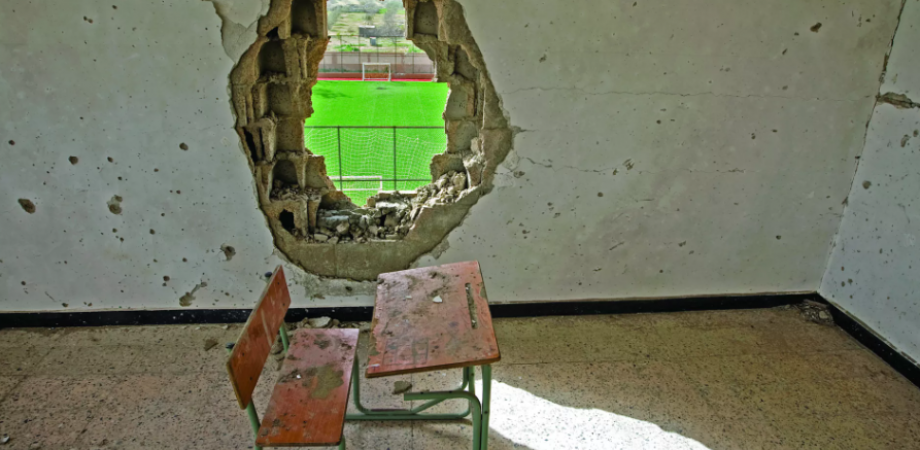
SAFA — Inside an educational tent at a displacement camp in Gaza City’s Zeitoun neighborhood, Jana Tulaib sits at a desk waiting for her teacher to begin a remedial class ahead of the new school year on September 19.
The sixth-grader is taking part in an accelerated learning program designed to address learning loss and review material from the previous school year before students advance to the next grade.
But studying is not the only reason Jana arrives early. For her, the classroom offers an escape from the pressures of displacement and daily responsibilities, including collecting water and waiting in long queues. It also gives her a chance to spend time with friends in an environment that brings back memories of school life before the war.
The makeshift school, named “A Flower Among the Rubble,” consists of six classrooms. Although the academic year has yet to officially begin, three classrooms are already being used by kindergarten children, while teachers in others provide remedial lessons as part of a program that has been running for three months.
For displaced families, having a school inside the camp has become increasingly important. Many parents fear sending their children to educational facilities farther away because of the continuing risk of Israeli attacks.
The kindergarten tents are decorated with alphabet cards, educational games and posters teaching words and sentences. Some activities are supported by organizations working with children, including the Qattan Centre.
In another tent, girls play an educational game with their facilitator using a colorful parachute. Moving together, they step backward and inward to form the shape of a flower, their laughter and excited voices providing a rare moment of relief from the pressures surrounding them.
Catching Up on Lost Learning
“I benefited greatly from this program by reviewing lessons from the previous year,” Jana told Felesteen newspaper. “I am now in a very good position to begin the new academic year. The remedial lessons helped me understand things I had forgotten, especially the important ones.”
Her classmate Lana Al-Hammami said the lessons helped improve her academic performance and recover knowledge lost during the war.
“I learned new things from the teachers that I either did not know or had forgotten,” Lana said. “Many members of my family were killed, and the atmosphere at school is beautiful, especially since I was deprived of it during the genocide.”
Another student, Hala Aqteifan, joined the school after a period of displacement brought her to her grandfather’s home nearby.
“Through the remedial program, I learned division, subtraction and multiplication well,” she said. “I also come here to play with the classmates I have gotten to know.”
The school was founded by its director, Rima Skik, who wanted to keep children away from queues for food, water and bread and restore some sense of normality by giving them a place to learn.
“The initiative began in November 2024,” Skik told Felesteen. “We started with one classroom and only a small board, while students sat on stones and on the ground. We were determined to ensure that students received their right to education.”
Three months ago, the school began offering accelerated foundational and remedial classes to prepare children for the new academic year. It now serves around 800 students from first through sixth grade, in addition to kindergarten classes.
From One Tent to 800 Students
Skik began with a single tent and 35 students. As demand grew, more classrooms were established and benches and tables were gradually added. The school now serves a displacement camp housing around 500 families and has received accreditation from the Ministry of Education.
Students attend according to a rotating schedule spread across three daily periods and three days each week.
After distributing student certificates and records in May, teachers began offering additional support in Arabic reading and writing, mathematics and science.
Despite its growth, the school continues to face severe shortages. Teachers struggle to find whiteboard markers and often rely on chalk, while the high cost of paper, printing and other educational materials limits what they can provide.
Yet amid the rubble of Zeitoun, the classrooms offer children something increasingly difficult to find in Gaza: a place to learn, play with friends and briefly experience the school life the war took away from them.
Source : Safa News


