
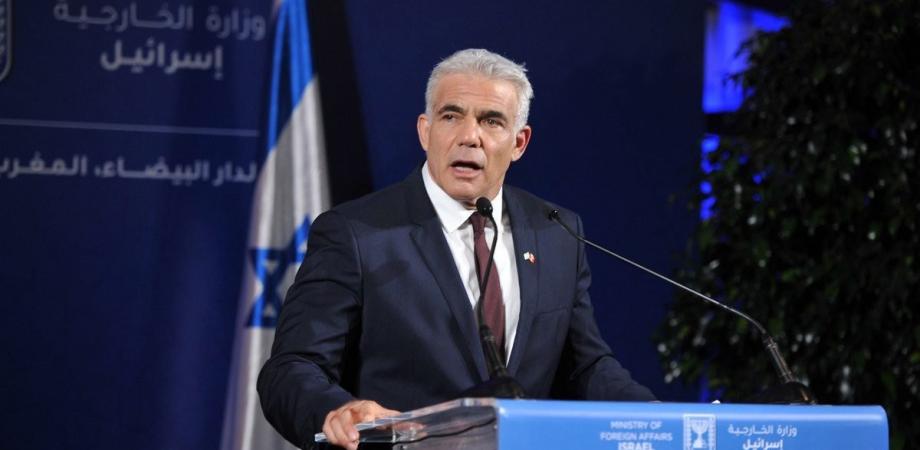
SAFA – Israeli opposition leader Yair Lapid has recounted what he called a “painful” encounter with a group of young Israelis who openly expressed support for killing Palestinians in Gaza, including babies, saying there were “no innocents.”
Speaking in a recent podcast interview, excerpts of which have circulated widely on social media, Lapid said he was disturbed by the views expressed during a meeting with a group of very young Israelis, who told him that everyone in Gaza should be killed.
“I had a painful meeting with a group of very young people, and I heard from them all those statements calling for killing everyone and claiming that there are no innocents,” Lapid said.
He said he challenged the group by asking whether their position extended even to babies. According to Lapid, they replied that babies should also be killed because they would eventually grow up to become “terrorists.”
Lapid’s account comes against the backdrop of years of inflammatory rhetoric about Palestinians from prominent figures in Israeli politics, including members of Prime Minister Benjamin Netanyahu’s governing coalition. His remarks focused particularly on the effect such rhetoric has had on Israeli society and on the country’s international standing.
Criticism of Ministers’ Calls for Extreme Force
During the interview, Lapid criticized statements made by members of Netanyahu’s coalition endorsing or appearing to endorse extreme violence against Palestinians in Gaza, saying such rhetoric had caused profound damage to Israel.
He pointed specifically to remarks made in November 2023 by Israeli Heritage Minister Amichai Eliyahu, who was asked during a radio interview whether Israel should use a nuclear weapon against Gaza and responded that it was one possible course of action.
Netanyahu publicly rejected Eliyahu’s comments at the time, saying they were “not based in reality,” and his office announced that the minister would be suspended from cabinet meetings. Eliyahu nevertheless retained his ministerial title.
Lapid said Israel would struggle to recover from the damage caused when a government minister could make such a statement and remain in office. He also criticized statements from Israeli officials concerning the starvation of Palestinians in Gaza, saying ministers who make such remarks should not be allowed to remain in government.
His criticism, however, does not amount to opposition to Israel’s use of military force in Gaza. Lapid has continued to defend Israel’s right to use force while drawing a distinction between military action and rhetoric endorsing the killing of civilians.
His comments during the podcast reflected concern that language denying the existence of innocent Palestinians risks normalizing the idea that civilians, including children and babies, can legitimately be killed.
Diplomatic Damage Abroad
Lapid also criticized the Netanyahu government’s confrontational approach toward governments that have strongly condemned Israel’s conduct in Gaza, including Ireland and Spain, both of which have recognized the State of Palestine.
While saying he rejects what he considers anti-Israel discourse in those countries, Lapid questioned the strategic value of retaliatory measures such as closing embassies, downgrading diplomatic relations or recalling ambassadors.
Instead, he said he would prefer Israeli leaders to travel to countries critical of Israel, appear in their media and directly confront criticism of Israeli policy rather than disengage diplomatically.
Lapid also said he believes some governments increasingly distinguish between Israel as a state and Netanyahu’s government, suggesting that a change in political leadership could provide an opportunity to repair strained diplomatic relationships.
“There are those who see that the problem is not the state but the government,” Lapid said.
Israel is scheduled to hold elections for the 26th Knesset on October 27, 2026, with voters choosing all 120 members of parliament.
Lapid said that if a new coalition replaces Netanyahu’s government, it should quickly communicate to foreign governments that political change has occurred and seek to reopen dialogue with countries whose relations with Israel have deteriorated.
A Disturbing Encounter
The most striking part of Lapid’s interview, however, was his account of the young Israelis who told him that even babies in Gaza should be killed because they could grow up to become “terrorists.”
The encounter does not by itself establish how widespread such attitudes are across Israeli society, but Lapid presented it as a deeply troubling example of the kind of thinking he says he has encountered during the war.
His account also comes after repeated statements by members of Israel’s political establishment denying or minimizing the distinction between Palestinian civilians and combatants, including Eliyahu’s 2023 declaration that there was “no such thing as uninvolved civilians in Gaza.”
For Lapid, the danger in such rhetoric is not only the damage it causes to Israel’s international standing but what happens when the same language is repeated by a younger generation.
The exchange he recounted was stark: when he asked whether calls to kill everyone extended even to babies, the answer he says he received was yes, because those babies might one day grow up to become “terrorists.”
Lapid’s testimony therefore offers a disturbing glimpse into the consequences he associates with years of rhetoric surrounding Palestinians and the Gaza war, even as the extent to which such attitudes are shared across wider Israeli society cannot be determined from the encounter alone.
Source : Safa News


