
SAFA — Fourteen-year-old Mohammed Riyad Abu Hamad had just returned from school. He was still wearing his school uniform, his backpack remained on his shoulders, and his notebooks were with him when an Israeli drone strike killed him near his home in Deir al-Balah, central Gaza.
The attack struck a group of Palestinians on Al-Baraka Street on Saturday, killing Mohammed and injuring four others, including a young girl.
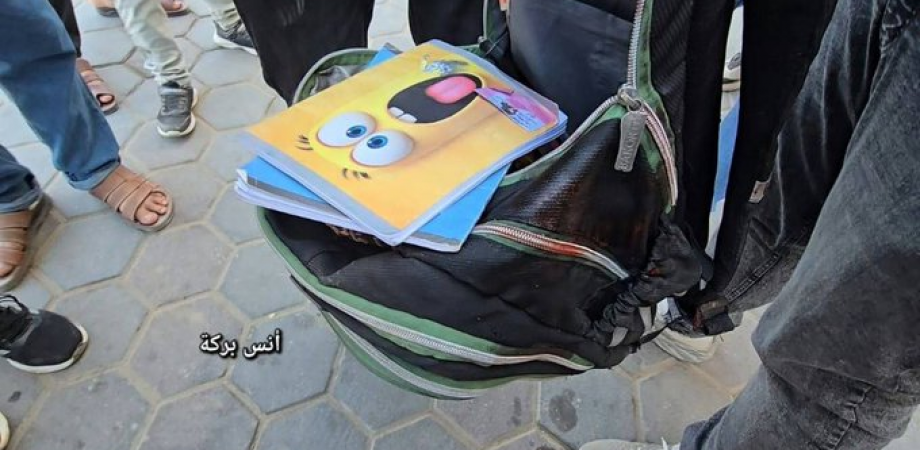
His school supplies were scattered at the scene, leaving behind a devastating image of a Palestinian child whose school day ended in death.
He Had Not Even Taken Off His Schoolbag
According to eyewitnesses, Mohammed had only just returned from school when an Israeli drone targeted a gathering of Palestinians on Al-Baraka Street.
He had not changed out of his school uniform or put down his backpack.
Within moments, the strike killed him and wounded four others.
His uncle, Ibrahim Hamad, said Mohammed was standing beside him near the entrance to their home when the missile struck.
"An Israeli drone fired a missile at us while we were standing at the door of the house. Mohammed was right beside me. The missile directly struck a child," he said.
Ibrahim recalled that his nephew had just returned from school and was still carrying his backpack.
"He hadn't even taken off his schoolbag. He had come to buy something, and his father had gone out to earn a living for the family. Why did they kill him?" he asked.
A Father Embraces the Son He Will Never See Again
Mohammed's father, Riyad Abu Hamad, had been expecting his son to return home and resume the ordinary routines they shared.
Alongside his studies, Mohammed helped his father work to support the family.
Instead of welcoming his son home, Riyad was confronted with the news of his death.
Overcome with grief, the father collapsed over Mohammed's body, kissing and embracing him as he struggled to comprehend what had happened.
"Oh God, oh God, my son Mohammed. May God bless you, my beloved," he cried.
Mohammed's mother also struggled to say goodbye.
"Stay with me, my son. I swear, you were the one who brought me comfort," she said.
For the family, Mohammed's death meant losing not only a beloved child but also a son who had helped shoulder the hardships of daily life in Gaza.
"You Make Us Live in Tents, Hunger and Poverty. Why Kill Us?"
Mohammed's uncle condemned the killing, describing the suffering Palestinian families already endure amid displacement, hunger, and poverty.
"Isn't it enough that you've made us live in tents, hunger, and poverty? Why are you killing us? What do you want from a child that you have to kill him?" Ibrahim asked.
His words reflected the anguish of a family struggling to understand why a child returning from school had been killed.
For Palestinian children in Gaza, even the most ordinary activities—attending school, walking home, or standing outside their houses—have become fraught with danger.
Mohammed was carrying schoolbooks, not weapons. He was returning from class, not taking part in any fighting.
His death has left his family grieving and renewed attention to the dangers facing Palestinian children amid continued Israeli attacks.
More Than 19,000 Gaza Schoolchildren Killed During Israel's War
Mohammed's killing comes amid the devastation inflicted on Gaza's children and education system by Israel's genocidal war.
Israeli attacks have destroyed or damaged schools and educational facilities, disrupted learning, and killed or injured large numbers of students and education workers.
According to figures cited by the Palestinian Ministry of Education and Higher Education, more than 19,000 school students have been killed in Gaza since the war began, alongside thousands of university students.
Tens of thousands of students have also been injured, some with permanent disabilities.
Beyond the deaths and injuries, Gaza's children face interrupted education, repeated displacement, the loss of family members, and severe psychological trauma.
The destruction of schools and learning facilities has placed the educational future of an entire generation at risk.
A Schoolbag Left Behind, a Childhood Cut Short
For Mohammed's family, the wider devastation of Gaza is now inseparable from the loss of their son.
He had gone to school carrying his books and notebooks, expecting to return home like any other child.
Instead, an Israeli missile killed him before he could even take off his backpack.
His school supplies, scattered after the strike, became a painful reminder of the life he should have been allowed to live.
His family is left with unanswered questions: How can a child be killed while returning from school? How can Palestinian families protect their children when even reaching home offers no guarantee of safety?
Mohammed's final journey from school ended before he could put down his bag.
His notebooks remain unfinished, his family is grieving, and his death stands as another reminder of the urgent need to protect Palestinian children and hold those responsible for attacks on civilians accountable.
Source : Safa News


