
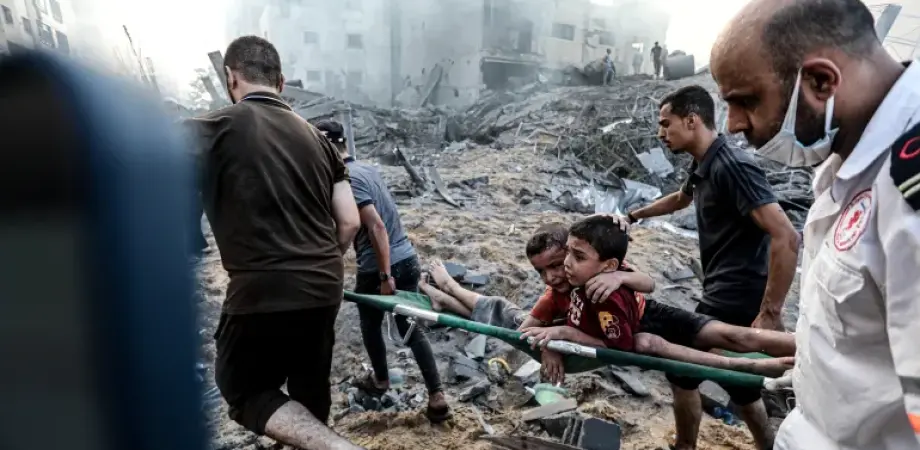
SAFA — For nearly three years, the ruins of Gaza City's al-Taj residential complex concealed the bodies of Palestinian children, mothers and fathers killed in one of the deadliest Israeli attacks of October 2023. Their families knew where they had died but could not reach them, bury them or say a final goodbye.
On October 25, 2023, Israeli warplanes dropped at least 20 heavy bombs on al-Taj 3 and neighboring residential buildings near Yarmouk Square, reducing homes filled with families to mountains of concrete.
A United Nations investigation documented 101 Palestinians killed, including 44 children and 37 women. The full toll remained uncertain because rescue teams lacked the equipment needed to recover everyone buried beneath the destruction.
Three years later, the massacre remains an open wound for families whose loved ones were trapped beneath the rubble.
Twenty Bombs, Entire Families Buried
The Israeli bombardment devastated an area estimated at 5,700 square meters, destroying a seven-story residential tower and surrounding apartment buildings.
The complex, described in reports as containing approximately 137 apartments, had also sheltered Palestinians displaced from other parts of Gaza.
Families who had fled earlier attacks in search of safety found themselves beneath another devastating bombardment.
Among the victims were 37 members of the Sharaf family.
Osama Sharaf lost his parents, siblings and other relatives. Some were recovered shortly after the attack, but others remained buried for almost three years.
“My father, my mother and all of my siblings,” he said, describing loved ones finally recovered during a recent excavation.
The al-Mahlawi family lost 15 relatives. Journalist Doaa Sharaf and her young son were also killed.
For the survivors, October 25 was not simply the day their relatives died. It marked the beginning of years spent waiting beside ruins that had become their family's grave.
After 17 Days of Digging, 105 Bodies Recovered
In September 2026, Gaza's Civil Defence, working with an Egyptian technical committee, began a major recovery operation at the al-Taj site.
After 17 days of excavation, Palestinian reports said teams recovered the bodies and remains of 105 people, including 47 children and 32 women.
The recovery figures emerged from a later excavation process and should not be treated as an additional death toll separate from the UN's earlier documentation.
For relatives, the operation brought the first opportunity in nearly three years to hold funerals and bury those they had lost.
Sixteen members of Osama Sharaf's family were reportedly among those recovered.
But even after the excavation, the search for answers continued. Reports indicated that 36 of the 105 recovered remains had not yet been identified.
Some families finally received their loved ones. Others were left waiting for names to be matched to the dead.
Children Were Among the Massacre's Greatest Victims
The scale of the killing at al-Taj reflects the devastating impact of Israeli attacks on Gaza's residential buildings.
Airwars documented at least 44 children killed in the October 25 attack. It also recorded another strike near the complex days later that killed at least 38 children.
Across Gaza, Airwars documented at least 1,900 children killed in incidents during October 2023. Approximately 92% died in incidents involving the destruction of residential buildings.
Its research also found that at least 88% of the 5,139 civilians it documented as killed that month died alongside one or more family members.
These findings reveal the human consequences of bombing densely populated homes: parents killed beside children, siblings buried together and entire family branches erased in a single attack.
Gaza's Rubble Still Holds Thousands of Bodies
The recovery of victims from al-Taj has exposed a tragedy extending far beyond one residential complex.
Gaza's Civil Defence estimates that more than 8,500 bodies remain buried beneath destroyed homes and buildings across the Strip.
A severe shortage of bulldozers, excavators and specialized rescue equipment continues to prevent recovery teams from reaching many of the dead.
Civil Defence official Abdul al-Majdalawi said it had been impossible to reach victims trapped beneath al-Taj immediately after the bombing. He also reported that rescue equipment had itself been targeted during the war.
For families, the lack of machinery has meant years without funerals, confirmed identifications or proper burials.
Every unrecovered body represents a family still searching for an answer.
Three Years Later, the Massacre Has Not Ended for Survivors
On the third anniversary of the al-Taj massacre, the numbers remain devastating: at least 20 bombs, 101 deaths documented by the UN, dozens of children killed and 105 bodies and sets of remains recovered in a painstaking operation nearly three years later.
Yet the deepest loss cannot be measured in figures.
It is carried by parents who buried their children years after their deaths, by siblings who lost entire families and by relatives who still do not know whether their loved ones will ever be identified.
The recovery operation allowed some families to close a painful chapter. It did not erase the massacre or answer every question surrounding it.
At al-Taj, the bombs fell three years ago. For the families who waited beneath the shadow of the rubble, the grief never stopped. And across Gaza, thousands are still waiting for their dead to be brought home.
Source : Safa News


