
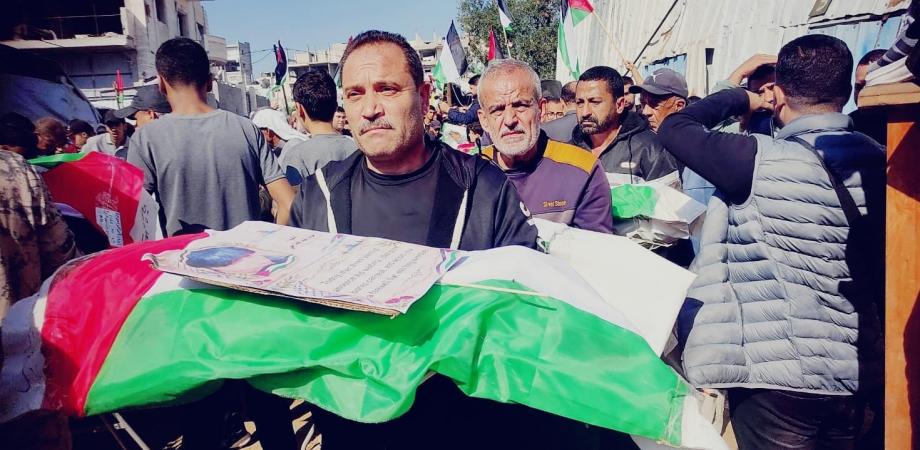
SAFA — Palestinian families in the Gaza Strip laid 69 people to rest on Sunday after civil defense teams recovered their bodies from beneath the ruins of homes and buildings destroyed by Israeli attacks in Jabalia refugee camp and Beit Lahia, northern Gaza.
For the grieving families, the funerals marked the end of a long and painful wait to recover their loved ones. But for thousands of others, that anguish continues, with more than 8,500 Palestinians still missing beneath the rubble of Gaza's devastated neighborhoods.
The bodies were recovered from several locations, including the Al-Hakoura area and the vicinity of schools in Jabalia refugee camp, as well as sites across Beit Lahia.
Among those recovered were members of the Abu Warda, Nabhan, Al-Yazji, Masoud, and Al-Dibs families.
Their recovery offered relatives the chance to finally hold funerals and bury their loved ones with dignity after months of uncertainty.
Yet the burials also exposed the scale of Gaza's continuing humanitarian catastrophe, where entire residential neighborhoods remain buried beneath collapsed concrete and thousands of families are still denied the most basic measure of closure: knowing where their loved ones are and bringing them home for burial.
A Painful Search Beneath Gaza's Ruins
The recovery of the 69 bodies is part of a prolonged effort by Gaza's Civil Defense to locate Palestinians buried beneath buildings destroyed during Israel's genocidal war on the territory.
The first phase of the recovery project began in late November 2025.
Despite severe shortages of equipment and machinery, rescue teams recovered 333 bodies from the ruins of 54 buildings.
Many other bodies remained inaccessible because crews lacked the heavy machinery needed to lift enormous concrete slabs and clear the wreckage of collapsed structures.
On July 19, 2026, Civil Defense launched the project's second phase, targeting 147 destroyed homes across Gaza City, northern Gaza, and the central governorate.
Rescue officials estimated that approximately 1,072 bodies remained buried beneath those homes, with recovery operations expected to require around 800 working hours.
In early August, crews recovered 112 bodies from the ruins of a residential block in Gaza City's Al-Sabra neighborhood.
However, another 157 people believed to have been buried at the same site remained unaccounted for.
Later that month, rescue teams recovered 21 bodies from two destroyed homes in Gaza City before beginning a search for approximately 40 missing people believed to be trapped beneath a third house.
According to a September 21, 2026, report by the United Nations Office for the Coordination of Humanitarian Affairs (OCHA), Civil Defense teams had recovered more than 630 bodies and human remains from destroyed buildings between November 2025 and September 2026.
On October 18, Palestinians also buried the remains of 75 people recovered from destroyed homes in Gaza City's Al-Daraj neighborhood.
Those remains belonged to approximately 20 families and were recovered following weeks of difficult search operations conducted with severely limited equipment.
Each recovery operation has brought new funerals, renewed grief, and another reminder of the thousands of Palestinians who remain buried beneath the ruins.
More Than 8,500 Bodies Still Beneath the Rubble
Mahmoud Basal, spokesperson for Gaza's Civil Defense, said more than 8,500 bodies remain missing beneath the rubble of destroyed homes across the Gaza Strip.
He warned that rescue teams are operating with such limited resources that they can recover only around 1,000 bodies annually under current conditions.
At that pace, locating and recovering those still buried could take many years.
The shortages extend across nearly every essential component of recovery operations, including bulldozers, excavators, heavy lifting equipment, spare parts, lubricants, and fuel.
Israeli restrictions on the entry of these supplies have further undermined the ability of Civil Defense crews to reach victims trapped beneath collapsed buildings.
In many locations, rescuers are forced to work with basic tools and their bare hands, attempting to move debris that would ordinarily require specialized machinery.
The consequences are devastating for families who know their relatives were inside destroyed homes but remain unable to retrieve their bodies.
OCHA has called for increased access to heavy machinery, specialized equipment, spare parts, lubricants, and fuel to expand search operations and accelerate the removal of rubble.
More Than 61 Million Tons of Destruction
The obstacles facing rescue teams are compounded by the extraordinary scale of destruction across Gaza.
According to estimates by the United Nations Development Programme (UNDP), Israeli military attacks have left more than 61 million tons of rubble across the territory.
Entire residential blocks have been reduced to mountains of broken concrete, twisted metal, and shattered household belongings.
In some neighborhoods, the destruction is so extensive that identifying the precise locations of former homes has become difficult.
Beneath that wreckage lie the remains of people who were killed when their homes and shelters were struck.
Recovering them requires far more than clearing debris. Teams must navigate unstable structures, carefully separate human remains from building materials, and preserve evidence that may be essential to identifying victims and documenting the circumstances of their deaths.
Without specialized machinery and forensic resources, the process becomes slower, more dangerous, and increasingly distressing for families awaiting news.
Families Denied the Right to Bury Their Loved Ones
For thousands of Palestinian families, the suffering caused by Israel's war has not ended with the death of their relatives.
It continues through the uncertainty of not knowing whether their loved ones' remains will ever be recovered.
Parents wait to bury their children. Children wait for the remains of their parents. Entire families remain missing beneath homes that were destroyed around them.
The inability to recover and identify the dead also raises serious humanitarian and human rights concerns, including the right of families to know the fate of missing relatives and the need to ensure that human remains are treated with dignity.
United Nations High Commissioner for Human Rights Volker Türk has warned that remains recovered from sites destroyed by Israeli attacks may represent only a fraction of the human loss.
He has emphasized the importance of preserving forensic evidence, biological samples, and information about burial sites, while ensuring that families are informed about the fate of their missing relatives.
Such measures are essential not only for identification and dignified burial but also for documenting possible violations of international humanitarian law and protecting evidence for future accountability processes.
A Funeral for 69, an Unending Wait for Thousands
Sunday's funerals brought 69 Palestinians out from beneath the rubble and into the arms of grieving communities.
Their families could finally mourn them at gravesides rather than beside the ruins of their homes.
But more than 8,500 others remain buried beneath Gaza's shattered buildings, beyond the reach of rescue teams struggling with inadequate equipment and overwhelming destruction.
For those families, every passing day deepens the uncertainty, while the possibility of recovering and identifying their loved ones becomes more difficult.
The demand is both urgent and profoundly human: access to the machinery needed to recover the dead, preservation of evidence, identification of victims, and the chance for families to bury their loved ones with dignity.
In Gaza, thousands of Palestinians have been denied not only the chance to say goodbye to their loved ones, but even the right to know where they lie.
Source : Safa News


