
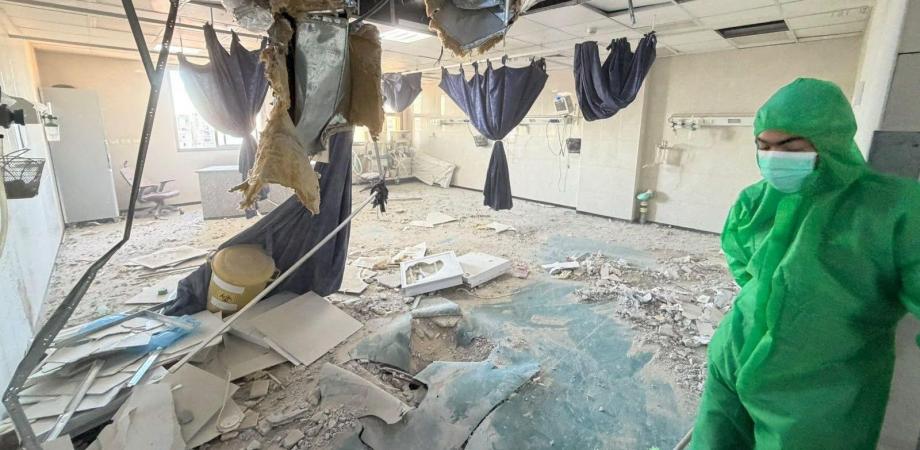
SAFA – Gaza's healthcare system is facing a deepening crisis as Israeli attacks, widespread destruction, and severe fuel shortages leave more than half of its healthcare service points out of operation and every hospital functioning below full capacity.
According to a report by Palestine Online, citing data from the United Nations, World Health Organization (WHO), and humanitarian monitoring organizations, attacks on medical facilities have continued despite the ceasefire that took effect on October 10, 2025.
The latest Israeli bombing of Nasser Medical Complex in Khan Younis on Thursday, November 12, dealt another blow to Gaza's devastated healthcare system, damaging critical medical departments and further disrupting lifesaving services.
More Than Half of Healthcare Service Points Shut Down
As of October 28, only 316 of Gaza's 670 healthcare service points were operational, according to the UN Office for the Coordination of Humanitarian Affairs (OCHA) and the Health Cluster.
Of those, just 43 were fully functional, while 273 were providing partial services. The remaining 354 were out of operation.
None of Gaza's hospitals was fully operational. Twenty were functioning partially, while 15 were completely out of service.
The territory had approximately 3,132 hospital beds available, including just 107 intensive care beds and 115 neonatal incubators.
These shortages have placed enormous pressure on medical teams struggling to treat wounded patients, newborns, and people with chronic illnesses.
Thousands of Attacks Devastate Gaza's Medical Infrastructure
The WHO's Surveillance System for Attacks on Health Care documented 972 attacks affecting healthcare in Gaza through June 30, 2026.
According to the figures cited in the report, those attacks resulted in 1,003 deaths and 1,676 injuries.
The WHO also recorded attacks affecting 176 healthcare facilities, including all 36 hospitals in Gaza, as well as 269 ambulances.
Separately, humanitarian monitoring organization Insecurity Insight documented 2,412 incidents affecting healthcare in Gaza between October 7, 2023, and September 30, 2026, out of 3,508 incidents across the occupied Palestinian territory.
The two organizations use different monitoring methodologies, so their figures are not directly comparable.
Attacks on Healthcare Continue Despite Ceasefire
Insecurity Insight recorded 157 incidents affecting healthcare in Gaza between October 10, 2025, and September 30, 2026, despite the ceasefire.
Seventeen of those incidents damaged hospitals, health centers, or medical warehouses. Approximately 90% of the damaging incidents involved kinetic weapons, including airstrikes, drones, artillery fire, or gunfire.
The report cited attacks affecting medicine warehouses and an outpatient building at Al-Aqsa Martyrs Hospital, a drone strike on Kamal Adwan Hospital, and two Israeli missile strikes on Al-Yemen Al-Saeed Hospital.
Al-Aqsa Martyrs Hospital and Al-Yemen Al-Saeed Hospital were each reportedly struck twice after the ceasefire began.
The continuing attacks have further reduced access to essential medical services and raised serious concerns about the protection of healthcare facilities under international humanitarian law.
Primary Healthcare and Mental Health Services Severely Damaged
The crisis extends beyond hospitals.
Of Gaza's primary healthcare centers, 105 remained operational, including 21 functioning fully and 84 partially. Another 88 were out of service.
UNRWA continued providing healthcare through seven permanent health centers, five temporary clinics, and 24 medical points.
More than half of Gaza's medical laboratories were nonfunctional, while over 60% of laboratory and diagnostic equipment had been damaged.
Mental healthcare services have also been severely disrupted. Gaza's only psychiatric hospital and most of its seven community mental health centers were out of operation.
More Than 1,700 Healthcare Workers Killed
Gaza's Health Ministry has reported that more than 1,700 healthcare workers have been killed since October 2023, according to figures cited by OCHA and Medical Aid for Palestinians.
Insecurity Insight separately verified the names of 785 healthcare workers killed in attacks and documented the detention of 399 medical personnel.
The difference in death tolls reflects the organizations' distinct documentation and verification methods.
Humanitarian workers have also suffered heavy losses.
According to OCHA figures cited in the report, 597 humanitarian workers had been killed as of November 4, including 395 UNRWA employees, 55 Palestinian Red Crescent Society staff members and volunteers, and four International Committee of the Red Cross workers.
Separately, 145 Palestinian Civil Defense rescue workers were reported killed.
The deaths and detention of medical personnel have further weakened Gaza's ability to provide emergency treatment and essential healthcare.
Fuel Shortages Threaten Lifesaving Equipment
Hospitals still operating in Gaza face the growing threat of electricity failures.
With approximately 90% of the territory's energy infrastructure reportedly destroyed, medical facilities depend heavily on backup generators to power operating rooms, ventilators, intensive care units, and refrigeration systems for medicines and vaccines.
In a November 5 report, OCHA warned that Israeli restrictions on the entry of engine oil and spare parts could cause generators to fail.
Such failures could interrupt emergency surgeries, endanger critically ill patients, and disrupt ambulance services.
Newborns face particularly severe risks.
Neonatal intensive care units were operating at 151% occupancy, while special-care units for infants had reached 199% occupancy, reflecting extreme overcrowding and insufficient treatment capacity.
Gaza's Healthcare Recovery Requires Billions
According to an April 2026 assessment attributed to the United Nations, European Union, and World Bank, rebuilding Gaza's healthcare sector would require approximately $10.03 billion, including $2.6 billion during the first 18 months.
Recovery would involve rebuilding damaged hospitals, restoring electricity and water networks, replacing medical equipment, and securing essential medicines and supplies.
The scale of destruction has left Gaza's remaining medical facilities struggling to meet even basic healthcare needs.
With more than half of healthcare service points shut down, hospitals operating at reduced capacity, and fuel shortages threatening critical equipment, continued Israeli attacks and restrictions risk pushing Gaza's already devastated healthcare system into an even deeper emergency.
Source : Safa News


