
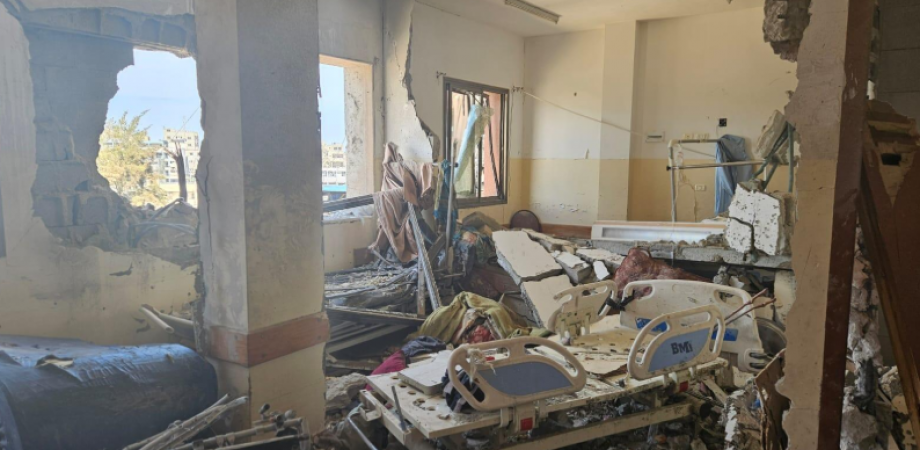
SAFA – Israel's deadly bombing of Nasser Medical Complex in southern Gaza has triggered widespread international condemnation, with the United Nations, World Health Organization (WHO), medical organizations, and several governments demanding protection for hospitals, accountability for attacks on healthcare facilities, and urgent action to prevent further civilian casualties.
The Israeli strike hit the hospital's surgical building in Khan Younis early Thursday, November 12, killing six Palestinians, including surgeon Dr. Rizq Abu Shaeera, and injuring more than 20 others, according to Gaza's Health Ministry.
The victims included medical personnel, patients, and people accompanying them.
The ministry condemned the bombing as a serious violation of international humanitarian law, warning that repeated attacks on medical facilities are further weakening Gaza's already devastated healthcare system.
The strike damaged critical hospital departments at a time when medical teams are struggling to treat patients amid severe shortages of medicines, equipment, fuel, and other essential supplies.
WHO Warns Nasser Hospital's Lifesaving Services Are at Risk
WHO Director-General Tedros Adhanom Ghebreyesus warned that the Israeli strike damaged essential medical facilities, including surgical departments, operating rooms, recovery areas, and intensive care services.
He emphasized the urgent need to protect healthcare facilities, maintain medical operations, and ensure the unrestricted delivery of essential medical supplies into Gaza.
According to the WHO figures cited in the reports, approximately 1,056 attacks affecting healthcare have been documented in Gaza since October 2023, resulting in 1,010 deaths and 1,725 injuries.
The figures illustrate the extensive harm suffered by healthcare facilities, medical personnel, and patients throughout the Israeli military campaign.
Doctors Without Borders (MSF) also expressed shock over the bombing, reporting that the attack occurred without prior warning.
The organization said the strike damaged several hospital departments, including inpatient wards, emergency facilities, radiology services, laboratories, and operating rooms.
MSF warned that the destruction threatens essential medical care for approximately 1.3 million people who depend on Nasser Medical Complex, a major referral hospital in southern Gaza.
According to the organization, the hospital has experienced at least six airstrikes since October 2023, alongside repeated ground incursions, shelling, and gunfire.
MSF called on world leaders to take concrete measures to protect healthcare facilities and ensure accountability for attacks on medical workers and patients.
United Nations Warns Attacks Threaten Gaza Ceasefire
The United Nations expressed concern over the bombing, warning that continued Israeli military operations threaten the fragile ceasefire in Gaza.
UN Deputy Spokesperson Farhan Haq stressed the need to protect hospitals and medical facilities from attacks.
He also emphasized that expressions of condemnation must be accompanied by effective measures to prevent further violence.
The attack comes amid continuing reports of Israeli military operations despite the ceasefire agreement that took effect on October 10, 2025.
Arab and Muslim Countries Demand Accountability
The Organization of Islamic Cooperation (OIC) strongly condemned the strike, describing the bombing of Nasser Medical Complex as a war crime requiring investigation and accountability.
The organization called for international protection for Palestinian civilians and the unrestricted entry of humanitarian assistance into Gaza.
Qatar's Foreign Ministry denounced the bombing as a grave violation of international humanitarian law, urging the international community to take action and hold those responsible accountable.
Egypt also condemned the attack, warning that strikes on medical facilities undermine international law and efforts to preserve the ceasefire.
Cairo called for an end to Israeli violations and demanded protection for civilians, healthcare workers, and hospitals.
Jordan joined the condemnation, urging greater international pressure to halt attacks on Gaza, protect medical personnel, and ensure sufficient, sustained humanitarian assistance.
European Governments Call for Protection of Hospitals
Spain condemned the bombing, emphasizing that hospitals are entitled to protection under international humanitarian law and must not be unlawfully targeted.
Madrid called for urgent humanitarian assistance and measures to safeguard medical facilities and civilian lives.
Turkey also denounced the attack, urging the international community to move beyond statements of concern and take practical steps to protect Palestinians and prevent further military assaults.
Meanwhile, the Palestinian Foreign Ministry demanded accountability for the bombing and called on the United States and the wider international community to pressure Israel to halt its attacks.
The ministry also urged the opening of Gaza's crossings and the unrestricted delivery of medical and humanitarian supplies.
International Law Protects Hospitals and Medical Personnel
The bombing of Nasser Medical Complex has renewed concerns about compliance with international humanitarian law, particularly the protections afforded to civilian hospitals under the Fourth Geneva Convention of 1949.
Article 18 requires civilian hospitals to be respected and protected during armed conflict.
Under Article 19, that special protection may cease only in narrowly defined circumstances, including when a hospital is used to commit acts harmful to the enemy, and only after a warning has been issued with a reasonable time limit, where appropriate, and remains unheeded.
Even when a medical facility loses its special protection, military operations remain subject to the rules of distinction, proportionality, and precautions in attack.
The protections are particularly significant in Gaza, where repeated attacks and widespread destruction have severely reduced access to emergency treatment, surgery, intensive care, and other essential medical services.
Condemnation Grows as Gaza's Healthcare Crisis Deepens
The latest strike has intensified calls for international action to protect Gaza's remaining hospitals and prevent further attacks on healthcare workers and patients.
Medical organizations warn that every additional disruption to hospital services places more lives at risk, particularly among critically injured patients, newborns, and people requiring urgent surgery.
The international response has highlighted growing concern over the gap between repeated demands to protect Gaza's healthcare system and the continuing violence affecting medical facilities.
For patients and healthcare workers at Nasser Medical Complex, the consequences are immediate: damaged treatment facilities, fewer available services, and an increasingly difficult struggle to provide lifesaving care.
Source : Safa News


