
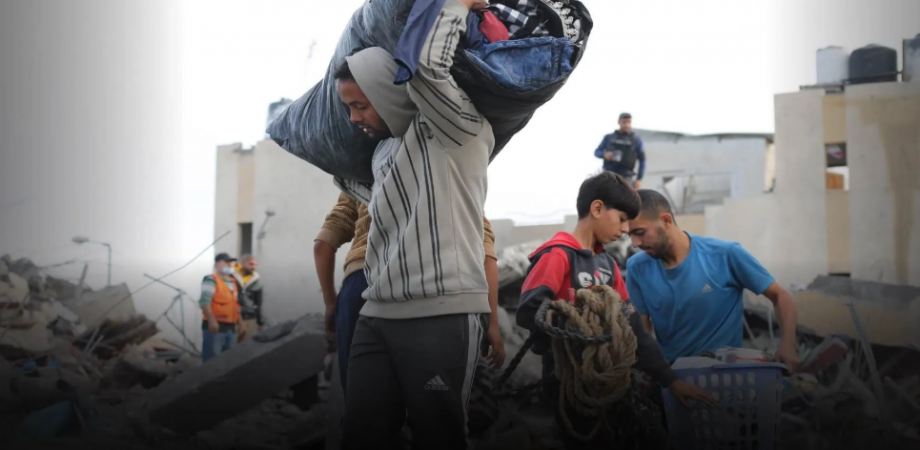
SAFA — Since the Palestinian Nakba in 1948, the United States has provided Israel with more than $300 billion in inflation-adjusted assistance, helping build and sustain its military capabilities through decades of wars, occupation, and attacks on Palestinians, including the devastating war on the Gaza Strip.
The financial support has extended far beyond diplomatic backing, encompassing weapons, ammunition, fighter jets, missile defense systems, military training, and economic assistance that have strengthened Israel's position as Washington's principal military partner in the Middle East.
According to figures compiled by the U.S. Congressional Research Service (CRS) and the Council on Foreign Relations (CFR), American assistance to Israel since 1948 exceeds $300 billion when adjusted for inflation.
In nominal dollars, U.S. aid recorded between 1946 and 2025 totaled approximately $174.97 billion, including $124.5 billion in bilateral military assistance, $34.35 billion in economic aid, and $16.11 billion for missile defense programs.
These figures place Israel among the largest cumulative recipients of U.S. foreign assistance since World War II.
Trump Announces Plan to End Annual Military Grants
The scale of Washington's longstanding support has come under renewed scrutiny following a reported announcement by President Donald Trump on Tuesday, November 3, that he had reached an agreement with Israeli Prime Minister Benjamin Netanyahu to end annual U.S. military aid to Israel by the close of 2026.
According to the account, Trump said Washington would discontinue approximately $4 billion in annual military assistance, arguing that Israel “no longer needs this money.”
He also indicated that the United States would continue selling weapons to Israel and providing assistance “if necessary.”
Trump said Netanyahu had proposed ending the financing and that the two sides had discussed the matter for several months.
If implemented, such a decision would represent a significant change to the structure of U.S. military financing for Israel. It would not, however, necessarily end American arms sales, military cooperation, or other forms of security assistance.
The reported announcement also raises questions about the existing 10-year memorandum of understanding between Washington and Israel, covering fiscal years 2019 through 2028.
Under that agreement, the United States pledged $38 billion in military assistance over a decade, equivalent to $3.8 billion annually, subject to congressional appropriations.
The arrangement includes $33 billion in Foreign Military Financing and $5 billion for missile defense programs.
Any decision to terminate annual assistance before the agreement expires would therefore require clarification about its implementation and the role of Congress.
Decades of U.S. Funding Built Israel's Military Arsenal
American assistance to Israel initially focused on economic support and loans before expanding into extensive military cooperation and arms transfers.
U.S. military backing increased substantially following the 1967 Arab-Israeli war and again after the October 1973 war, gradually becoming the dominant component of Washington's financial assistance.
Between 1971 and 2007, Israel received substantial economic assistance alongside military funding.
The two governments subsequently agreed to phase out most economic grants, directing the bulk of future assistance toward military procurement and defense cooperation.
According to CRS figures cited in the report, cumulative U.S. economic assistance reached approximately $34.35 billion, compared with $124.5 billion in bilateral military aid and $16.11 billion in missile defense funding.
This assistance has supported Israel's acquisition of advanced weapons, military infrastructure, and defensive systems, while reducing the financial burden of maintaining its armed forces.
U.S. Military Assistance Surged During the Gaza War
American military support increased sharply during Israel's war on Gaza, as Israeli bombardment caused extensive civilian casualties, mass displacement, and widespread destruction of homes, hospitals, schools, and essential infrastructure.
In 2024, recorded U.S. assistance to Israel rose to approximately $12.5 billion, compared with around $3.8 billion annually in 2021 and 2023.
The 2024 figure included roughly $6.8 billion in military assistance and $5.7 billion for missile defense, driven largely by emergency supplemental funding approved by Congress in April 2024.
The total was more than three times the annual assistance recorded in 2021 and 2023.
The increase came as Gaza's humanitarian crisis deepened and international scrutiny intensified over the weapons and military assistance supplied to Israel.
For Palestinian rights advocates, the funding has raised urgent questions about Washington's responsibility for the consequences of Israeli military operations and the continued supply of weapons used during the war.
Billions in Arms Sales Would Continue Beyond Direct Aid
U.S. military support for Israel is not limited to annual financial grants.
It also includes an extensive system of arms sales, equipment transfers, military services, training, and joint defense programs that has developed over decades.
According to the Council on Foreign Relations, Israel had approximately 751 active U.S. Foreign Military Sales cases as of April 2025, with a combined value of around $39 billion.
These cases represent a substantial pipeline of military transactions separate from annual aid appropriations, although some purchases may be financed through U.S. assistance.
The U.S. State Department explains that Foreign Military Financing allows Israel to acquire American defense equipment, services, and training through the Foreign Military Sales system and eligible commercial procurement arrangements.
Major systems involved in U.S.-Israeli military cooperation include F-35 fighter jets, CH-53K helicopters, KC-46 aerial refueling aircraft, and precision-guided munitions.
Israel has also historically been permitted to spend a portion of its American military financing on purchases from its domestic defense industry, an arrangement scheduled to be phased out under the current assistance agreement.
Consequently, ending annual military grants would not automatically halt existing weapons contracts, future arms sales, or broader security cooperation.
For Palestinians, the Question Is Whether U.S. Weapons Will Stop Flowing
Decades of U.S. financial and military assistance have created a deeply institutionalized relationship extending beyond annual budget allocations.
The partnership encompasses arms procurement, military training, missile defense development, and long-term defense contracts that would not necessarily disappear with a change in the structure of American aid.
For Palestinians, the debate carries consequences far beyond Washington's foreign assistance budget.
Palestinian advocates argue that American weapons and financial backing have helped sustain Israeli military operations that have killed and displaced civilians and devastated communities across Gaza and the occupied Palestinian territories.
As Washington considers whether to replace direct grants with arms sales or other financing arrangements, a central question remains: Would such a shift reduce U.S. military support for Israel, or simply change the mechanisms through which that support continues?
Source : Safa News


