
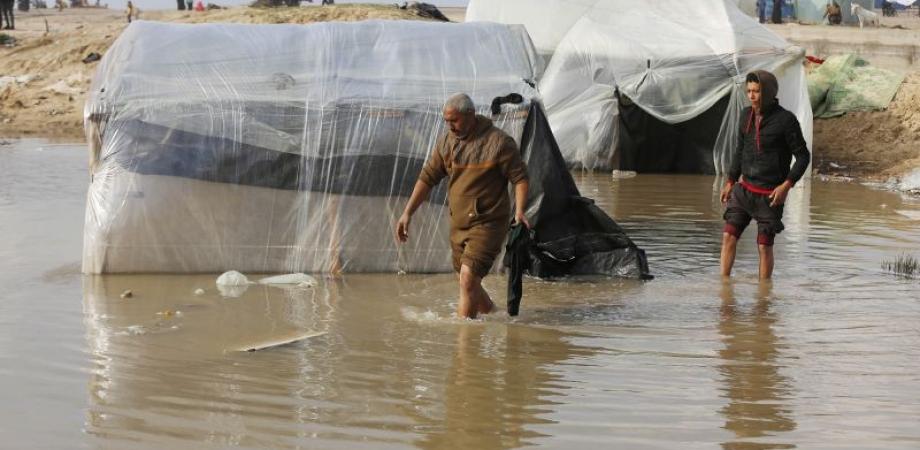
SAFA — Approximately 1.43 million Palestinians in the Gaza Strip, accounting for 68% of the population, are living in tents amid widespread destruction caused by Israel's war on the territory, according to a map released this month by the United Nations Office for the Coordination of Humanitarian Affairs (OCHA).
The map, titled “Access and Movement in the Gaza Strip, November 2026,” revealed that 77% of Gaza's road network has been damaged or destroyed, while 82% of buildings have been destroyed, damaged, or potentially damaged.
The shelter figures are based on 2026 population estimates, which put Gaza's population at approximately 2.1 million, including around 673,000 people living in buildings.
Widespread Destruction of Roads and Buildings
The road damage assessment was based on satellite imagery collected by the United Nations Satellite Centre on July 8, 2025, with the findings published in September of that year.
According to the assessment, approximately 3,479 kilometers of roads were affected, including 1,511 kilometers destroyed, 484 kilometers severely damaged, and 1,484 kilometers moderately damaged.
The destruction spans all five governorates of the Gaza Strip, affecting major highways and secondary roads connecting residential neighborhoods with essential services.
The extensive damage has severely disrupted civilian movement and complicated the delivery of humanitarian aid, while making it increasingly difficult for ambulances and rescue teams to reach affected communities.
A separate satellite assessment conducted on June 16, 2026, identified 201,290 affected structures across Gaza.
Of those, 134,422 were classified as destroyed, 13,848 as severely damaged, 28,096 as moderately damaged, and 24,924 as potentially damaged.
The map also estimated that approximately 328,000 housing units had been damaged during Israel's war on Gaza.
Israeli Restrictions and Collapse of Essential Services
According to the OCHA map, Israeli access restrictions affect approximately 65% of Gaza's total area of 365 square kilometers.
The map also identified areas under Israeli military presence, border crossings, transportation routes, and locations where humanitarian workers are required to coordinate their movements with Israeli forces.
Gaza's healthcare system remains severely disrupted, with none of the territory's 37 hospitals operating at full capacity.
The map further revealed that 53% of healthcare service points were no longer functioning, significantly limiting access to essential medical care.
The humanitarian crisis extends to water and sanitation services, with 91% of households included in a water assessment experiencing household water insecurity.
Meanwhile, 70% of wastewater collection and treatment facilities remain out of service, raising serious concerns about sanitation conditions and public health risks.
The map was compiled by OCHA's Information Management Unit using data collected from several United Nations agencies and humanitarian organizations, including the United Nations Satellite Centre and the Food and Agriculture Organization.
The underlying assessments were conducted at different points throughout 2025 and 2026, reflecting the cumulative scale of destruction and the continuing challenges facing Gaza's population.
The findings underscore the enormous shelter, infrastructure, and humanitarian needs across the Gaza Strip after more than three years of Israeli military operations, as hundreds of thousands of displaced Palestinians remain without adequate housing or access to essential services.
Israel's war on Gaza has killed more than 74,000 Palestinians and injured over 175,000 others, including thousands of children, according to the figures cited in the report.
Source : Safa News


