
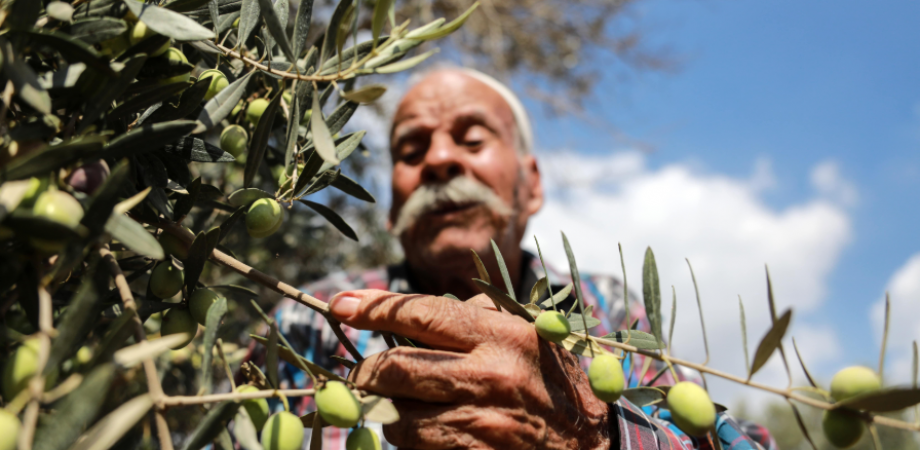
SAFA — Israeli forces have detained Palestinian farmers, human rights defenders and international solidarity volunteers attempting to protect the olive harvest in the occupied West Bank, as settler attacks reach record levels and military restrictions increasingly prevent Palestinian families from accessing their agricultural land, Human Rights Watch (HRW) warned Monday.
The crackdown comes during what the United Nations Office for the Coordination of Humanitarian Affairs (OCHA) described as the most violent olive harvest season in its 20 years of monitoring the occupied West Bank.
Between October 1 and 26, 2026, OCHA documented 397 Israeli settler attacks resulting in casualties or property damage, the highest monthly figure recorded since monitoring began in 2006.
Israeli human rights organization Yesh Din also reported that Israeli soldiers were present during 26.5% of documented settler attacks between September 27 and October 14, raising concerns about the military's response to violence against Palestinian communities.
"The olive harvest season should be a period of joy, strengthened community, and income for thousands of Palestinian families, but rising settler violence and harsh restrictions by the Israeli military have turned it into a period of anxiety and fear," said Sarah Sanbar, acting Israel and Palestine director at Human Rights Watch.
Settler Attacks Threaten Palestinian Farmers and Their Livelihoods
For generations, the olive harvest has provided Palestinian families with essential income while preserving their connection to land cultivated across generations.
Today, many farmers face physical assaults, threats, property destruction and restrictions that prevent them from reaching their olive groves.
Human Rights Watch reported that settler violence has intensified since Prime Minister Benjamin Netanyahu's current governing coalition took office in December 2022.
The organization also raised concerns about the financial, material and legal support available to settlers involved in abuses, as well as incidents in which Israeli soldiers were present during attacks.
In response, Palestinian communities and solidarity activists have organized protective-presence initiatives, with Palestinian, Israeli and international volunteers accompanying farmers to vulnerable agricultural areas.
These campaigns aim to deter violence, document violations and help families complete their harvests safely.
However, activists say the escalating attacks and military restrictions have made even peaceful protective accompaniment increasingly difficult.
Rabie Abu Naim, a Palestinian farmer and activist from al-Mughayyir, northeast of Ramallah, said volunteers had previously helped reduce attacks and allowed farmers to harvest more quickly, limiting their exposure to danger.
He described a sharp deterioration in security, saying attacks that once occurred daily were now taking place almost hourly.
According to Abu Naim, settlers have assaulted Palestinians, burned vehicles, used tear gas and established ambushes along roads near the village.
He warned that residents traveling through the village's only remaining entrance fear for their lives.
Israeli Restrictions Deny Palestinians Access to Olive Groves
The threats facing Palestinian farmers extend beyond direct settler attacks.
Israeli military orders, land closures and access restrictions have increasingly prevented Palestinians from cultivating and harvesting their agricultural land.
In August 2025, the head of the Israeli military's Central Command ordered the uprooting of olive trees across approximately 300 dunams, equivalent to 30 hectares, in al-Mughayyir, citing security concerns.
However, according to Israeli organization Kerem Navot, settlers from the Shiloh area subsequently cleared approximately 620 dunams, or 62 hectares, more than twice the area covered by the military order, and took control of parts of the land.
The consequences have been devastating for local farmers.
"This year, there are no [protection] campaigns for Al-Mughayyir, because there are no lands we can access," Abu Naim said. "This year's season, we can say that there isn't a harvest."
Similar restrictions have expanded across the occupied West Bank.
Israeli settlement watchdog Peace Now reported in October that military orders barred Palestinians from entering approximately 88,300 dunams of land, or 21,800 acres, without prior military coordination.
That represented a 30% increase compared with 2025.
By comparison, the organization reported that Israeli citizens were prohibited from accessing approximately 6,890 dunams of West Bank land.
Israeli forces have also designated agricultural areas as closed military zones, preventing farmers and volunteers from entering without authorization.
Those attempting to reach the land risk detention or removal, even when the agricultural property belongs to Palestinian families.
Activists have reported incidents in which soldiers ordered them to leave without presenting the written military orders authorizing the closures.
Matten Kadish-Berner, an Israeli activist with Protect the Harvest, told Human Rights Watch that soldiers instructed volunteers to leave an area but refused to show the relevant order.
According to his account, the soldiers eventually withdrew without producing the documentation.
Mass Arrests Target Palestinian Farmers and Solidarity Volunteers
Human Rights Watch also documented arrests targeting people involved in protecting Palestinian agricultural communities.
On October 27, Israeli forces raided Burin, south of Nablus, and detained approximately 60 people, including 32 international activists.
Israeli authorities subsequently deported the foreign volunteers and released most of those detained, but Palestinian farmer and human rights defender Ghassan Najjar remained in custody.
Najjar, a co-founder of the Sumood Network, had previously faced threats from Israel's Shin Bet security agency over his involvement in organizing protective accompaniment for Palestinian farmers in the Nablus area, according to the report.
On November 17, an Israeli judge approved a four-month administrative detention order against him.
The Sumood Network said the Israeli Military Prosecution acknowledged during judicial proceedings that Najjar's detention was connected to unarmed, nonviolent political activities.
The Israeli military, however, accused Najjar of throwing stones at Israeli civilians, an allegation disputed by the Palestinian organization.
Administrative detention allows Israeli authorities to hold Palestinians without charge or trial, often on the basis of secret evidence withheld from detainees and their lawyers.
Such orders can last up to six months and may be renewed repeatedly.
According to Israeli human rights organization HaMoked, 3,101 Palestinians were being held under administrative detention in October 2026.
International solidarity volunteers have also faced detention.
On October 21, Israeli forces detained approximately 80 American, Israeli and British volunteers accompanying Palestinian farmers near Bethlehem.
The report identified several rabbis, a former Israeli deputy attorney general and US political figure Brad Lander among those detained.
Days earlier, Israeli settlers reportedly attacked a delegation that included French, Belgian and Polish diplomats, Catholic clergy members and a French mayor.
These incidents have intensified concerns about the safety of international observers and volunteers seeking to accompany Palestinian communities.
Human Rights Watch Calls for International Action
Human Rights Watch urged Israeli authorities to release Palestinians unlawfully held under administrative detention, end the abusive use of detention without trial and ensure farmers can safely access their agricultural land.
The organization also called on foreign governments to take measures addressing serious abuses in the occupied Palestinian territories.
Its recommendations included targeted sanctions against those responsible for serious violations, suspension of arms transfers to Israel, a prohibition on trade with Israeli settlements and consideration of suspending preferential trade arrangements.
Human Rights Watch further urged governments to support the International Criminal Court and its investigations, including by enforcing applicable arrest warrants.
The organization emphasized that protecting Palestinian farmers requires more than responding to individual incidents of settler violence.
It also requires addressing restrictions that prevent Palestinians from reaching their land and ensuring that those accompanying them are not subjected to arbitrary detention or intimidation.
"Organizing an olive harvest is not a crime," Sanbar said, calling on Israeli authorities to stop repressing activists and fulfill their obligations to protect Palestinians.
For Palestinian families, the escalating violence threatens far more than a single agricultural season.
The loss of access to olive groves undermines household incomes, agricultural traditions and the ability of communities to maintain their connection to land cultivated for generations.
As attacks and arrests continue, farmers face growing uncertainty over whether they can safely harvest their crops or return to their land at all.
Source : Safa News


