
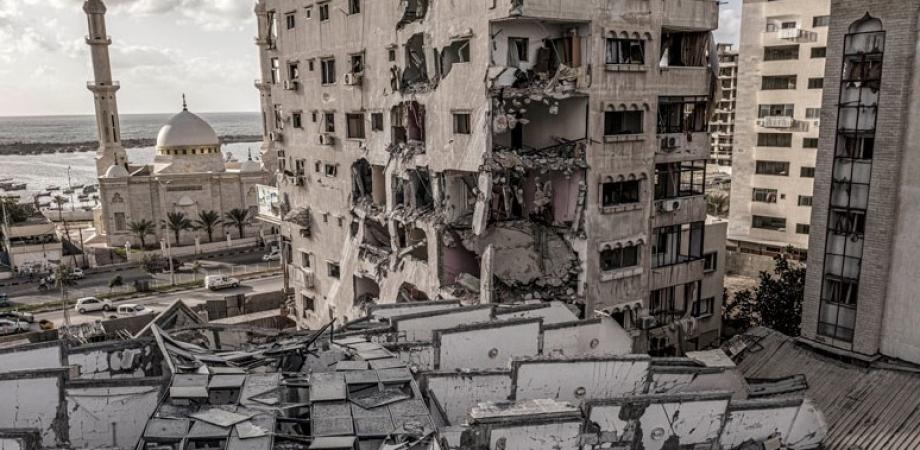
Across Gaza, entire neighbourhoods remain reduced to rubble, with families navigating the ruins of homes, hospitals and schools that once formed the backbone of daily life. As survival becomes the central concern for a population pushed to the edge, growing criticism has emerged over European policies that tie reconstruction assistance to political and security demands unrelated to civilian protection.
A prominent human rights body has warned that conditioning the rebuilding of Gaza on demilitarisation effectively normalises the devastation inflicted during the genocidal war waged against its population. According to the organisation, such an approach disregards the scale of destruction and civilian suffering, while shifting attention away from the systematic targeting of essential infrastructure. Linking humanitarian recovery to security criteria, it argued, transforms basic rights into tools of pressure rather than obligations under international law.
The criticism intensified following recent statements by senior European officials suggesting that Gaza’s reconstruction would depend on the disarmament of local authorities. These remarks were presented as part of a broader political framework that includes governance reforms and international oversight, alongside limited steps such as the partial reopening of border crossings. For rights advocates, however, this narrative masks a deeper failure to uphold legal duties to prevent genocide and protect civilians, instead reinforcing political cover for ongoing harm.
Despite a ceasefire announced in late 2025, conditions on the ground remain volatile. Restrictions continue to limit the flow of aid, while civilians attempting to move in and out of Gaza face intimidation and abuse. Health authorities report that hundreds of Palestinians have been killed and thousands injured since the ceasefire took effect, underscoring that the genocidal war’s consequences persist well beyond formal pauses in fighting.
Human rights groups have repeatedly called for unconditional humanitarian assistance, large-scale infrastructure repair and reconstruction free from political preconditions. They stress that accountability, arms embargoes and international legal action remain essential steps if Europe is to avoid being seen as complicit in one of the gravest human catastrophes of the modern era.
Source : Safa News


