
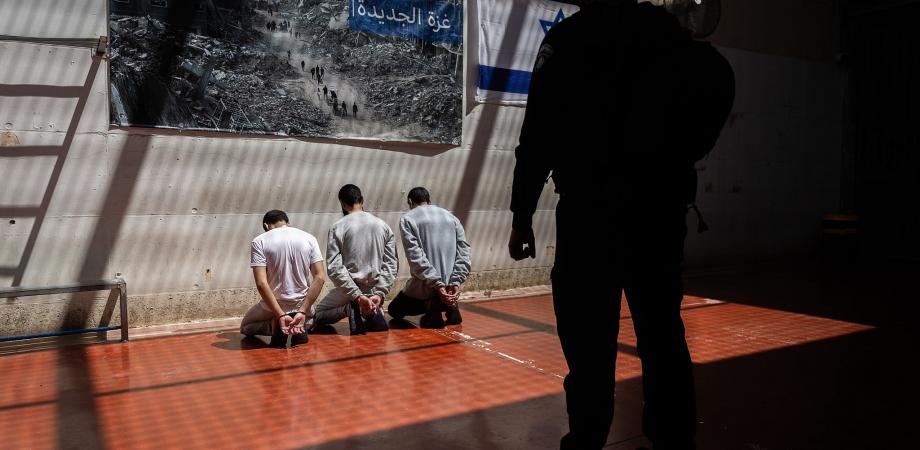
What follows is a reconstructed account drawn from the testimony of a former detainee who later returned to journalism, offering a rare view from inside a detention system operating during a genocidal war. It is not a chronological diary, nor a personal lament, but a reported narrative shaped by observation, memory, and the discipline of bearing witness.
He was arrested in Gaza in December 2023, during a period of sweeping detentions carried out amid military operations. From the outset, detention was designed not merely to restrict movement but to dismantle the individual. Transfers between facilities were marked by beatings, hunger, and prolonged sleep deprivation. Interrogation was conducted as a process of domination rather than inquiry, where humiliation preceded questions and fear was treated as an administrative tool. Threats against family members were used as leverage, pushing prisoners to the edge of psychological collapse. Compliance, when extracted, was rewarded not with freedom but with deeper entanglement in coercion and guilt.
Within interrogation centres and later in prison sections, medical spaces offered no refuge. Clinics functioned as extensions of control, where pain was minimised, injuries dismissed, and dignity routinely denied. Overcrowded cells, lack of hygiene, and sealed airless rooms accelerated physical decline. Prisoners measured time not in days but in endurance. Several died under these conditions. Among them was Dr Adnan Al-Barsh, who collapsed after severe mistreatment shortly after his transfer to a high-security prison wing in April 2024. Fellow prisoners attempted to revive him, but he was removed unconscious and later declared dead. Officials cited natural causes; those who watched his final moments described something very different.
The journalist who recounts these events left detention carrying visible marks and lasting psychological scars. Others remained behind, unnamed, absorbed into a system where suffering is hidden from public view. This account is offered not as an appeal for sympathy, but as documentation. In times of genocidal war, when narratives are contested and erased, testimony itself becomes evidence. Prisons, as described here, are not passive structures of custody but active mechanisms that test how far a human being can be broken, unseen.
Source : Safa News
