
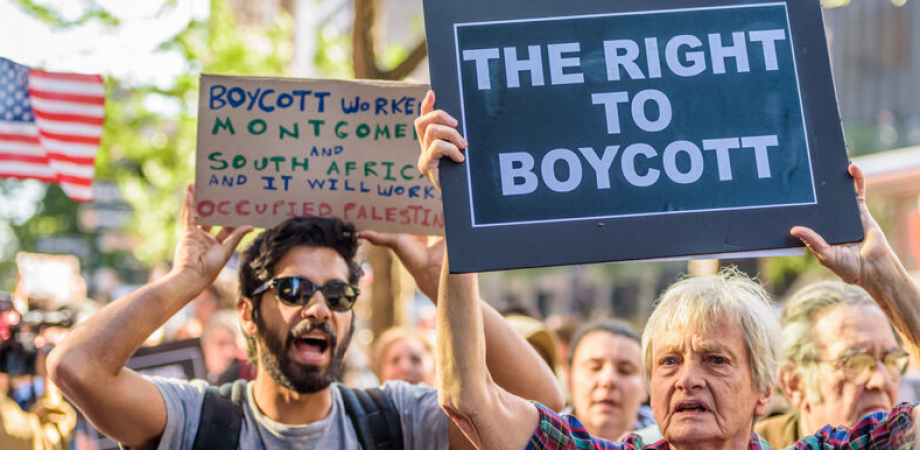
SAFA - The economic boycott of Israeli occupation is entering a new and more stringent phase, driven by a series of European decisions aimed at reducing engagement with settlement products, reflecting a growing political and economic shift across the continent.
The Netherlands recently announced a ban on importing, purchasing, and selling products originating from Israeli settlements, with the decision set to take effect on September 22, 2026, as part of its commitment not to contribute to activities considered violations of international law.
The move comes as part of a broader European trend led by countries such as Spain, Ireland, and Belgium, at a time when the European Union is witnessing divisions between states pushing for economic restrictions and others favoring maintaining trade relations without escalation.
The campaign is based on an advisory opinion issued by the International Court of Justice in 2024, which deemed settlements illegal and called for ending any economic dealings that contribute to their continuation, providing growing legal backing for boycott campaigns.
Official data indicates that Israel’s total exports reached around $165 billion in 2024, while settlement exports account for only 2% to 3% of that figure, estimated at around $3 to $5 billion annually.
Despite the limited share, the European Union is Israel’s largest trading partner, accounting for around 28% to 32% of its total foreign trade, making any European restrictions have a multiplied impact on the Israeli economy.
Foreign investment data also shows that Europe represents a major source of investment in Israel, contributing nearly 40% of foreign direct investment flows in recent years, increasing the Israeli economy’s sensitivity to any shift in European sentiment.
The Cumulative Impact
Experts argue that the real impact of the boycott is not limited to direct losses but extends to the “cumulative effect,” as legal and reputational risks may push European companies to reduce or end their dealings with Israeli companies, particularly those linked to settlements.
Economists estimate that expanding the boycott to include sectors such as technology, agriculture, and food industries could reduce Israeli economic growth by between 0.5% and 1% annually if widely adopted across Europe.
Such measures could also increase companies’ legal compliance costs, weaken investor confidence, and lower credit ratings if economic pressures continue to grow.
Economic expert Dr. Samir Al-Daqran says the economic boycott should not be measured only by the volume of direct losses but also by its ability to create a “structural shift” in market behavior. He explains that international experiences indicate that every 1% decline in exports to a major market could be accompanied by a larger decline in investments linked to that market.
Speaking to Felesteen Newspaper, Al-Daqran notes that the Israeli economy relies heavily on export-oriented sectors, especially advanced technology, which accounts for around 50% of total exports. This makes any negative signals from European markets capable of disrupting this vital sector.
He adds that major companies usually avoid legal and reputational risks, even when direct losses are limited, strengthening the boycott’s impact in the medium and long term.
He stresses that the “cumulative effect” could be the most dangerous factor, as the boycott may begin with settlement products but gradually expand to include other Israeli companies connected to supply chains or investments, potentially causing an indirect decline in trade volume of up to 5% over several years if European measures expand.
Factors Behind Success
Economic specialist Dr. Haitham Draghmeh explains that the success of the boycott depends on three main factors: continuity, international coordination, and expansion across different sectors.
He notes that previous experiences, such as economic sanctions on other countries, have shown that partial measures achieve limited impact, while coordinated boycotts can produce tangible results within a period ranging from three to seven years.
Draghmeh adds that the impact is not limited to trade but extends to the investment environment, as the “risk premium” on the Israeli economy could rise, leading to higher borrowing costs and reducing the market’s attractiveness to foreign investors. He estimates that a 1% increase in this premium alone could cost the economy hundreds of millions of dollars annually.
He also points out that European companies, especially multinational corporations, rely on environmental, social, and governance (ESG) compliance standards, making them more sensitive to involvement in activities facing legal controversy, such as settlements. Therefore, the boycott could push companies to reassess their business relations, not only for political reasons but also to protect their commercial interests.
Draghmeh believes that combining economic boycotts with political and media pressure could create a “multi-level pressure environment,” where governments, companies, and public opinion move in the same direction, increasing the chances of influencing policies.
At the same time, he warns that the absence of full international coordination could limit the boycott’s effectiveness, as companies may redirect their trade routes toward alternative markets in Asia or Latin America, reducing the scale of European pressure.
From a macroeconomic perspective, experts emphasize that any sustained decline in exports and investments could affect growth and employment indicators, as reduced activity in export sectors may lead to fewer job opportunities, especially in export-related industries.
Overall, experts agree that economic boycotts, if sustained and expanded, may not create an immediate shock, but they have the potential to bring gradual and profound changes to the structure of the economy, making them an effective long-term pressure tool.
Source : Safa News


