
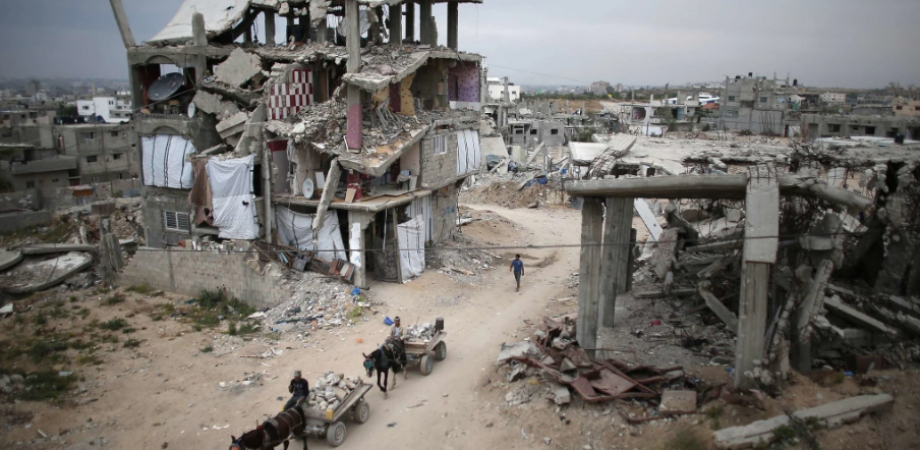
SAFA — Around 8,000 Palestinians remain missing in Gaza, many believed to be buried beneath the rubble of buildings destroyed by Israeli attacks, as the International Committee of the Red Cross (ICRC) warns that the chances of identifying the dead are diminishing with time.
The warning comes as rescue teams struggle to recover human remains amid unexploded bombs, severe equipment shortages, and the destruction of Gaza's medical infrastructure during Israel's genocide in the territory.
In comments reported by CNN, ICRC spokesperson Pat Griffiths said the obstacles facing recovery and identification efforts have become increasingly complex, leaving families waiting for answers about relatives who disappeared during Israeli attacks.
Griffiths emphasized that international humanitarian law requires parties to armed conflicts to search for the dead and missing, recover and identify human remains, preserve relevant information, and share it with the opposing side.
Rescue Workers Search Through Rubble and Unexploded Bombs
Recovery operations remain extremely dangerous because unexploded Israeli munitions are scattered throughout destroyed residential areas.
According to Griffiths, rescue workers sometimes have to remove debris just a few centimeters at a time to avoid triggering unexploded ordnance.
Their work is further hampered by a shortage of heavy machinery and Israeli restrictions on the entry of equipment needed to clear rubble.
Gaza Civil Defense spokesperson Mahmoud Basal said rescue teams have recovered approximately 1,000 bodies since October 2025.
He estimated that around 8,000 Palestinians remain missing, most of whom are believed to be trapped beneath collapsed buildings.
For families searching for loved ones, every delay makes the possibility of recovering and identifying their remains more uncertain.
Gaza Lacks DNA Testing Facilities to Identify the Dead
The destruction of Gaza's healthcare system has also severely limited the ability of medical workers to identify recovered bodies.
Griffiths warned that repeated Israeli attacks on medical facilities have left forensic teams dependent on basic identification methods.
Gaza lacks functioning DNA testing facilities, forcing medical personnel to rely on blood-type checks and other limited laboratory procedures that cannot reliably establish a person's identity on their own.
CNN also quoted forensic doctor Ahmed Dhuheir, one of only three forensic specialists reportedly still working in Gaza, who described how shortages of refrigeration equipment and fuel, along with repeated power outages, are causing biological samples to deteriorate.
These conditions make it increasingly difficult to preserve evidence that could help families identify their relatives.
Unidentified Palestinians Buried in Numbered Graves
In Deir al-Balah, central Gaza, approximately 1,000 unidentified Palestinians have been buried in a cemetery designated for people whose identities remain unknown, according to Civil Defense.
Their graves are marked with numbers in the hope that families may one day learn where their loved ones were buried.
But without adequate forensic equipment, DNA testing, and proper preservation facilities, identifying the dead remains an enormous challenge.
The UN High Commissioner for Human Rights, Volker Türk, has also warned that clearing rubble in areas under Israeli control without properly preserving human remains and other evidence could destroy information relevant to investigations into alleged war crimes.
He called for the protection of evidence and access for international investigators throughout Gaza.
Families Left Searching for Their Loved Ones
Among the Palestinians still living with the consequences of Israel's attacks is Mohammad Youssef Shalail, who lost several relatives when an Israeli strike hit a home in Jabalia in 2024.
Speaking to CNN, Shalail recalled having to collect the remains of women and children from beneath the rubble.
His experience reflects the suffering of families who have been forced to search through destroyed homes for relatives killed or buried during Israeli attacks.
For thousands of Palestinians, the devastation has left not only the grief of losing loved ones but also the uncertainty of not knowing where their bodies lie.
As recovery efforts continue to face dangerous conditions and severe shortages, families remain desperate for the chance to identify their relatives and give them a dignified burial.
Source : Safa News


