
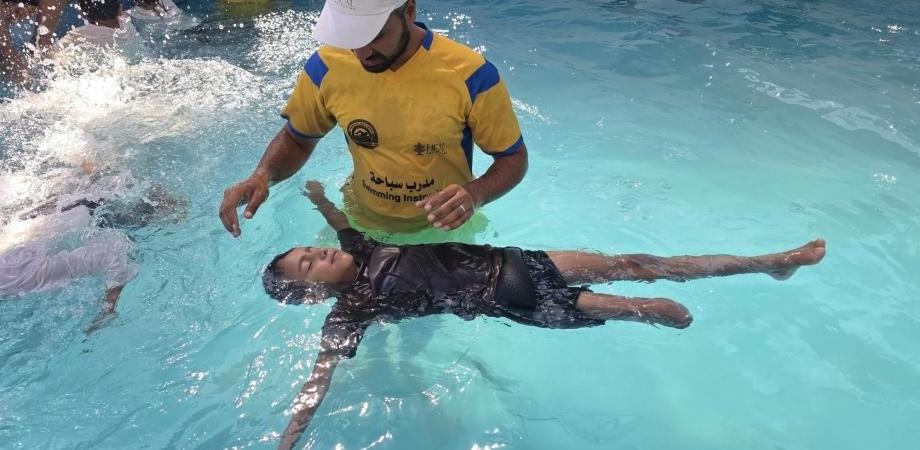
SAFA - At a small swimming pool in al-Mawasi, Khan Younis, in southern Gaza Strip, Palestinian children who have lost limbs are trying to reclaim what the genocidal war took from them: the confidence to move and live their lives again. Here, swimming is more than a sport. It is a space for healing, overcoming fear, and reconnecting with their peers despite their injuries and the trauma of war.
Among the participants is 14-year-old Mahmoud Rafiq Abu Shadq, who still carries vivid memories of the day he was injured. On August 1, 2025, while displaced, he was wounded in the war and lost his leg to amputation. He was taken to the hospital, where he spent nearly a month receiving treatment.
Mahmoud recalls that it was the hardest period of his life. He could not get out of bed or make his way to the bathroom on his own and struggled to use crutches and a wheelchair.
But the suffering went beyond his physical injury. Mahmoud also endured the harsh conditions of famine and food shortages in the Strip. He remembers searching for anything that could ease his hunger. “I was starving,” he says, recalling how, at times, he had no choice but to eat bread mixed with sand because there was nothing else to eat.
After months of pain and limited mobility, Mahmoud found a new outlet in swimming through training sessions organized by Heal Palestine. At first, he was afraid of the water, but little by little, he began to step into it.
“I used to be afraid of the water, but now I can swim,” he tells Felesteen newspaper with a smile. He has learned several strokes, including the “dog paddle” and “star,” despite having never known how to swim before.
Today, Mahmoud dreams of becoming a swimmer and continuing his training to master new strokes. The pool is no longer just a place to practice. It has become a space where he can feel excitement and joy and challenge the lasting effects of his injury.
Thirteen-year-old Mena Ashour is on a similar journey. She lost her leg in a bombardment that struck a house next to where her family had sought refuge in the Chalets area of Deir al-Balah in July 2025.
Mena tells Felesteen that shrapnel struck her and her siblings, resulting in the amputation of her leg and her sister’s. Her injury came as her family, like countless others across Gaza, struggled with shortages of food and medicine and soaring prices. She recalls that her mother would buy only a small amount of grapes for 60 shekels.
Today, Mena finds herself in a different place. She comes to the pool to train and learn new strokes, including the “star,” “rocket,” and “dog paddle,” as well as backstroke.
“It feels good,” she says of the experience, though her self-confidence, she admits, “has come back, but not much.”
Swimming coach Najwa Abu Amr has witnessed the change in the children since the program began.
Abu Amr coaches at Tantish Swimming Academy, which partners with Heal Palestine on a program designed to help rehabilitate children who have lost limbs.
She says the children initially arrived carrying a deep fear of the water, convinced that their disabilities and the circumstances of war made swimming impossible.
Gradually, the coaches helped them break through that fear and learn to swim independently, building their confidence, hope, and determination along the way.
The sessions do not begin with the children plunging straight into the water. First, they receive psychological support, followed by warm-up exercises and recreational activities to ease them into the swimming session.
Abu Amr tells Felesteen that swimming goes far beyond sport. It helps move children from a state of negativity toward a more positive one while giving them the chance to enjoy a hobby that makes them feel like a natural part of society.
The program currently serves around 30 children, with its organizers hoping to expand it as large numbers of children who have lost limbs in Gaza continue to need activities like these.
Abu Amr says the program’s central message is simple: “Nothing is impossible.” Losing a limb, she stresses, should not keep a child from learning or taking part in sport.
In the pool, the children are learning to move in bodies transformed by war. But they are also learning that an injury does not define their lives and that losing a limb does not mean losing the ability to dream. With every stroke they master, they reclaim a piece of their childhood, sending a message that disability may change the way they move, but it cannot take away their determination or hope.
Source : Safa News


