
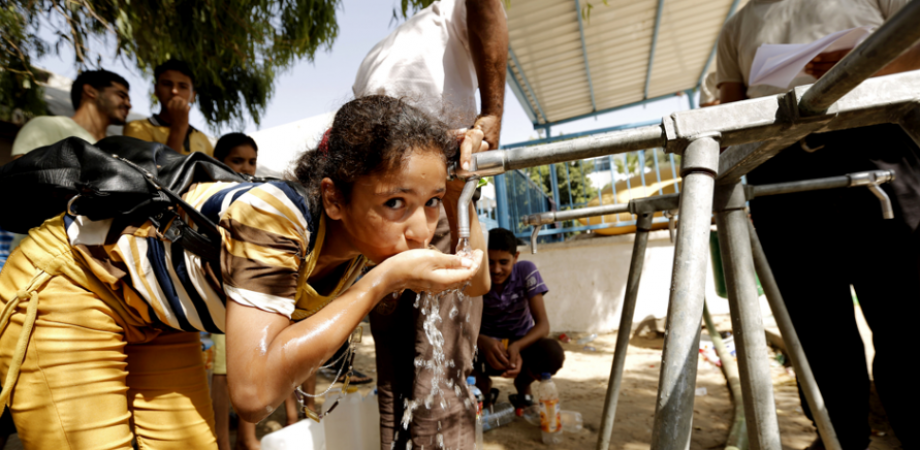
SAFA - Since the early morning hours, long lines have formed outside a water desalination plant in Khan Younis, southern Gaza. Children, women, and elderly people stand among the crowds, waiting to secure enough water for drinking and daily use as a deepening crisis is compounded by the summer heat, rising consumption, and shortages of the supplies needed to operate generators.
Exhausted bodies carry heavy water containers as children and women struggle to transport them back to where they are staying, a scene that has become part of daily life for displaced people who have endured harsh conditions and persistent shortages of basic services for years.
Among them is 62-year-old Zainab Maawad, who was displaced from Rafah around two and a half years ago.
Zainab lives on the third floor of a shelter school. She says securing water has become an exhausting task, one she has no choice but to undertake herself.
With no children or family member to support her, Zainab says she is forced to carry the water herself and climb the stairs several times a day.
Her ordeal is made harder by pain in her hands and shoulder. Yet she still sets out in the morning in search of water, returning with containers that last no more than a day.
The struggle, she says, goes beyond finding water. Carrying it back is a hardship in itself, particularly for older people, women, and children.
Zainab tells Felesteen newspaper that she sometimes has to go up and down the stairs five or six times a day to collect water, wondering where she can turn when water is unavailable both on the upper floors and at other displacement sites.
“We have a water problem,” she says, calling for a solution that could ease the daily burden on displaced people.
Daily Queues
Zainab’s experience is shared by many other families displaced from eastern Khan Younis, including those who fled the town of Khuza’a.
Ahmad Abu Asi says he is staying at Bilal Mosque in Khan Younis and must transport around 17 containers of water every day to meet his family’s needs.
His family needs around six containers of drinking water each day, he says, while consumption rises with the soaring temperatures.
Abu Asi tells Felesteen newspaper that his family begins the search for water early each morning, facing severe overcrowding at filling points. Children also take part in carrying the water despite their young age and the heavy containers they have to lift.
He describes the situation as “difficult and tragic,” saying the struggle to transport water has continued for nearly three years, since his family was displaced from the eastern area.
The crisis extends beyond thirst and the struggle to secure drinking water. Ahmad says carrying the containers every day has caused pain and exhaustion in people’s hands and joints, adding to the toll already borne by families living through the consequences of war and displacement.
Fuel and Spare-Part Shortages
The water crisis is further aggravated by the declining ability of water facilities to operate reliably amid shortages of generator oil, equipment, and spare parts needed for maintenance.
Engineer Khaled Mohammed Abu Mohsen, head of the Water Quality Department at Khan Younis Municipality, says the summer brings a major challenge due to shortages of oil and generator spare parts, directly affecting wells and desalination plants.
Abu Mohsen tells Felesteen newspaper that demand for desalination plants has risen sharply as residents’ need for drinking water grows, while shortages of operating supplies are reducing the amount of water that can be produced.
According to Abu Mohsen, residents’ needs have far exceeded normal levels, with one, two, or even three containers no longer enough to meet families’ daily needs.
He warns that any sudden failure at a generator or desalination plant could cause widespread disruption to water supplies, particularly as adequate alternatives are unavailable.
He notes that one water facility was forced to shut down for two days around two or three weeks ago after its generator oil ran out. The municipality was eventually able to secure a new supply and restore operations.
Summer Drives Up Demand
The crisis comes as temperatures climb, driving water consumption well above levels seen during the rest of the year.
The head of the Water Quality Department at Khan Younis Municipality confirms that water consumption doubles during the summer, particularly as temperatures rise. This places additional pressure on wells and desalination plants while increasing residents’ need for more water.
As queues continue to stretch outside desalination plants, water containers have become a daily burden for displaced people, who must walk long distances and carry heavy loads simply to secure the most basic needs of their families.
Source : Safa News