
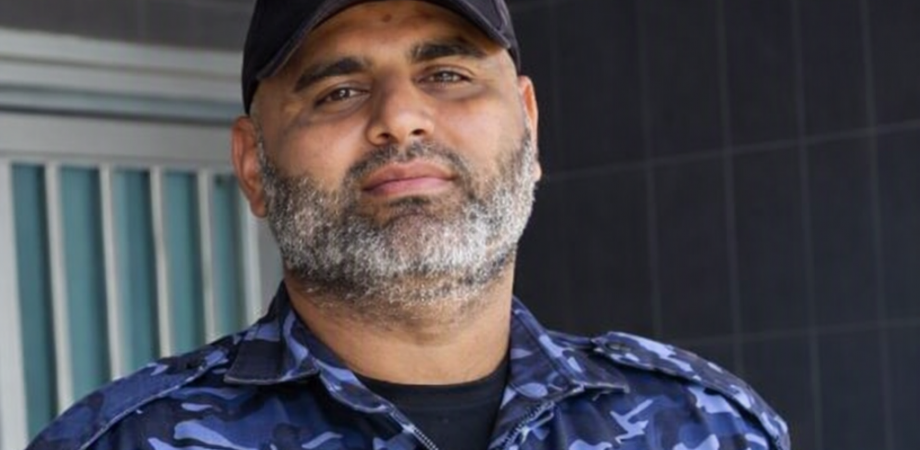
SAFA — Abdel Rahim Al-Hayya knew that wearing a police uniform in Gaza during the war no longer meant simply carrying out security duties. It meant taking to the streets amid bombardment and destruction to protect civilians, maintain order and respond wherever he was needed.
From the first day of the genocidal war, Abdel Rahim remained at his post as an officer in the Police Department’s Intervention and Public Order Unit. Whenever a security incident occurred or a task required a police presence, he went into the field, even as Israeli bombardment intensified.
His wife and lifelong companion, Amal Al-Hayya, recalls: “From the very first day of the war, he remained at his post. He never abandoned his duty for a single day. He would go out to help and protect civilians even at the height of the bombardment.”
His commitment to his work was nothing new. In 2006, at around 18 years old, Abdel Rahim began serving in the Executive Force. He later pursued a career in security and became an officer in the Intervention and Public Order Unit.
Amal told Felesteen newspaper that his work was a constant presence in their family life. She had grown accustomed to knowing that any phone call could mean another mission was waiting for him.
According to Amal, Abdel Rahim believed his presence in the streets during the war was necessary, particularly in areas where aid trucks needed to be secured and the movement of people organised.
One of his duties involved securing aid in the Al-Shati refugee camp area. He would walk there from Shuja’iyya through the bombardment, wearing his police uniform and carrying his weapon.
Abdel Rahim had previously been wounded during fighting with Israeli forces in 2008 and, according to his wife, later survived several attempts to target him. Each time, she said, he returned to his duties.
Between North and South
As the war expanded, Abdel Rahim’s family was forced to flee. Amal and the children headed south with relatives, while he remained in northern Gaza.
The family feared that Israeli soldiers might identify him at military checkpoints because of his police work and previous injury. He therefore stayed behind while Amal assumed responsibility for their children in the south.
The phone became the family's only connection. Despite the separation, Abdel Rahim remained involved in their daily lives, asking about the children and what they needed while preparing for the day they would finally return home.
“He would call us every day and wait for us to return,” Amal says. “He missed us terribly. He would buy food, clothes and kitchen supplies, and plan how he would welcome us when we came back.”
He often spoke with his son Yaman, promising him toys and clothes he had bought. He wanted to watch his eldest son, Malik, grow up and was delighted when he learned that his only daughter, Malak, had started wearing the hijab.
After his killing, those ordinary details became some of the family’s most painful memories.
Around two weeks before he was killed, Amal noticed a change in the way her husband spoke. He repeatedly reminded her to look after herself and their children.
“In the last couple of weeks before he was killed, he was always reminding me to take care of the children,” she recalls. “He would tell me, ‘Take care of yourself and take care of them.’”
He also began speaking more often about the possibility of being killed. According to Amal, one of his greatest fears was being captured.
A Farewell They Never Had
In June 2024, Abdel Rahim was carrying out his duties in the Al-Shati refugee camp area, west of Gaza City. According to his wife, his shift was nearing its end and he had just performed ablution when an Israeli strike killed him.
For his family, however, the tragedy extended beyond his killing. Their displacement meant they could not see him or say goodbye.
“The news of his death reached us as we were in deep shock,” Amal recalls. “At first, we could not believe it. I entrusted him to God as a martyr, while my children broke down.”
Her children struggled to understand that their father would never return.
“The children are always asking, ‘How did Dad die?’ Yaman says, ‘Let me call him on the phone in heaven.’ How are we going to live without him? How can it be that we won’t see him anymore?”
Abdel Rahim was buried in Al-Tawansi Cemetery in Gaza City’s Shuja’iyya neighbourhood. Three days later, according to Amal’s account, Israeli forces entered the area, leaving the family unable to reach his grave.
All Amal wanted was a place where she and her children could visit him. Even that became impossible.
When she finally returned home following the January 2025 ceasefire, she discovered everything Abdel Rahim had prepared for the family’s return: clothes, bedding, household supplies and water he had stored for them.
“He had filled buckets and water drums, and put bottles of drinking water in the refrigerator,” she recalls.
The preparations were meant to welcome his family home. Instead, they became reminders of the man who would never be there to greet them.
Later, the house itself was destroyed during another period of displacement, taking many of those final traces with it.
“When we were displaced for the second time, I regretted not taking something that carried his scent, or even a few simple belongings,” Amal says. “After that, the house and the memories were gone. The house was destroyed.”
Now, she says, Abdel Rahim returns only in her dreams.
“He comes to me in my dreams a lot. He gives me things, or feeds me and the children. When he appears in my dreams, he comforts me and tells me, ‘Don’t be afraid. I am always with you.’”
Then morning comes, and Amal wakes to the reality of raising their children without him — carrying alone the responsibilities, memories and plans they once shared.
Source : Safa News


