
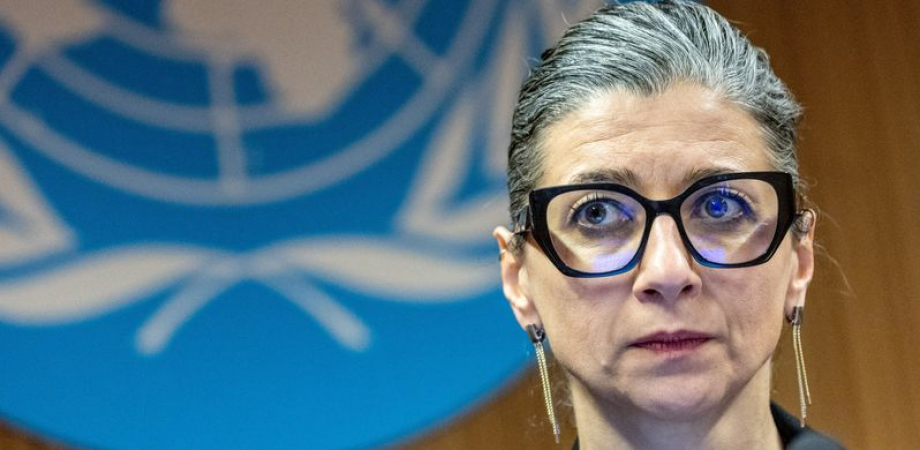
SAFA – UN Special Rapporteur Francesca Albanese has warned that Israeli military checkpoints and sweeping movement restrictions across the occupied West Bank are “strangling” Palestinian life, fragmenting communities and reinforcing what she characterized as an arbitrary and deeply discriminatory system of control.
Albanese, the UN Special Rapporteur on the situation of human rights in the Palestinian territories occupied since 1967, said the dense network of checkpoints, road gates and other barriers imposed by Israeli forces dominates everyday life for millions of Palestinians, affecting their ability to reach workplaces, schools and universities, visit relatives and obtain urgent medical care.
“Arbitrariness itself becomes a form of torment when every trip, every appointment, every family visit depends on whether a gate is open or whether a soldier decides to let you pass,” she said.
Statistics Cannot Capture the Human Cost
Albanese stressed that statistics alone cannot convey the full human consequences of the movement restrictions imposed across the occupied West Bank.
“This system steals hours and days from people’s lives, separates family members from one another, deprives students of education and workers of their income, and obstructs access to life-saving health care,” she said.
To illustrate the human cost, Albanese cited the death of four-month-old Palestinian infant Ahmed Zaid in July. She said Israeli forces prevented his family for more than an hour from reaching an ambulance waiting beyond a military barrier, delaying their access to emergency medical assistance.
OCHA separately documented Ahmed’s case, reporting that the family was forced to wait for approximately 25 minutes at a closed road gate before taking a roughly 40-kilometer detour to reach medical care. The infant subsequently died.
Albanese pointed to his death as a tragic example of what movement restrictions can mean for Palestinians when delays at checkpoints and road gates become a matter of life and death.
For millions of Palestinians, she said, ordinary journeys to work, school, university, hospitals or relatives’ homes can take hours longer than expected, be diverted without warning or become impossible altogether.
925 Movement Obstacles Across the West Bank
According to the UN Office for the Coordination of Humanitarian Affairs, 925 checkpoints and other movement obstacles were documented across the occupied West Bank as of December 2025, restricting the movement of approximately 3.4 million Palestinians, including residents of occupied East Jerusalem.
OCHA said the figure was the highest recorded in 20 years and represented a 43 percent increase compared with the average of 647 movement obstacles documented over the preceding two decades.
The restrictions include permanently or intermittently staffed checkpoints, road gates, earth mounds, roadblocks, earth walls and trenches. Checkpoints and road gates account for nearly 60 percent of the obstacles documented by the UN.
Beyond the number of physical barriers, Palestinians also face unpredictable closures and restrictions that can transform relatively short journeys between neighboring communities into lengthy trips.
The consequences extend far beyond inconvenience. Movement restrictions affect access to employment, education, agricultural land and medical facilities while separating Palestinian communities from one another and disrupting social and family life.
A Territory Increasingly Fragmented
Albanese said research drawing on field reporting, surveys, satellite imagery and extensive mobility data demonstrates how the system of movement restrictions has intensified in both scale and impact.
She characterized the expanding network of checkpoints and barriers as a “choking system” that fragments Palestinian territory and subjects everyday movement to unpredictable Israeli military control.
For Palestinians, the effect is measured not only in the number of checkpoints on a map but in hours spent waiting, missed classes and workdays, families separated from one another and patients delayed while attempting to reach hospitals.
Albanese said the system has become deeply embedded in everyday Palestinian life, with the ability to travel even short distances increasingly dependent on military checkpoints, road gates and decisions made by Israeli forces.
The death of four-month-old Ahmed Zaid illustrates the potentially devastating consequences. What should have been a journey to emergency medical care instead became a struggle against physical barriers and delays, turning the West Bank’s sprawling system of movement restrictions into a matter not simply of mobility, but of Palestinian lives.
Source : Safa News


