
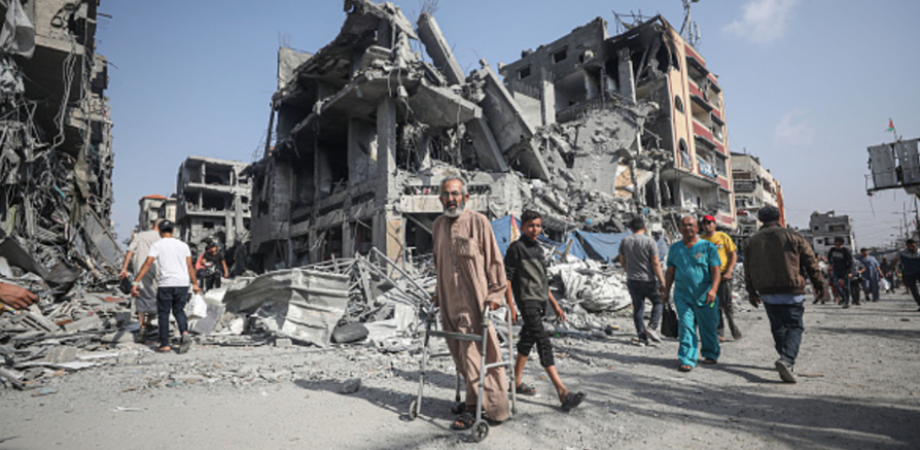
SAFA — International funding for Gaza's reconstruction could become a tool of political and economic control over Palestinians, deepening dependency and allowing foreign actors to dictate recovery priorities instead of addressing the destruction caused by Israel's genocide, a new Palestinian policy study has warned.
The Palestinian Center for Policy Studies cautioned that reconstruction could become a mechanism of political "subjugation" if international donors continue linking financial assistance, building materials, and recovery projects to restrictive political and security conditions.
The warning comes in a study titled “The Economics of Dependency and Conditional Reconstruction: International Financing for Gaza Between Early Recovery Requirements and Tracks of Political Subjugation.”
The paper examines the gap between Gaza's reconstruction needs and international funding commitments, the conditions governing the flow of assistance, and the risks of placing Palestinian recovery under external political control.
Gaza Faces $54.4 Billion Reconstruction Funding Gap
According to the study, Gaza will require approximately $71.4 billion over the next decade to rebuild its devastated infrastructure, housing, public services, and economy.
By comparison, the Peace Council has pledged around $17 billion, equivalent to less than one-quarter of the estimated reconstruction requirement.
The difference leaves a funding gap of approximately $54.4 billion, exposing the enormous financial challenges facing Gaza's recovery.
However, the researchers stressed that the problem extends beyond the amount of money promised.
They warned that international pledges do not necessarily translate into funds being released or reconstruction projects being implemented.
The study calls for closer scrutiny of how much money donors actually disburse, how funds are allocated, and how much ultimately reaches projects on the ground.
Without such accountability, reconstruction announcements could create the appearance of progress while Palestinians continue living amid destroyed homes, damaged infrastructure, and inadequate essential services.
Political Conditions Threaten Palestinian Control Over Reconstruction
The study identifies "conditional reconstruction" as a central threat to Gaza's economic independence and Palestinian decision-making.
It defines the practice as linking financial assistance, the entry of construction materials, and the implementation of recovery projects to political, security, and administrative requirements.
These conditions may include institutional oversight, bureaucratic approvals, permits, and restrictions determining which geographic areas can receive assistance.
The researchers warned that such requirements could allow donors and external political actors to exercise control over Gaza's reconstruction priorities.
Instead of rebuilding according to the needs of Palestinian communities, projects could become dependent on political approval and externally imposed conditions.
The study cautioned that this approach risks transforming urgently needed assistance into a mechanism of pressure, leaving essential infrastructure and public services vulnerable to political leverage.
For Palestinians struggling to recover from widespread destruction, restrictions on funding and construction materials could delay rebuilding while reinforcing long-term economic dependency.
Study Proposes Safeguards Against Political Subjugation
To address these risks, the Palestinian Center for Policy Studies proposed an approach it calls "restricted acceptance" of international assistance.
Under this model, Palestinians would accept necessary reconstruction funding while seeking to prevent political conditions from determining access to essential and humanitarian services.
The approach also emphasizes collective negotiations to protect Palestinian national interests and strengthen Palestinian influence over decisions affecting recovery.
The researchers argued that reconstruction must respond to the needs of the population rather than the political priorities of external actors.
They stressed that Palestinians should have a decisive role in setting reconstruction priorities, managing resources, and overseeing the implementation of projects.
Without such safeguards, international financing could reinforce existing structures of dependency rather than support sustainable economic recovery.
Transparency and Local Production Key to Economic Independence
The study outlined several measures to protect Gaza's reconstruction from external political control.
It recommended establishing a monitoring mechanism to identify and assess the conditions attached to international aid and reconstruction projects.
The researchers also called for regular public reports comparing donor pledges with actual financial disbursements and spending inside Gaza.
Such reporting would help determine whether promised assistance is reaching the projects and communities that need it most.
The paper further called for securing the release of withheld Palestinian clearance revenues, including tax funds collected by Israel on behalf of the Palestinian Authority.
Access to these revenues could strengthen Palestinian financial resources and reduce dependence on international assistance.
The study also emphasized the importance of expanding local production in sectors essential to reconstruction, particularly rubble recycling, solar energy, and agriculture.
Developing these sectors could help create employment, restore productive capacity, and reduce reliance on imported materials and externally managed recovery programs.
Gaza's Reconstruction Must Remain Under Palestinian Control
The Palestinian Center for Policy Studies warned that rebuilding Gaza cannot be treated solely as a financial or technical undertaking.
The conditions attached to reconstruction funding, the restrictions governing the entry of materials, and the authority to determine development priorities will shape Gaza's economic and political future.
The researchers cautioned that without effective safeguards, international assistance could deepen Palestinian dependency and leave essential services vulnerable to external pressure.
They called for a reconstruction framework that protects humanitarian needs from political conditionality, strengthens local economic capacity, and guarantees meaningful Palestinian control over resources and development decisions.
For Palestinians facing the destruction of their homes, livelihoods, and public institutions, the central question is not simply how much money will be pledged to rebuild Gaza.
It is whether reconstruction will restore their ability to live and develop independently or place their future under another system of political and economic control.
Source : Safa News


