
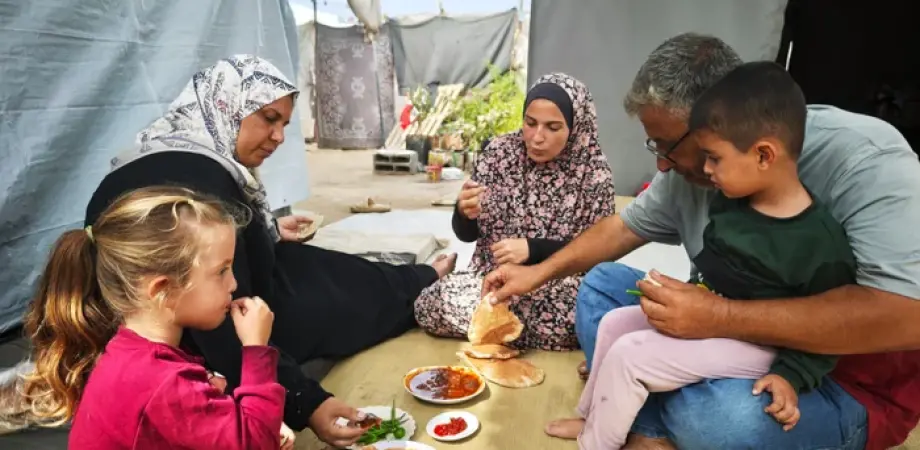
SAFA — Tens of thousands of Palestinian government employees in the Gaza Strip are struggling to feed their families as irregular and severely reduced salary payments push them deeper into poverty, leaving workers who have continued providing essential public services throughout Israel's genocidal war unable to afford basic necessities, including food, medicine, transportation, and their children's education.
Approximately 45,000 government employees have received only three small payments since the beginning of 2026, with more than 77 days passing since the last disbursement, according to Gaza's public employees' union, which warned that the collapse of regular salaries has created an unprecedented living crisis for workers and their families.
The union said the payments are too small and infrequent to provide meaningful financial security, particularly in an economy devastated by Israeli attacks, widespread destruction, unemployment, and soaring prices that have made even the most basic household necessities increasingly unaffordable.
Khalil Hamadeh, head of Gaza's public employees' union, described the situation as the worst financial crisis government workers have experienced, warning that employees who spent years serving their communities are now forced to seek assistance simply to provide food for their children.
"This is the worst living crisis public employees have ever faced," Hamadeh said.
"Many families are facing real famine. Employees who spent their lives serving their people now literally have to ask for help to feed their children."
Hamadeh explained that the consequences extend beyond food insecurity, as families are increasingly unable to pay university tuition, purchase school supplies, obtain essential medicines, or cover other expenses necessary for maintaining even a basic standard of living.
Police Officer Cannot Afford Taxi Fare to Take His Wife to Give Birth
For Fawaz Abu Omar, a lieutenant colonel in Gaza's police force, the salary crisis turned the birth of his daughter, Nasreen, into a painful experience that exposed how severely financial hardship has affected even long-serving public employees.
When his wife went into labor, Abu Omar discovered that he did not have enough money to pay for a taxi to take her to the hospital, forcing him to call relatives and ask for small amounts of financial assistance while she struggled with increasing labor pains.
"Every time my wife screamed from the pain and said, 'I need to go to the hospital to give birth,' the real torment began," Abu Omar recalled.
"I would pick up my phone and start calling relatives, asking this one for a small amount and that one for help, just so I could secure the taxi fare."
After years of service, Abu Omar said he never imagined that he would find himself unable to afford transportation for his wife during childbirth, describing the experience as deeply distressing and humiliating.
"Imagine carrying the rank of lieutenant colonel after long years of service and literally not having the price of transportation to take your wife to deliver," he said.
Yet the difficulty of reaching the hospital was only one part of the family's prolonged struggle, as his wife had suffered from inadequate nutrition throughout her pregnancy because they could not afford meat, milk, fruit, or a balanced diet.
Abu Omar explained that the family survived largely on rice and meals distributed by charitable kitchens, while his children were repeatedly deprived of foods that had once been ordinary parts of family life.
"The kids were craving a chicken meal for lunch and I was completely helpless," he said.
"We did not taste fruit at all except once, through a small voucher we received in the last month."
His experience reflects the growing hardship facing Palestinian families whose members remain employed in public institutions but no longer receive sufficient or reliable income to meet their most basic needs.
Union Reports 12,000 Government Employees Killed in Israeli Attacks
The financial crisis has been compounded by devastating losses among Gaza's public workforce, with Hamadeh reporting that approximately 12,000 government employees have been killed in Israeli attacks since the beginning of the war.
Their deaths have left thousands of families without their primary breadwinners, forcing surviving relatives to confront grief, displacement, and severe financial insecurity at a time when employment opportunities and regular sources of income have largely disappeared.
Hamadeh said the families of employees killed during the war are living under extremely difficult humanitarian conditions, particularly as compensation and financial assistance remain irregular and insufficient to cover their needs.
Despite these hardships and the widespread destruction of public facilities, thousands of civil servants have continued working in healthcare, education, municipal services, and administrative institutions, often walking long distances to reach their workplaces because transportation is unaffordable or roads have been damaged.
Their continued service has helped sustain essential public functions despite severe shortages of equipment, fuel, electricity, and financial resources.
Union Demands Payment of Outstanding Salaries
Hamadeh called on all bodies involved in administering Gaza, including existing government institutions, the National Committee for Gaza's Administration, and the proposed Peace Council, to urgently address the salary crisis by paying outstanding wages and establishing a reliable system of regular payments.
He rejected any attempt to link employees' financial rights to political disagreements or factional disputes, emphasizing that public workers serve Palestinian society regardless of political affiliation and should not be deprived of their livelihoods because of disputes over governance.
"The public employee is a civilian who serves his community, not a figure belonging to any party or faction," Hamadeh said, stressing that the experience and professional knowledge of government workers are essential to rebuilding Gaza's institutions and restoring public services.
He warned that continued delays in salary payments threaten not only employees and their families but also the ability of public institutions to maintain essential operations and respond to the enormous needs created by the war.
Public Employees Keep Gaza's Institutions Functioning Despite Destruction
Taysir Muhaysin, an adviser to Gaza's Government Media Office, described public-sector workers as a central force in preserving Palestinian institutions throughout the war, emphasizing that their continued service has prevented the complete collapse of essential government functions despite repeated Israeli attacks and the destruction of public infrastructure.
He said government employees have faced detention, torture, injuries, displacement, and prolonged separation from their families while continuing to perform their duties under exceptionally dangerous conditions.
"Many were arrested, tortured and abused by the occupation while performing their duties," Muhaysin told Sanad.
"Some were killed or wounded. Others worked for months away from their families and children."
Muhaysin highlighted the sacrifices of medical personnel and hospital administrators, some of whom remained inside healthcare facilities for more than a year without returning home, sleeping on floors for only a few hours and sharing limited food supplies while treating patients amid bombardment, fuel shortages, and severe restrictions on medical equipment and essential supplies.
He said civil defense crews, municipal workers, and humanitarian relief teams had demonstrated similar dedication, continuing to clear roads, remove rubble, repair damaged water and sewage networks, and assist displaced families despite the dangers surrounding their work.
Their efforts have been essential to maintaining basic services in communities where extensive destruction has disrupted healthcare, sanitation, transportation, and access to clean water.
Protecting Workers' Rights Is Essential to Rebuilding Gaza
Muhaysin stressed that safeguarding the salaries, dignity, and job security of Gaza's government employees is not simply a demand affecting one professional sector, but an urgent requirement for preserving the institutions that will be needed to rebuild the territory and restore essential services.
He warned that the continued deterioration of public employees' living conditions could undermine the remaining capacity of government institutions, particularly when workers are expected to serve communities facing extraordinary humanitarian needs while struggling to provide for their own families.
As Gaza's economy remains devastated and thousands of households depend on humanitarian assistance, union officials have warned that the absence of a sustainable solution to the salary crisis could push tens of thousands of additional families into severe poverty.
For workers such as Abu Omar, the crisis has already transformed ordinary responsibilities, including providing food for children and transportation during a medical emergency, into overwhelming financial challenges.
The continued survival of Gaza's public institutions depends heavily on employees who have worked through bombardment, displacement, and severe shortages, yet many of those same workers now face hunger and poverty because their salaries remain unpaid or drastically reduced.
Union officials are demanding immediate action to restore regular payments and protect the livelihoods of the civil servants whose work remains indispensable to Gaza's recovery.
Source : Safa News


