
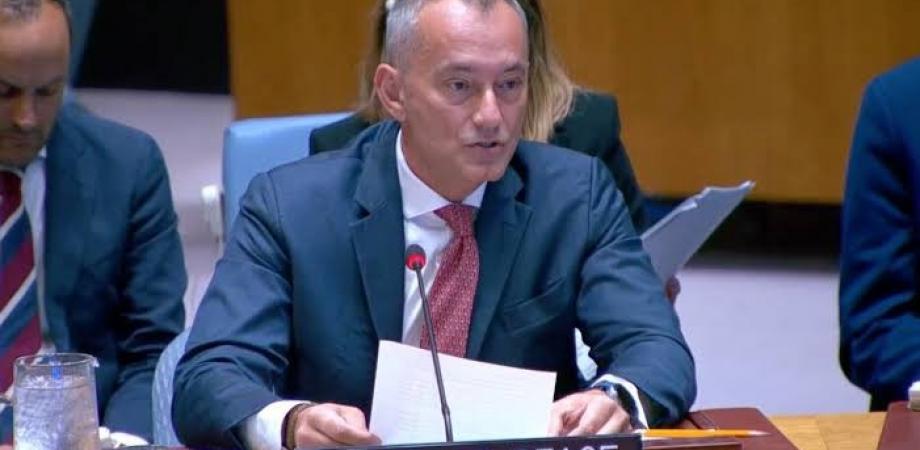
SAFA — A severe winter storm that flooded tens of thousands of displacement tents across the Gaza Strip has intensified Palestinian criticism of the so-called "Peace Council" and its envoy, Nikolay Mladenov, over their alleged failure to address the worsening humanitarian crisis.
As images of flooded camps, soaked belongings, and families struggling to protect their children from the cold circulated over the past two days, Palestinian human rights advocates, political factions, and tribal leaders questioned the council's silence.
Critics said the body, established as part of international arrangements for Gaza following the ceasefire, had failed to issue a public response to the flooding or take meaningful steps to secure emergency shelter for displaced families.
They accused the council of prioritizing political and security arrangements over civilian protection while Israeli restrictions continued to obstruct the entry of essential humanitarian supplies.
Human Rights Advocate Accuses Council of Sharing Responsibility
Rami Abdu, chairman of the Euro-Med Human Rights Monitor, said he had warned days before the storm that Gaza was approaching a humanitarian disaster as winter neared.
He estimated that displaced Palestinians urgently needed approximately 200,000 tents and one million tarpaulins to withstand the approaching weather.
"With tens of thousands of tents now flooded, the world is asking: Where is the Peace Council and where is the National Committee for the Administration of Gaza? Why are they absent?" Abdu asked.
He stressed that Israel, as the occupying power, bears primary responsibility for the destruction, displacement, and humanitarian suffering in Gaza.
However, he argued that the council's silence and the failure of newly established administrative bodies to intervene amounted to a shared responsibility for the unfolding disaster.
According to Abdu, Israel continues to prevent essential shelter materials from entering Gaza, including approximately 8,600 emergency shelter kits awaiting entry from outside the Strip.
He also accused Israeli authorities of linking the admission of temporary housing units to political and security conditions.
"The council has been preoccupied with security files and political arrangements to serve the interests and security of the occupation, while leaving the protection of civilians hostage to Israeli conditions," he said.
Abdu called for the council's mandate to be terminated, accusing it of failing to secure meaningful improvements in civilian living conditions or ensure the implementation of humanitarian commitments.
He urged the international community to pressure Israel to open Gaza's crossings immediately for tents, temporary housing units, and Civil Defense equipment without imposing political conditions.
Palestinian Factions and Tribal Leaders Demand Council's Dissolution
Palestinian factions and political forces issued a joint statement criticizing the Peace Council and Mladenov, accusing them of "providing cover for the occupation and turning a blind eye to its crimes."
The factions demanded that the council fulfill its responsibilities by pressing Israel to end violations against Palestinians and comply with humanitarian obligations.
They also called on the National Committee for the Administration of Gaza to enter the Strip immediately and begin carrying out its responsibilities, including managing essential services and addressing the needs of displaced residents.
Tribal and clan leaders across Gaza went further, demanding the dissolution of the Peace Council and the transfer of responsibility for Gaza's humanitarian and political affairs to the United Nations and the UN Security Council.
They described the council's performance as a "shameful failure," arguing that it had neither alleviated Palestinian suffering nor achieved meaningful progress toward ending the humanitarian catastrophe.
In their statement, the tribal leaders described the council as "born dead," accusing it of failing to deliver on its stated objectives.
They argued that the absence of effective international intervention had left displaced Palestinians exposed to flooding, cold weather, and worsening living conditions.
Calls to Declare Gaza a Disaster Zone
Alaa al-Aklouk, head of the National Council of Palestinian Tribes, Clans and Families, called for Gaza to be officially declared a disaster zone.
During a meeting with Keith Stansell, deputy UN humanitarian coordinator, al-Aklouk urged the United Nations to dispatch a high-level delegation to Gaza to inspect flooded displacement camps and assess the humanitarian consequences of the blockade and widespread infrastructure destruction.
He said at least 270,000 tents were urgently needed to provide shelter for hundreds of thousands of displaced Palestinians.
Al-Aklouk stressed the need for immediate international action to address the shortage of safe housing and prevent further suffering as winter weather intensifies.
Flooded Camps Expose Gaza's Worsening Shelter Crisis
The latest storm has flooded tens of thousands of tents across Gaza, leaving displaced families struggling to protect their belongings and children from heavy rain and falling temperatures.
Local officials say more than two million Palestinians remain displaced, with many living in deteriorating tents, overcrowded shelters, or buildings damaged during Israel's military offensive.
Continuing restrictions on the entry of prefabricated housing units, shelter materials, and reconstruction equipment have complicated efforts to provide safer accommodation.
The destruction of drainage networks and other essential infrastructure has also increased the risk of flooding in displacement camps, particularly in low-lying and coastal areas.
As the humanitarian emergency deepens, Palestinian organizations are demanding stronger international intervention to secure shelter supplies, lift restrictions on humanitarian access, and begin reconstruction.
The growing criticism of the Peace Council reflects frustration among Palestinian groups that the institutions established to address Gaza's postwar conditions have yet to deliver meaningful relief to displaced families.
"While the council stalls and its leadership colludes with the occupation, our people face the winter in ruined camps, and our catastrophe continues without a horizon for relief or rebuilding," tribal leaders said in their statement.
For Palestinian families facing another winter in flooded tents, the immediate demand is for safe shelter, unrestricted humanitarian access, and concrete action to prevent further suffering.
Source : Safa News


