
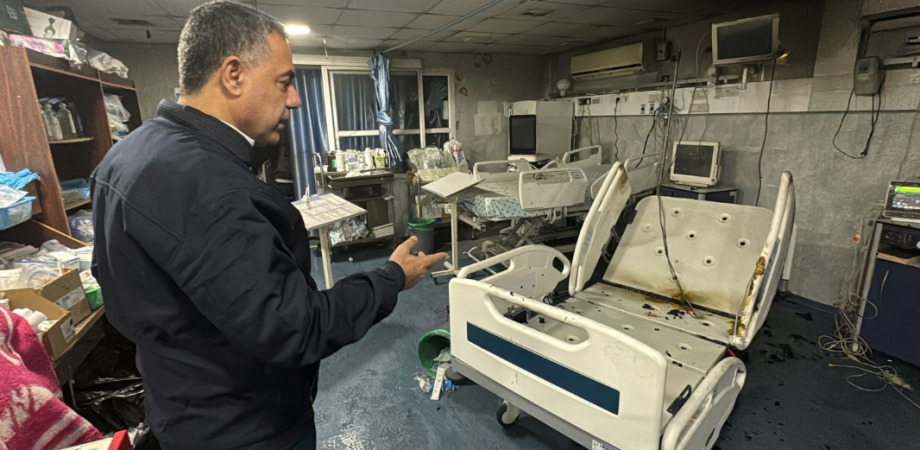
He was taken not as a fighter, but as a doctor whose daily work had been to keep people alive while the health system around him collapsed. When the director of Gaza’s largest medical complex was detained during the siege of Al-Shifa in late 2023, his journey through detention revealed a system designed less to question than to break.
For days before his arrest, the hospital had been encircled, its wards overwhelmed and its corridors filled with fear as much as injury. Staff and patients endured a prolonged siege in which time blurred and exhaustion became constant. Assurances were given that doctors would leave safely once patients were evacuated. Yet as ambulances carried away the last women, children and wounded, those promises dissolved. At a checkpoint dividing the territory, the hospital director was singled out, restrained, blindfolded and beaten, marking the start of months in detention without formal charges beyond his position itself.
What followed was a cycle of interrogation and punishment. Hours-long questioning sessions were paired with deprivation of sleep, warmth and basic dignity. Cells were kept permanently lit, movement was restricted, and humiliation was routine. Transfers between detention centres brought further abuse, including severe beatings that left lasting injuries. He later recalled that the aim was not information, but submission, to force a collapse of the inner self rather than extract a statement.
Inside overcrowded cells, conditions deteriorated further. Food was rationed to the point of hunger, medical treatment was withheld despite chronic illness, and religious practice was punished. Perhaps the most corrosive element was uncertainty: he was denied any knowledge of whether his family had survived the destruction outside. News of the death of a fellow doctor under torture underscored the lethal reality of the place, turning fear into a constant companion.
The most painful blow came not from fists, but from words. An officer informed him that Al-Shifa had been destroyed and that he would never return to it. The statement was intended to erase both past and future, to sever a doctor from the institution that defined his life. Months later, his release came without warning or ceremony. One moment he was behind bars, the next he was outside, still wearing the clothes he had been taken in.
Within days, he returned to work. Scarred, weakened, but unbroken, he walked hospital corridors with a deeper understanding of suffering, his own and that of the thousands of prisoners still inside. His experience, he says, is not an exception but part of a wider reality that has reshaped life since the Nakba: bodies can be damaged, institutions destroyed, yet the will to stand, to heal and to bear witness remains.
Source : Safa News


