
SAFA - With the hum of sewing machines, women in Gaza are working with needles and thread to rebuild their lives. These sewing projects give displaced women a way to earn money and find hope during the difficult war.
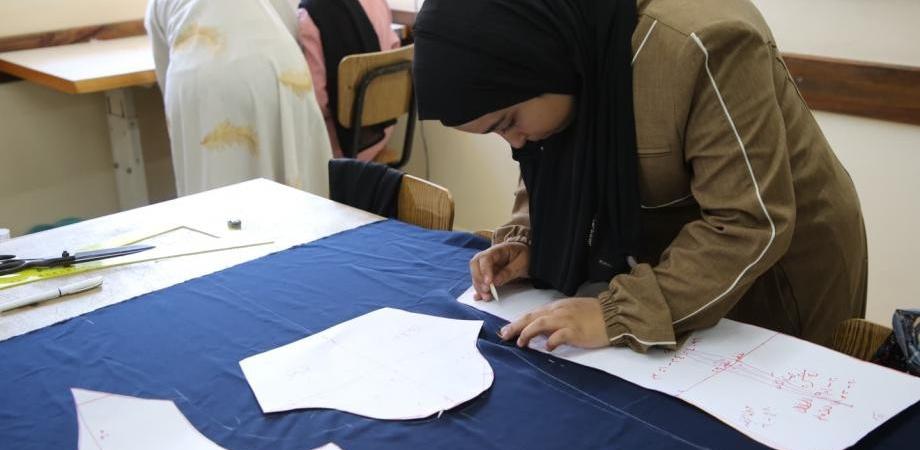
Inside the sewing and tailoring workshop run by the Palestinian Women’s Union Association in Gaza City, trainees are busy drawing patterns, taking measurements, and carefully cutting fabric. Their journey is not only about acquiring a professional skill but also about recovering the education, employment opportunities, and sources of income they lost because of the war.
Among the trainees is 24-year-old Eman Al-Mansi, who was displaced from Gaza City’s Al-Shuja’iyya neighborhood and now lives on Omar Al-Mukhtar Street. She carefully measures a training piece of fabric before returning to the sewing machine to master the first steps of a profession she hopes will one day become her source of income.
Al-Mansi says the war’s devastation went far beyond the loss of her home, extending to her education and future aspirations.
Speaking to Felesteen newspaper, she said, "The war took my home, the place where I felt safe and comfortable. It took away my dreams and ambitions. It also stole three years of my life, years during which I was supposed to complete my university education. But I decided not to stand still. A person must continue developing themselves, no matter the circumstances.”
She added that she enrolled in the sewing course because she wanted to learn a profession that would enable her to support herself and her family.
“I wanted to help myself and my family and not be a burden on them. That’s why I turned to vocational training so I could work and become productive,” she said.
A Small Project Amid the Blockade
Al-Mansi did not wait for the training course to end before putting her new skills into practice. Despite the harsh economic conditions, she managed to buy a simple sewing machine with her own savings and began taking on small sewing jobs for neighbors and friends to help cover her daily expenses.
“I tried to start with whatever was available,” she said. “I bought a basic sewing machine, then purchased fabric, thread, and needles despite their soaring prices. I started sewing for neighbors and friends so I could earn enough to cover my personal and daily expenses.”
Yet she says sustaining the project has become increasingly difficult because of soaring prices for sewing supplies, chronic electricity shortages, and the lack of raw materials.
“The spool of thread that used to cost five shekels now costs more than 50. A needle that once cost one shekel now costs three. Fabric and sewing supplies have become much more expensive, and sometimes we need a specific type of fabric or tool that simply isn’t available in the market.”
Despite these challenges, Al-Mansi remains determined to continue learning and working, hoping conditions will eventually improve and allow her to expand her small business.
Learning a Profession from Scratch
For her part, sewing instructor Ilham Al-Jojo says the war has forced many young women to rethink their priorities. Whereas many once aspired to complete their university education or secure professional jobs, they are now searching for practical skills that can provide a measure of financial independence.
Al-Jojo said the workshop accommodated around 50 trainees before the war, but displacement and the difficulties of movement have significantly reduced enrollment to around 20.
She explained that the training course lasts two months, with classes held three days a week for two hours each day. Trainees begin by learning the basics of pattern making, taking measurements, and cutting fabric before progressing to tailoring and sewing, eventually producing garments ready for use or sale.
She stressed that many trainees have lost their homes or had their education interrupted because of the war, prompting them to seek vocational skills that could help them build a new future. She added that the association continues to welcome women interested in learning sewing and tailoring, helping them acquire a sustainable source of income despite the difficult economic conditions.
At the Palestinian Women's Union Association in Gaza, women are attempting to repair what the war has torn apart while scissors trace the outlines of fabric and needles secure the first stitches. Every garment they sew carries a story of displacement, interrupted education, or a dream left unfulfilled. Yet behind every thread lies the belief that a new beginning is still possible, no matter how harsh the circumstances.
Source : Safa News


