
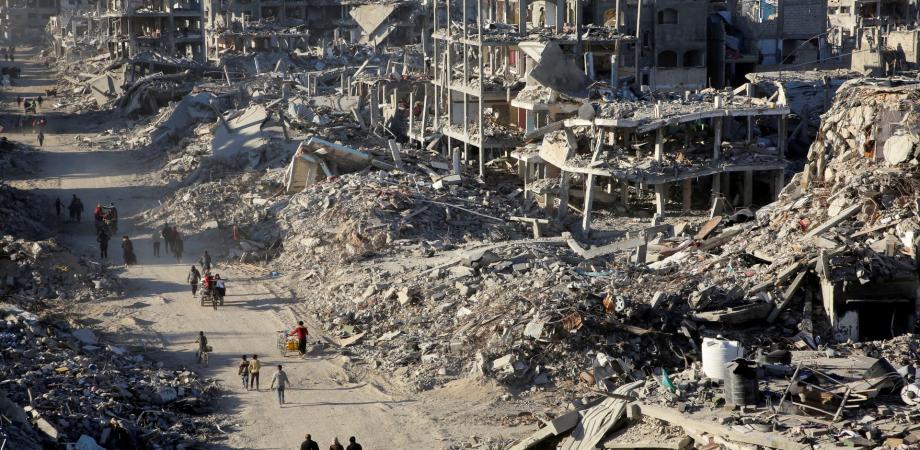
SAFA – As Israeli occupation forces expanded their ceasefire violations in Gaza City's southeastern Zeitoun neighborhood and moved the yellow concrete barriers closer to Salah al-Din Street, hundreds of Palestinian families once again found themselves facing forced displacement. They were left with two impossible choices: abandon what remains of their homes or stay under the constant threat of shelling and gunfire.
Over recent days, the area around Dawla Junction and along Salah al-Din Street has witnessed a new wave of forced displacement after Israeli military vehicles advanced deeper into residential neighborhoods. Many families gathered whatever belongings they could carry and fled to other parts of Gaza City, while others chose to remain, saying displacement no longer guarantees safety.
Roads leading away from the neighborhood were filled with familiar yet heartbreaking scenes. Animal-drawn carts and small vehicles loaded with mattresses, water containers, flour bags, and personal belongings moved slowly along damaged roads as families searched for another place to build makeshift shelters.
A Brief Return, Followed by Another Displacement
Obaida Shreir, a resident of eastern Zeitoun, never imagined he would have to leave his home again only months after returning.
Speaking to Felesteen, he said:
"We returned after the ceasefire and repaired just one room so we could live there. Today we're leaving again because the tanks have moved closer. We can no longer sleep because of the constant gunfire and drones."
Shreir said his family rushed to collect their identification documents and essential clothing as the shelling intensified before briefly returning to gather the rest of their belongings.
"Every moment we delayed carried a risk. The area is no longer the same, and we feel danger could reach us at any time."
For Shreir, displacement is more than moving from one place to another. It means losing the fragile sense of stability his family had fought to rebuild after months of destruction and repeated displacement.
Choosing to Stay Despite the Danger
A short distance away, Umm Ahmed Hajji watched families leave without packing her own belongings. Her family decided to remain despite the growing danger.
Speaking to Felesteen, she said their previous experience of displacement had been even harder than staying.
"We moved between schools and tents more than once and never found anywhere safe. If we leave today, we don't know where we will go. There aren't enough tents, food, or water."
Hajji said many families now face two equally difficult choices. Staying means living under constant danger, while displacement begins another chapter of hardship, from searching for shelter to securing the most basic daily necessities.
Residents who have remained in the neighborhood say repeated displacement has exhausted them financially and psychologically, particularly after losing their livelihoods and seeing their homes partially or completely destroyed.
The "Yellow Line": A Growing Symbol of Fear
In recent days, Israeli military vehicles advanced into Zeitoun while gunfire and artillery shelling continued near Dawla Junction. At the same time, Israeli forces moved the yellow concrete barriers dozens of meters westward, shrinking the area accessible to civilians and forcing more families to flee.
Hajji said the barriers have become "a daily symbol of fear" because they signal that the danger zone is moving closer to homes, tents, and makeshift markets where residents obtain basic necessities.
"Every time these blocks move, we feel the safe area is shrinking and that we could be forced to leave at any moment."
Lives Suspended Between Leaving and Staying
Activist Maysara Arafat said not all residents have left Zeitoun. Some families remain along parts of Salah al-Din Street and in the western section of the neighborhood, trying to continue their lives under extremely difficult conditions.
Speaking to Felesteen, he said:
"On the first night Israeli forces advanced, armed groups moved in alongside them and detained several people from Zeitoun before releasing them two days later."
Arafat said the incidents spread fear throughout the neighborhood, forcing many families to leave out of concern they could be targeted or detained.
He added that daily life has become increasingly fragile as drones and military vehicles open fire without warning, forcing residents and anyone passing through the area to seek cover inside damaged buildings or tents.
Despite the conditions, some residents continue trying to preserve a sense of normal life. Small market stalls have reopened, while others sell firewood and basic supplies to meet the needs of families who remain.
A New Shelter Crisis
For displaced families, hardship does not end once they leave. It is followed by the difficult search for somewhere to stay.
That is the reality facing 60-year-old Nasser Ashour, who began searching for shelter in the Tel al-Hawa neighborhood after Israeli military vehicles advanced toward his home.
He has been unable to find shelter. The few homes still available for rent are far beyond what he can afford.
Ashour said he is still looking for a place where he can stay with his wife and three daughters after leaving some of his belongings with neighbors while waiting to find temporary accommodation.
The latest wave of displacement has placed additional pressure on western Gaza City, where overcrowded shelters and a lack of space for tents have already left little capacity to receive more displaced families.
Local observers say the latest Israeli military advance into Zeitoun is more than a battlefield development. It carries immediate humanitarian consequences by driving another wave of displacement, shrinking the areas available to civilians, and deepening Gaza City's already severe shelter and basic services crisis.
With some families forced to flee and others determined to remain, Zeitoun has become a symbol of an impossible reality. For many residents, displacement no longer guarantees safety, while staying no longer offers security. Both choices carry grave risks as families struggle to preserve what remains of their lives amid an ever-deepening humanitarian catastrophe.
Source : Safa News