
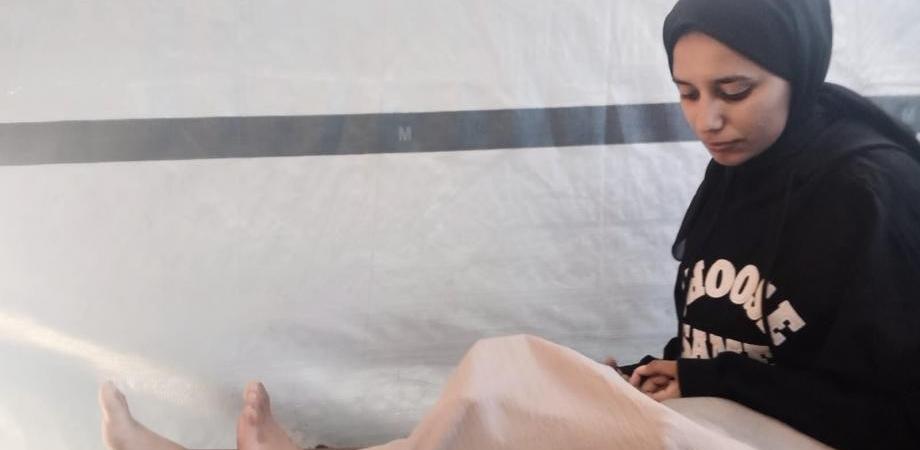
SAFA - Shaza Shahin spent her days traveling around in search of her goal of doing well on the General Secondary Education Certificate Examination (Tawjihi), despite the incredibly challenging conditions she and her family faced while living in displacement tents. That was her life a year ago, before Israeli shrapnel pierced her leg and changed everything.
Although life was incredibly difficult for Shaza’s family, her dream of achieving a high score in the Tawjihi exams motivated her to keep striving.
Speaking to Felesteen newspaper, her mother, Majeda Shahin, said, "She studied tirelessly to succeed. While we were sheltering in one of the displacement schools in Al-Bureij refugee camp, an Israeli strike hit a neighboring school. A piece of shrapnel pierced Shaza’s thigh and left her unable to walk.”
On 6 May last year, just before her Tawjihi examinations, Shaza suffered an injury that completely changed the course of her life, leaving her confined to a hospital bed and undergoing one surgery after another. “The shrapnel penetrated her left thigh, shattered the bone, and severed the arteries, veins, and nerves.”
Her mother added: “Doctors performed an emergency operation to repair the damaged arteries, veins, and nerves. They then carried out another surgery to implant a metal plate in her thigh in an effort to save her leg while hoping she would be able to travel abroad for treatment soon. Her left leg has become 14 cm shorter than her right.”
Amid the pain of her injury and the suffering caused by multiple surgeries, Shaza’s family encouraged her to sit for the Tawjihi examinations. She achieved a score of 84 percent. “We could not bear to see all the effort she had put in throughout the school year go to waste. She took the exams based on everything she had studied during the year, and thankfully she passed despite her difficult health condition.”
Waiting for Treatment as Her Condition Worsens
Like tens of thousands of other families with wounded and sick relatives, Shaza’s family faced severe delays in medical evacuations from the Gaza Strip because of restrictions imposed by the Israeli occupation authorities. As a result, she has now entered her second year waiting for treatment, which has taken a heavy toll on both her physical and psychological health.
With deep sorrow, her mother continued: “She suffers from recurrent infections caused by the metal plate implanted in her thigh, making her an almost permanent patient in the hospital. Doctors removed one of the screws from the implant to ease her pain and found that it had turned black due to the severity of the infection.”
Doctors fear that if Shaza is unable to travel for treatment soon, her thigh bone will continue to deteriorate, making her condition far more difficult to treat and greatly reducing the chances of restoring her mobility.
Majeda said, "I pleaded with the doctor supervising her case to perform the operation in Gaza. He told me he could never guarantee its success because the necessary medical resources are unavailable here and that serious complications could occur. He said he would only perform the operation if I agreed not to hold him responsible when it fails.”
Majeda now finds herself caught between two painful choices: enduring the endless waiting and watching her daughter’s suffering, or agreeing to a risky operation in Gaza. “My daughter is in pain every day because the infections have spread throughout her body. She cannot walk except for short distances with crutches. The journey from Al-Bureij camp to Nasser Hospital in Khan Younis, where she receives treatment in the complex fractures department, exhausts her physically and emotionally. She has even begun refusing to go to the hospital because of how difficult the journey is.”
The suffering extends beyond Shaza herself. The repeated hospital visits have placed an enormous physical and financial burden on the family. Her injury has also disrupted their social life, as they are unable to travel anywhere far because Shaza cannot endure the difficult transportation.
Her mother added, "Her mental health has deteriorated to the point that she refused to enroll in university. We eventually convinced her to continue her education to help distract her from her suffering, and thankfully she successfully completed her first university semester.”
According to Gaza’s Ministry of Health, since the beginning of the genocide on the Gaza Strip on 7 October 2023, the total number of injured people has reached 174,052, while the death toll has risen to 73,335.
Since the ceasefire agreement came into effect last October, 3,599 people have been injured and 1,122 others have been killed, according to the ministry.
On 14 July, the Government Media Office in Gaza stated that the Israeli authorities had allowed only 8,878 people to travel out of the 24,000 who were expected to be permitted to leave after the reopening of the Rafah border crossing, representing a compliance rate of just 36%.
What pains the Shahin family most is watching Shaza cry day and night because of the severe pain while being unable to help her. They fear that the continued delay in her medical evacuation will worsen her condition to the point where surgery will no longer be beneficial after all this waiting.
Source : Safa News