
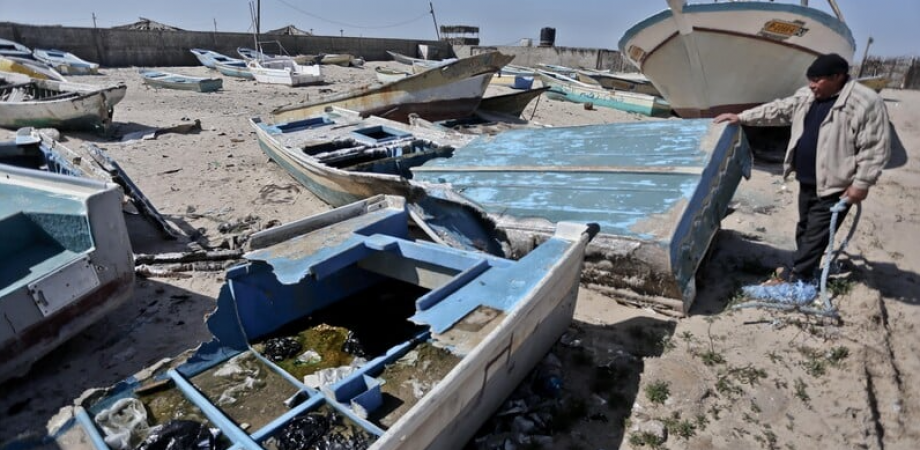
SAFA – Fishermen and industry representatives in the Gaza Strip are calling for an urgent and comprehensive rescue plan to revive a fishing sector devastated by years of war and destruction, warning that its continued decline threatens both livelihoods and food security across the territory.
Their demands include rehabilitating damaged fishing boats, supplying essential equipment and spare parts, guaranteeing safe access to fishing grounds, and providing fuel support.
They are also calling for the reconstruction of fishing ports, the restoration of cold storage and refrigeration facilities, and direct financial compensation for affected fishermen.
Additional priorities include temporary employment programs, accessible financing and insurance schemes, support for aquaculture projects, capacity-building initiatives, and the integration of the fishing industry into Gaza’s broader recovery and reconstruction plans.
The appeals are made as Gaza struggles with the economic and humanitarian fallout from the nearly three-year conflict, which has destroyed infrastructure and disrupted the livelihoods of thousands of families who rely on fishing to survive.
A Livelihood Under Threat
For Abu Saeed Al-Basheeti, a fisherman from central Gaza, the profession passed down through generations of his family has become increasingly difficult to sustain.
“Before the war, we went to sea almost every day and returned with enough fish to support our families,” he told Felesteen newspaper. “Today, we sometimes spend hours at sea and come back without earning enough to cover our operating costs.”
Al-Basheeti said many of the boats that once formed the backbone of Gaza’s fishing fleet have been destroyed or severely damaged. Those that remain operational often lack functioning engines, spare parts, and basic equipment needed to continue working.
“The boats are no longer capable of operating as they once did,” he said. “Without repairs and replacement parts, many fishermen simply cannot continue.”
Beyond the economic losses, fishermen face persistent safety concerns at sea. According to Al-Basheeti, restrictions on movement limit access to productive fishing areas, forcing crews to operate in narrow zones where fish stocks are scarce.
“Even basic fishing equipment has become difficult to obtain,” he added. “Nets are either damaged or extremely expensive, while navigation devices are nearly impossible to find. All of this reduces our ability to fish and earn a living.”
Mounting Economic Pressures
Fisherman Mohammed Al-Hessi said the crisis extends well beyond damaged boats and equipment, affecting every aspect of fishermen’s daily lives.
“The cost of a single fishing trip has risen dramatically because of fuel prices,” he said. “Sometimes we spend everything we have just to reach the sea, only to return with a catch that does not even cover our expenses.”
As a result, many fishermen have reduced their fishing trips or abandoned the profession altogether in search of alternative work.
“Some fishermen have taken physically demanding temporary jobs simply to provide food for their families because fishing alone is no longer enough,” Al-Hessi said.
He stressed that the lack of meaningful support has deepened the crisis and called for financial compensation, direct assistance, and emergency employment programs to help fishing families survive.
Nizar Ayyash, head of the Fishermen’s Syndicate, said the sector has suffered losses exceeding $75 million due to the extensive destruction of ports, boats, and maritime infrastructure.
He said Gaza City’s main fishing port and the port in northern Gaza were completely destroyed, while facilities in central and southern Gaza sustained severe damage. The destruction has brought much of the fishing industry to a standstill and prevented thousands of fishermen from returning to work.
Fishing boats, warehouses, navigation systems, communication equipment, and other essential assets have also been damaged or destroyed, creating enormous obstacles to recovery.
Ayyash said rebuilding the sector requires a comprehensive strategy beginning with the rehabilitation of fishing ports, fish landing sites, sorting and packaging facilities, ice factories, cold-storage units, and the wider cold-chain network.
He also called for affordable financing and insurance programs for fishing boats and equipment to help restore economic stability and ensure the long-term sustainability of the industry.
In addition, Ayyash highlighted the importance of investing in aquaculture projects to strengthen local food production, expanding the use of solar energy to reduce operating costs, supporting fisheries cooperatives, and developing an integrated information system to improve planning and resource management.
A Key Part of Gaza’s Recovery
Ayyash warned that ongoing Israeli restrictions continue to create a highly challenging operating environment, with fishermen confined to limited fishing zones and forced to work with severely depleted resources.
He cautioned that the continued deterioration of the fishing sector poses a direct threat to food security and risks driving poverty and unemployment even higher in a territory already facing profound economic hardship.
“The fishing sector must be included in Gaza’s early recovery and reconstruction plans,” he said. “It is not only a source of income for thousands of families but also a vital contributor to food security and economic resilience.”
According to Gaza’s Ministry of Agriculture, annual fish production before the war exceeded 5,000 metric tons, in addition to approximately 600 metric tons produced through aquaculture. The sector employed around 6,000 active fishermen, alongside hundreds of workers in fishing ports and fish farms, while thousands of families relied on the industry as their primary source of income.
Today, with much of that infrastructure destroyed and production sharply reduced, fishermen warn that without urgent intervention, one of Gaza’s oldest and most important economic sectors could face collapse.
Source : Safa News


