
SAFA - Palestinians in Gaza are once again displaying their resolve to protect education and continue learning despite the destruction and displacement brought about by Israel's genocidal war.
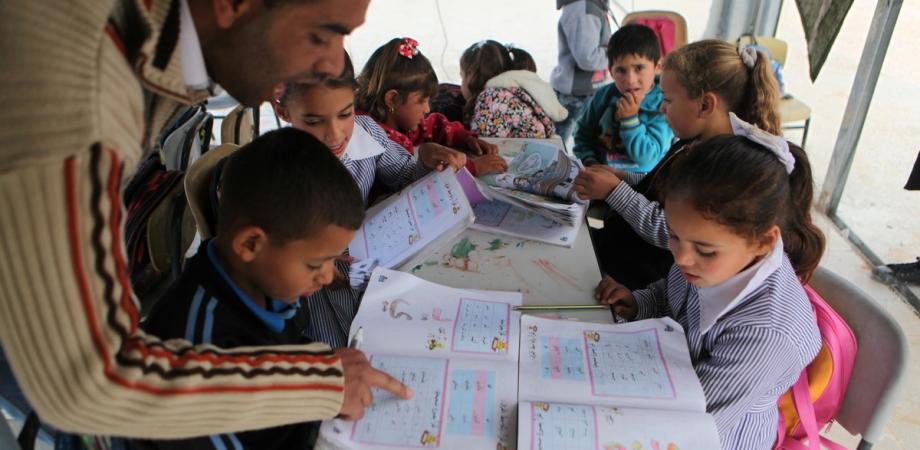
In the heart of the displacement camps on the sandy coast of al-Mawasi in southern Gaza, classrooms are emerging amid tents and rubble, offering children an opportunity to return to in-person education after months away from regular schools.
One such initiative is the newly opened Makkah School, established as part of an effort to provide safe educational spaces for displaced children. The project is supported by the King Salman Humanitarian Aid and Relief Centre, with field implementation and supervision by the Saudi Center for Culture and Heritage, in partnership with the Ministry of Education.
According to its organizers, the school represents an important intervention for thousands of displaced students who have been cut off from regular education for extended periods.
Emergency Response to Gaza’s Education Crisis
Issam Abu Khalil, head of the Saudi Center for Culture and Heritage in Gaza, told Safa news agency that the school was established in al-Mawasi in response to the severe population pressure created by the displacement of hundreds of thousands of families from across the Gaza Strip.
The initiative aims to address the educational vacuum facing children living in displacement camps and provide them with a structured learning environment.
Abu Khalil said the school seeks to replace the uncertainty of displacement with a setting based on routine, learning, and social interaction, helping children regain a sense of stability and hope for the future.
The school has been equipped as a safe educational space, taking into account the difficult environmental and weather conditions in al-Mawasi, where large numbers of displaced families are living in tents.
Field classrooms have been fitted with boards, alternative seating, and other basic educational facilities, allowing students to learn in an environment designed to reduce some of the psychological pressures associated with daily displacement.
School Opens With 1,000 Students
The school is operating through a phased system, with an initial capacity of 1,000 students, divided across different classes and learning periods to accommodate the large number of children in the area.
The project has also created 32 jobs for teachers, administrators, and other educational specialists, including young professionals and experienced educators who lost their sources of income amid the ongoing crisis.
The staff are implementing intensive remedial education programs designed to address the significant learning gaps created by prolonged interruptions to schooling.
The program relies on core educational materials and interactive activities while working around severe shortages of textbooks, school supplies, and other learning resources.
Mental Health Support Central to Program
Alongside academic instruction, psychological and social support forms a central part of the school’s daily program.
Psychologists and social workers organize activities aimed at helping children process their emotions, including group games, art workshops, and music-based activities. The activities are designed to provide children with opportunities for emotional expression and help them cope with the accumulated effects of trauma, fear, and repeated displacement.
Abu Khalil said returning to in-person education and allowing children to interact directly with teachers and classmates can play an important role in rebuilding their psychological and social well-being.
He described the school as more than a place for academic instruction, saying it can serve as a safe space where children can recover, build resilience, and regain elements of a normal childhood.
He added that the opening of the school represents a source of hope for children in Gaza by giving them an opportunity to resume their education in a safe and supportive environment.
Expansion Plans Target 4,000 Students
The experience at al-Mawasi reflects the determination of Gaza’s residents to preserve education despite the enormous challenges created by Israel’s genocidal war, Abu Khalil said.
The project is being implemented through a phased plan, with organizers aiming to eventually increase the school’s capacity to 4,000 students from al-Mawasi and surrounding areas.
Abu Khalil said the initiative reflects Saudi Arabia’s commitment to supporting Palestinians, particularly in education, which he described as a cornerstone of society.
The broader expansion plan includes constructing additional classrooms, increasing the number of teaching and administrative staff, and bringing in additional educational materials to serve more children living in displacement camps.
The organizers are also calling on international and humanitarian institutions, United Nations agencies, and development organizations to increase their support for Gaza’s education sector.
They urged organizations to provide school bags, stationery, educational supplies, and equipped learning tents while supporting the expansion of similar initiatives across displacement sites and residential communities throughout Gaza.
For children living amid the ruins and uncertainty of Israel’s genocidal war, the return to classrooms offers more than lessons. It provides a measure of routine, community, hope and a reminder that Gaza’s determination to learn has survived alongside its determination to endure.
Source : Safa News


