
SAFA - Yousef Khalifa did not know, as he recounted the most difficult scenes he had witnessed during his work as a paramedic with the Palestinian Civil Defense, that months later, his words about death would become a testimony etched in memory to one of the most horrific crimes targeting rescue and emergency teams in the Gaza Strip.
He spoke calmly about the children he had carried in his arms, the homes reduced to piles of rubble by bombardment, and the bodies he had pulled from beneath the debris while trying to separate his professional duty from the emotional toll those scenes left on him.
Yet on March 23, 2025, Yousef’s journey came to a halt in another scene; he was no longer a paramedic carrying the wounded to the hospital but one of those waiting for someone to come and recover his body.
Yousef, 41, joined the Civil Defense in 2009 and served as a paramedic throughout his years of service. He was a refugee from the town of Yibna, depopulated in 1948, and was married with five daughters: Fatima al-Zahra, Leen, Arjouan, Rital, and Aseel.
According to his colleague Ahmed Radwan, Yousef did not view his work as merely a job that provided him with a livelihood. Rather, he saw it as a humanitarian mission he had pursued and attained and continued to develop himself for. He attended specialized courses in first aid and emergency care and obtained a professional diploma in first aid and emergency care from the University College of Applied Sciences.
Yousef used to say of his profession, "My work is very difficult and requires sincerity, dedication, and integrity,” grounding his sense of duty in the Quranic verse, "And whoever saves one life, it is as if he had saved all mankind.”
Saving the Sole Survivor
In a previous interview with Felesteen newspaper during the genocide, Yousef recalled the most harrowing scenes of his work. He did not need much time to think when asked about the moments that had remained etched in his memory; most of what he witnessed in the field involved children.
He said that “most of the casualties he treated were children" and that among the scenes he could not forget was the story of six-month-old Hani Qashta, whose family home was targeted.
According to Yousef’s account at the time, Hani was the only survivor of the house, but he was nearing his final moments.
Yousef carried him to the ambulance and began attempting to resuscitate his heart and lungs throughout the journey to Al-Najjar Hospital. He fought to keep the child alive with all the experience and determination he possessed, but the child arrived at the hospital in critical condition, and doctors were unable to save him.
“An incredibly difficult feeling… very difficult,” Yousef said when asked how he felt at that moment.
He knew that death had become part of his daily work, but he could never treat it as something ordinary, especially when children were involved.
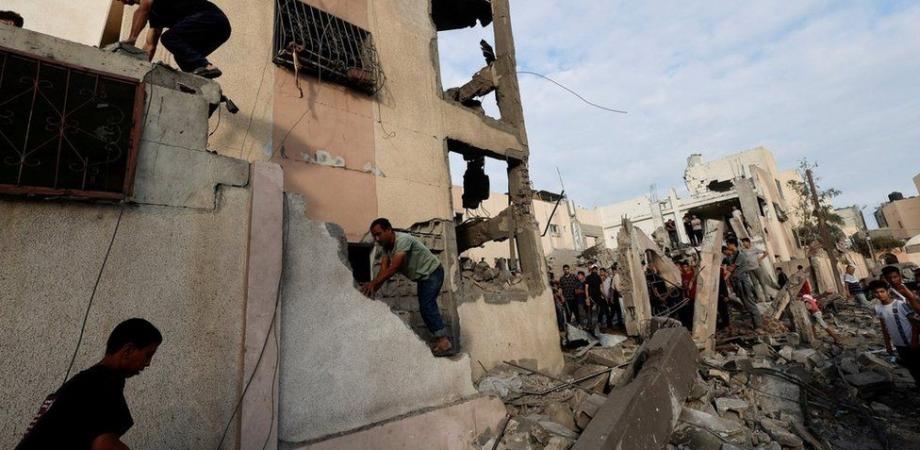
He said that the hardest thing a paramedic could witness was a home that had been standing just minutes earlier, only to be reduced to a pile of rubble by bombardment, while the paramedic was left searching through the debris for anyone who could still be saved.
He spoke of children who could be hurled dozens or even hundreds of meters from their homes by the force of an explosion, only for paramedics to reach them and find faint signs of life in their bodies, clinging to whatever remained.
The “white bag,” as Yousef described it, was one of the most tragic scenes in his work.
He said that when people see paramedics carrying a white bag, they sometimes assume it contains the body of a single person. But the bag may contain the remains of four or five people, collected from a single bombing site.
Yousef spoke about these details without concealing their psychological weight, describing elderly people whom paramedics found trapped inside their burning homes, as well as the women, children, and wounded left in the war’s wake.
Gentle Embrace
For his colleague Ahmed Radwan, Yousef’s character could not be defined solely by his skills as a paramedic.
Radwan says they shared long hours of work, but what brought them together was more than their profession; it was their shared humanity and sense of moral and national duty.
He remembers him as a kind, trustworthy, and honest man, generous and compassionate, who loved helping people and never hesitated to respond to calls for help, whether during his working hours or outside them.
He says Yousef valued teamwork and did not limit himself to paramedic duties. He also worked alongside rescue and firefighting teams and was always present wherever people needed him.
But one image remained particularly vivid in Radwan’s memory. It was taken after the Al-Ghoul family home was bombed in the Tal al-Sultan neighborhood of Rafah.
Rescue teams had pulled children from beneath the rubble. As everyone tried to cope with the scene, Yousef carried two children and embraced them as a father would embrace his own children.
Radwan was holding a camera at the time, but he could not hold back his emotions.
He says he was deeply moved and his eyes filled with tears, so he put the camera aside and went to help Yousef before returning later to document the scene so it would not disappear from his memory or from his phone.
The Rescue Mission That Turned Deadly
At dawn on March 23, 2025, Yousef was among the emergency crews deployed in the Tal al-Sultan area, west of Rafah, on a humanitarian mission to recover the dead and treat the wounded.
The convoy consisted of four ambulances belonging to the Palestinian Red Crescent, two Civil Defense vehicles, and a vehicle belonging to the United Nations Relief and Works Agency for Palestine Refugees (UNRWA). But the mission turned into a massacre.
The convoy came under Israeli gunfire, killing several paramedics and leading to the detention of survivor Munther Abed, who later said he had been detained and tortured before being released.
When other teams attempted to reach the site and recover their colleagues, the gunfire resumed. Contact was lost with several members of the teams, other ambulances went missing, and the fate of Yousef and his colleagues remained unknown for days.
Attempts to reach them were hindered by the continued gunfire, until a United Nations team managed to reach the area on March 27 and found the emergency vehicles destroyed and partially buried under the rubble. The following day, Civil Defense personnel found the body of one of their colleagues near his burned-out vehicle.
On March 30, a mass grave was discovered containing the bodies of 14 emergency and Civil Defense workers, along with a UN employee, as recovery operations continued.
Yousef was one of five Civil Defense personnel killed by the Israeli occupation forces in the massacre.
The International Committee of the Red Cross reported that the bodies of 15 people were found, including eight from the Red Crescent, five Civil Defense personnel, and an UNRWA employee.
Later, video evidence emerged from one of the paramedics’ phones, showing the vehicles clearly marked as emergency vehicles with their emergency lights on. Journalistic investigations also revealed details about the shooting of the convoy. The Israeli forces later acknowledged that “operational errors” had occurred in the incident, after previously presenting different accounts of what had happened.
A Father Who Will Not Return
In Yousef’s home, there is no longer a paramedic returning after a shift, nor a father coming home carrying with him the laughter and stories of the field.
Five daughters have lost their father: 15-year-old Fatima al-Zahra, 13-year-old Leen, 11-year-old Arjouan, seven-year-old Rital, and Aseel, who was only three and a half years old.
Radwan says, "What people remember most when they mention Yousef is his warm smile. He was gentle in his dealings with everyone, had no disputes or conflicts, and was loved by his colleagues and everyone who knew him.”
He used to say that his role model was the Prophet Muhammad, and therefore sought to make his character a reflection of what he believed in.
Yousef is gone, but his image remains: a paramedic carrying a child from beneath the rubble and a father embracing an unfamiliar child as though she were one of his own daughters.
Before becoming a body himself in a mass grave, Yousef had chosen his place in this war from the very first day: among the people, in the most dangerous places. Where others fled from death, he and his colleagues went toward it to save those who remained alive until he became one of the victims of the genocide.
Source : Safa News


