
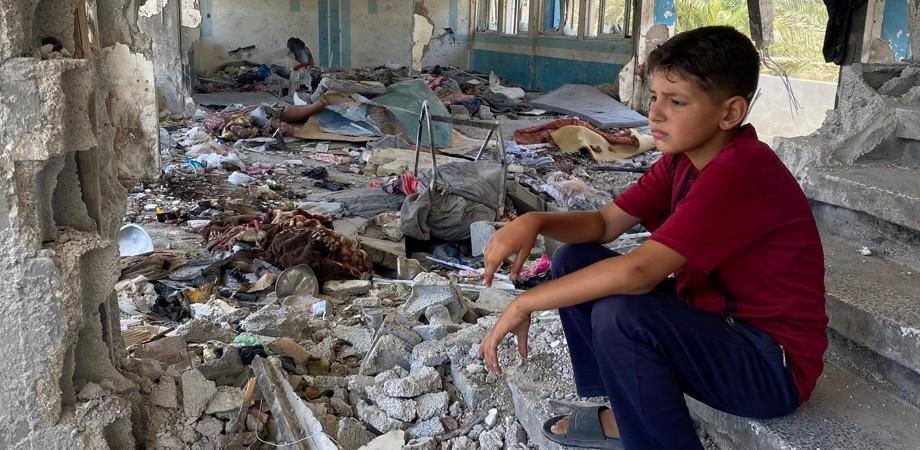
SAFA - The Director of Education for East Gaza, Munir Abu Zuaiter, said that around 80% of schools in the Gaza Strip are now out of service due to the destruction that has affected educational institutions during the Israeli genocide. He stressed that the educational process is facing an unprecedented catastrophe as a result of the occupation’s targeting of schools and destruction of the foundations necessary for education.
Abu Zuaiter explained that the Gaza Strip had around 584 school buildings of various types, including government schools, UN-run schools, and private schools. He noted that around 307 schools were destroyed or their fate could not be determined, while approximately 161 schools suffered complete or partial destruction as a result of the Israeli assault.
He added that only around 21% of classrooms remain suitable for education, while the majority of the remaining schools have been converted into shelters for displaced people. He stressed that Gaza City has barely benefited from any classrooms, given the continued use of schools as shelters.
Thousands of Students Left Outside the Education System
Abu Zuaiter clarified that the war has caused major human losses among educational staff. Around 535 male and female teachers have been killed out of approximately 22,000 teachers in the Gaza Strip, while around 20,000 school-age students have also been killed.
He pointed out that around 19,500 students have left the Gaza Strip because of the conditions caused by the genocide. This has affected the number of students participating in the educational process and increased the scale of the challenges facing educational institutions.
Abu Zuaiter said that, amid the destruction of schools, educational authorities were forced to search for alternatives to accommodate students. These included establishing educational points and field schools inside shelters and residential neighborhoods, using tents and basic construction materials.
He added that online education represented another option for continuing the educational process, with around 84,000 male and female students enrolling in it. However, poor internet connectivity, power outages, shortages and high prices of electronic devices, as well as repeated displacement and bombardment, prevented larger numbers of students from participating.
He stated that the strategic option during the coming period is to establish temporary field schools alongside online education, with the aim of reaching the largest possible number of students. He stressed that online education will not be discontinued; rather, efforts will be made to integrate it with face-to-face education.
Field Schools Become a Lifeline
Abu Zuaiter noted that around 400,000 male and female students enrolled in newly established schools during the previous academic year, whether in the courtyards of destroyed schools or inside residential neighborhoods. He explained that approximately 55% of these schools were established in tents.
He added that, despite their simplicity, field schools managed to accommodate the largest number of students, given the difficulty of constructing alternative school buildings because of the high costs and the challenging conditions on the ground and humanitarian situation.
He indicated that the percentage of students enrolled in online education reached approximately 14%, while around 127,000 male and female students remain outside the educational process, whether face-to-face or online, representing approximately 20.5%.
Abu Zuaiter confirmed that the new academic year in the Gaza Strip is expected to begin on September 6, 2026, in coordination with the Ministry of Education in Ramallah, while efforts will continue to provide educational alternatives that guarantee students’ right to access education despite the continuing consequences of the genocide.
He stressed that the scale of destruction affecting schools and educational facilities, along with the loss of large numbers of teachers and students, represents a major challenge to rebuilding the educational process. He emphasized the need to provide the necessary alternatives and resources to accommodate students and bring them back to their classrooms.
Source : Safa News


