
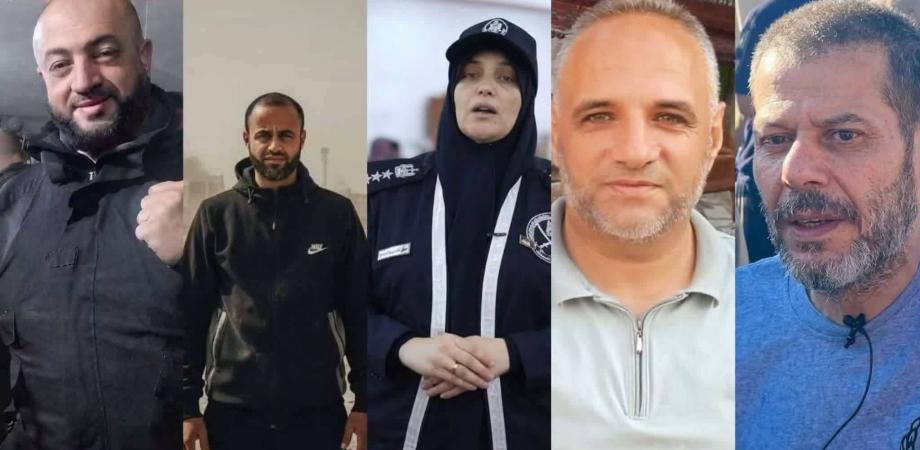
SAFA — In a powerful display of solidarity, growing public support has emerged across Gaza for the Palestinian police following an Israeli attack on a police headquarters that killed several officers and personnel as they held a regular meeting focused on maintaining public security, easing residents’ suffering and upholding the rule of law.
The attack came just days after Gaza police commander Brig. Gen. Jamal Abu Kmeil was killed in his car. Despite years of Israeli genocidal war, bombardment, displacement, severe shortages and months without salaries, police officers have continued performing their duties as a vital safeguard for Gaza’s internal security.
Families and community leaders across the Strip have responded by voicing support for the police and stressing the need to prevent any security vacuum.
A Shield for Gaza’s Internal Front
Speaking to Felesteen newspaper, tribal leaders and community figures praised the police for continuing their work despite limited resources and repeated Israeli attacks.
Community leader Yassin Assaf, 58, condemned the systematic targeting of police officers, stressing that Gaza’s families would stand behind them because society urgently needs law enforcement and accountability for those who violate the law.
He warned that weakening the police could allow crime and disorder to spread, something he said Palestinians would not accept.
Rami Kaheel, 62, described the police as the backbone of stability on Gaza’s internal front, saying that targeting the force was an attempt to weaken society and push it towards chaos.
He called on all sectors of society to support police officers materially and morally during this critical period. Kaheel also criticized Israeli attempts to manipulate the political narrative, saying that the “Board of Peace” and similar initiatives were being used to provide political cover for Israeli actions.
Mohammed al-Qayed, 65, said Gaza’s families regard police officers as their own sons and that targeting them threatens the personal security of every resident. He said attempts to create a security vacuum had been confronted by communities that recognized the danger early on.
Ziad al-Dayah, 53, noted that police officers had continued reporting for duty despite direct threats to their lives and the loss of their livelihoods. He urged residents to support them in protecting markets, public facilities and communities.
Protecting Civilian Life
Community mediator Rami al-Sankari, 48, praised police efforts to preserve civil peace and called for international intervention to halt Israeli attacks on civilian police personnel.
In Gaza’s markets, traders also stressed the importance of the police presence.
Vendor Mohammed Abu Aita, 42, said officers on the streets provide an essential safeguard for commercial activity and help prevent theft, profiteering and disorder.
Raed al-Hannawi, 35, similarly warned that attacks on the police were affecting everyday stability and called for broad public support for the force.
Lawyer Ali al-Ghazi, 35, described Israeli attacks on police officers performing civilian functions as a grave violation of international humanitarian law and protections afforded to civilian institutions.
Community and tribal leaders stressed that Gaza’s social fabric would continue supporting law enforcement and protecting residents’ rights and property. They pointed to the formation of community and family support committees alongside the police as evidence of solidarity on the ground.
They said the killing of police personnel would only strengthen determination to preserve public order, saying that widespread popular support sends a message that attempts to undermine Gaza’s internal stability will face strong social resistance.
Gaza’s police directorate said Wednesday that an Israeli airstrike targeted the Municipal Police headquarters in Gaza City, killing and wounding several people.
The directorate described the attack as another “brutal massacre” targeting members of Gaza’s civilian police force.


