
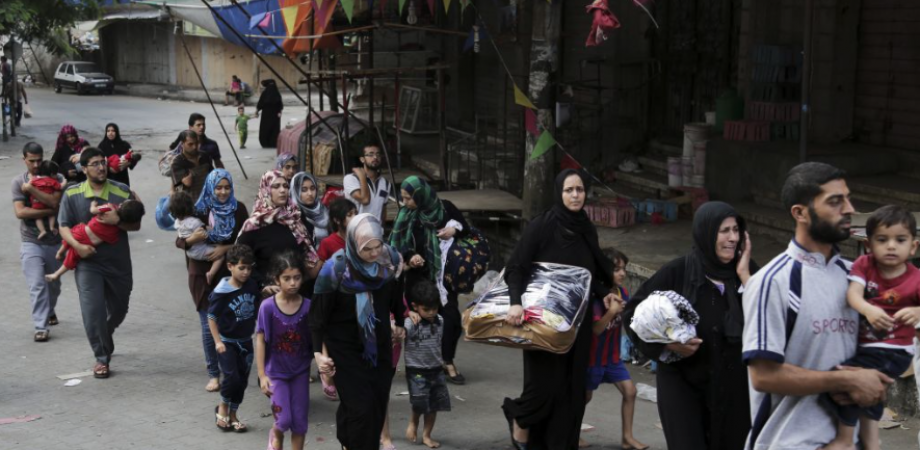
SAFA - The shelter crisis is among a series of obstacles hindering the regular resumption of in-person education in the Gaza Strip, where Israel’s ongoing genocide has entered its third consecutive year, destroying more than 90% of schools and educational facilities.
Yet some displaced Palestinians are sharing classrooms with students from different educational levels in schools that survived the attacks but have been left dilapidated by Israeli bombardment and the harsh living conditions of displaced families. No practical solutions have emerged to address the shelter crisis, despite provisions in the October 2025 ceasefire agreement that were supposed to pave the way for its resolution. Israel, however, disregarded the agreement’s humanitarian protocol.
The Government Media Office renewed its call this week for urgent national action to address the catastrophic living and shelter conditions facing displaced Palestinians in Gaza. It cited data documented by the National Shelter System, which lays bare the scale of the housing crisis across the Strip.
It said the total number of displaced families in Gaza stands at 509,393, comprising more than 2.15 million displaced people. Of these, 1,027,396 are living inside shelters, while another 1,122,566 are staying outside them.
Temporary Shelters
Displaced Palestinian Mustafa al-Aloul is one of thousands who fled from northern Gaza to the south. For the past two and a half years, he has been living inside a classroom at a UNRWA-run shelter school in the Nuseirat refugee camp.
A year ago, the school administration, along with community committees and community leaders, attempted to relocate the father of five. Their efforts, however, resulted only in clearing a limited number of classrooms of displaced families and reopening them for educational activities.
Now, the school administration is insisting that all classrooms be vacated so they can be cleaned and repaired ahead of the 2026–2027 academic year. But for 45-year-old al-Aloul, that is “not good news.”
“We are not against the school’s decision or the return of education to schools. We have children, and we want all of them to return to school,” he told Felesteen newspaper. “But the question is: Where will I go with my family?”
Al-Aloul also lives with his bedridden mother inside the classroom. In his view, staying in the school shelter is far better than living in makeshift camps on bare ground, where many basic necessities are lacking.
“We, the displaced, are ready to leave the school if UN or international organizations provide dignified shelters rather than fabric tents,” al-Aloul added, referring to displaced families’ calls for temporary housing units such as caravans or reinforced plastic tents.
The situation is a little different for 65-year-old grandfather Asaad al-Nabahin, who lives with his sons, their wives, and his grandchildren in two classrooms at a government-run shelter school in the central Gaza town of al-Zawaida.
“I am ready to leave the school now if a place and dignified shelter are available,” said al-Nabahin, who was displaced from Juhr al-Dik, east of the central governorate, to al-Zawaida in the west.
He speaks angrily of nearly three years of repeated displacement and the destruction of his family home and farmland by the Israeli army. “Provide us with temporary housing, and we will leave immediately,” he said.
“How are 25 people supposed to live in tents that offer no protection from the summer heat or winter cold?” the grandfather asks. He says he is ready to leave the shelter now and return to his devastated hometown of Juhr al-Dik.
That, however, is made impossible by the Israeli army’s control over more than 60% of Gaza through the imposition of the “Yellow Line,” preventing residents from returning to their destroyed towns and neighborhoods and making their return conditional on reaching a political agreement on its terms.
Obstacles and Challenges
Dr. Mahmoud al-Talla’, director of the Administrative Department at the Directorate of Education in the Central Governorate, spoke of a series of obstacles facing the resumption of in-person education in Gaza.
Among the most pressing are the destruction of the education system and its facilities, the killing of educational staff, a shortage of learning spaces, and the overcrowding and concentration of displaced people in certain areas.
Yet according to al-Talla’, who spoke to Felesteen newspaper, these challenges pale in the face of the determination among Palestinians to keep education going and restore in-person learning. Efforts include expanding educational spaces through centers and tents, as well as leasing or donating land to establish temporary schools, in an effort to keep the educational process moving forward.
He confirmed that coordination and cooperation are underway with UNRWA to resume and strengthen in-person education despite the on-the-ground challenges and Israeli restrictions.
Regarding displaced people sheltering in some schools, he said their presence poses a major obstacle to the smooth resumption of in-person education and the accommodation of students from different educational levels. At the same time, he stressed that displaced people have a right to shelter, just as students have a right to education.
To avoid a direct clash between the two needs, the Directorate of Education has resorted to using classrooms for different educational stages in alternating shifts and time periods to accommodate large numbers of students, for example, allocating three days across three shifts.
In this context, the government official urged UN agencies and international organizations to prioritize education as a legal and humanitarian right of Palestinian generations, while also addressing the displacement crisis and temporary shelters in order to overcome the ongoing crises left in the wake of the genocide.
The Government Media Office reports that the Israeli occupation forces are limiting the entry of necessary shelter supplies, especially building materials and caravans. It also condemned the international silence over the disruption of debris-removal programs, which are considered a crucial first step toward recovery and early rehabilitation.
Source : Safa News


