
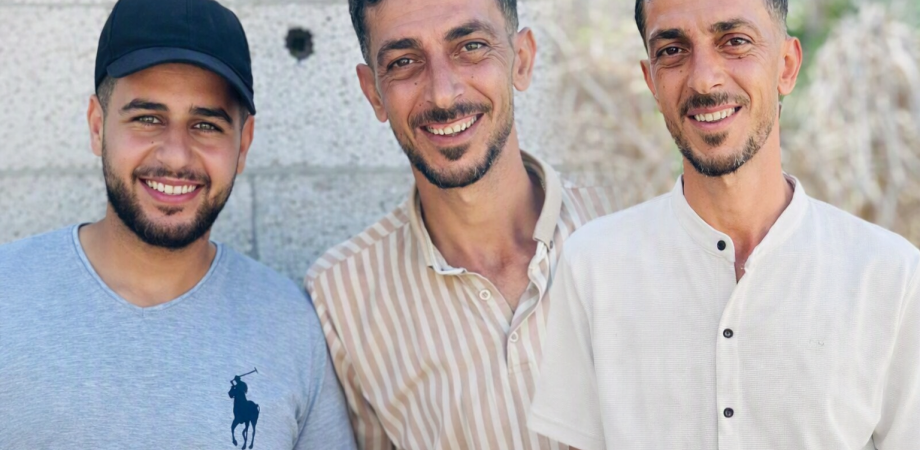
SAFA- Three Palestinian farmers from the Abdeen family were killed in an Israeli strike while tending crops on their farmland east of al-Qarara in southern Gaza, near the so-called “Yellow Line,” just as they were preparing for the harvest they had spent months working toward.
Abdul Hamid Mohammed Abdeen, 36, and his cousins, Lafi Fayez Abdeen, 39, and Taysir Fayez Abdeen, 28, had spent months planting, watering and caring for the land despite the dangers of working near the “Yellow Line.”
The three farmers had been waiting for harvest season, the moment they could finally reap the fruits of months of hard work.
They never lived to see it.
They had spent months cultivating and watering their land east of al-Qarara in southern Gaza, near the so-called “Yellow Line,” despite the constant danger surrounding the area.
The men rarely left the farmland, taking turns guarding it because the crops had become their main source of income.
But they never lived to see the harvest.
Landowner Abdul Hamid Mohammed Abdeen, 36, was killed alongside his cousins, Lafi Fayez Abdeen, 39, a married father of three, and Taysir Fayez Abdeen, 28, in an Israeli strike on the land they had spent months cultivating.
Abdul Hamid’s children, Ella, 7, Mohammed, 6, and two-and-a-half-year-old Miyam, had been waiting for their father to harvest the crops and return home after spending long periods away caring for the land.
Instead, their father returned carried on the shoulders of mourners.
A Deadly Strike Before the Harvest
Fadwa Abdeen, Abdul Hamid’s sister, recounted the circumstances leading up to the attack to Felesteen newspaper.
“Last Friday, my brother had been awake since dawn,” she said. “They drank tea and decided to prepare a meal using young pigeons they raised on the land. But they could not find a knife, so they went to look for one from the neighbors.”
Fadwa said three strangers then attempted to cross the farmland. The men suspected they were affiliated with groups collaborating with Israeli forces and prevented them from entering.
Only minutes later, she said, Abdul Hamid’s brother Abdul Majeed left the land briefly to buy something from a nearby grocery store.
Then the strike hit.
“When my brother returned, he found Abdul Hamid and my cousins, Lafi and Taysir, killed,” Fadwa said. “My nephew was with them and survived the attack.”
With ambulances struggling to reach the area, Abdul Majeed faced another ordeal: getting the bodies to a hospital.
They were eventually transported on a horse-drawn cart.
The family initially tried to withhold the news from the farmers’ father, who was receiving cancer treatment in Egypt and had undergone surgery only days earlier. His wife was with him.
But they learned of the killings through media reports.
They called their children in Gaza to confirm the news as their sons were being laid to rest.
Fadwa herself learned what had happened while preparing lunch for her children.
As she listened to the news over the phone, she remembered her father’s words to her: “Your brothers are your responsibility.”
As the eldest daughter, Fadwa said she had long felt like a mother to her brothers.
“I tried many times to persuade them not to go to the land, or at least to spend less time there,” she said. “But they were determined to harvest the crops.”
Farming Under Constant Israeli Fire
Palestinian farmers working near the so-called “Yellow Line” face persistent danger from Israeli gunfire and attacks, making access to agricultural land increasingly hazardous.
Palestinians say the restrictions and attacks are pushing farmers away from their land and further west, while many continue trying to cultivate what remains accessible despite the risks.
Gaza had around 170,000 dunams of agricultural land before the widespread destruction caused by the war. According to figures cited in the report, only a small fraction of that farmland remains cultivated after vast areas were bulldozed and destroyed.
For Abdul Hamid, returning to agriculture had become a means of survival.
“The land belongs to my father,” Fadwa said. “Before the war, my brother Abdul Hamid worked in sweet shops. But when the war began and businesses stopped operating, he turned to reclaiming and working on my father’s land.”
He planted jute mallow, eggplants and zucchini, along with olive trees and other crops whose harvest he had been eagerly awaiting.
Abdul Hamid bought an electric generator to operate the well and irrigate the crops, investing what he could in restoring the farmland.
But working there meant living under constant danger.
Fadwa said Israeli military vehicles repeatedly opened fire toward the area, while quadcopter drones regularly hovered overhead.
She recalled that her uncle was once fired upon while visiting the farmland, reinforcing the family’s fears about Abdul Hamid and the others continuing to work there.
On Thursday, the day before he was killed, Abdul Hamid tried to return home to spend a day or two with his children before heading back to the farm.
He could not find transportation from the eastern part of the area and remained on the land.
It would be his final night there.
“My Sisters, My Flowers”
Fadwa described Abdul Hamid as deeply loved by his family and those who knew him.
Whenever she heard about an attack east of al-Qarara, she said, she would immediately call him to make sure he was safe and urge him to take every possible precaution.
A message he sent her only a week before his killing now carries a different weight.
“My sisters, my flowers, you are the light of my life,” Abdul Hamid wrote. “As long as I am here, I will remain your support.”
Fadwa said the message immediately made her uneasy.
“When I read it, I became afraid that something had happened to him, so I called,” she recalled.
“He told me how much he missed us because he had been so busy planting and caring for the crops.”
A week later, Abdul Hamid was killed on the land whose harvest he had spent months waiting to see.
Source : Safa News


