
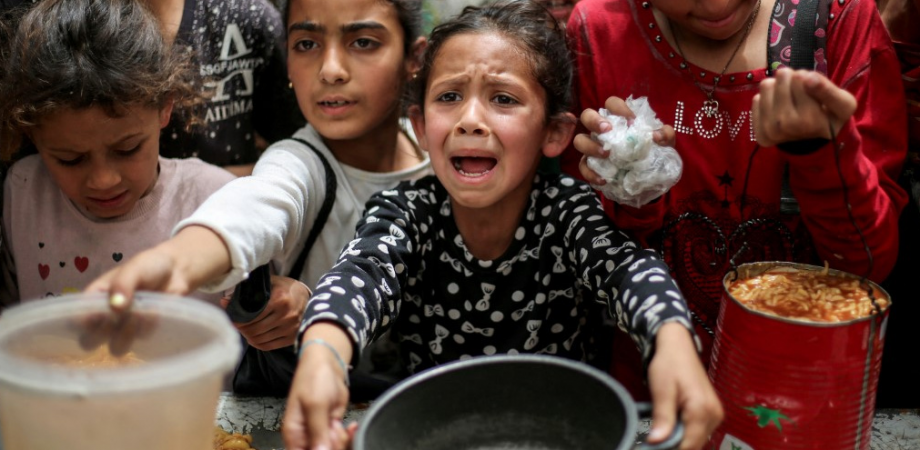
SAFA — As the community kitchen was delayed, children began tapping their empty pots. Camp administrators told them they had contacted those running the kitchen.
Children, women and men gathered, waiting for the food to arrive, while more people came from nearby displacement camps after hearing that a community kitchen was operating at the camp on al-Jalaa Street in Gaza City.
The worsening humanitarian crisis across the Gaza Strip has affected nearly every aspect of daily life, forcing many community kitchens to scale back their operations.
Many now operate at limited capacity, while those still functioning offer a narrow range of meals, including peas, beans, mujaddara, pasta, lentils and maftoul, often prepared with bulgur.
The Last Refuge
Amid these harsh conditions, community kitchens have become a last refuge for families exhausted by poverty, displacement and war. Some leave early in the morning searching for a kitchen that is still serving food.
World Central Kitchen (WCK), one of the largest organisations providing meals in Gaza, has reduced its operations by around 80%, while hundreds of workers have reportedly lost their jobs, deepening the crisis for displacement camps that had relied on its services.
When the kitchen’s pots finally arrive, children rush forward ahead of the adults, each fearing they will return to their tent with an empty plate.
Mohammed Awkal, a young man standing in the shade of a tent to escape the midday sun, described the high cost of preparing even a single meal, which he said can exceed 50 shekels.
As he waited for the community kitchen to arrive, he told Felesteen newspaper: “I rarely find work these days, so I have no income to provide food. Prices are extremely high, and I cannot afford to buy vegetables or even some chicken.”
Every morning, Awkal sets out in search of a community kitchen, hoping to arrive early enough to receive food. Finding a meal has become a daily journey of its own.
“I used to get food from three kitchens operating every day near us,” he said. “But their numbers have declined, and the crowds and pushing in front of them have become worse. I was afraid of getting burned. Now, we can barely manage to get food from a kitchen twice a week.”
Asked about the food served by the kitchens he visits, Awkal gave a faint smile through his frustration.
“There is no variety. They only add some spices, salt and a few simple ingredients. We force ourselves to eat it just to silence our hunger.”
Sixty-year-old Asaad al-Hasani lives alone in one of the camp’s tents, and community kitchens have become his main source of food.
“I live alone in the tent,” he told Felesteen. “I divide my daily tasks between fetching water and finding food.”
“I live in a tent and I cannot work,” al-Hasani added. “When I go to fetch water, I become exhausted, and sometimes I have to make one or two trips. In the past, I used to go to more than one place every day, and there was a variety of food, not just rice or cooked meals. But today, we have no choice but to eat whatever is available.”
Waiting for the food to arrive, al-Hasani continued: “People are exhausted. They wait here because there is no work, no source of income, nothing. Life is hard for everyone. When the kitchen arrives, people are happy, but they rush and push to get food. On top of that, we suffer from water shortages and the hardship of living in tents.”
Still, he said the kitchen eases part of his burden.
“It helps me a lot. We need firewood and basic utensils for food and drink, but we cannot afford them. We ask God to have mercy on us and help us through these conditions.”
Young Ghazal Abed stood beside her friend holding an empty plate.
“I come to the kitchen every day, but sometimes I cannot get any food because there is not enough,” she told Felesteen. “I bring food for my family because my brother is not here, and there are seven of us.”
Speaking with a maturity beyond her years, Ghazal added: “There used to be three kitchens, but today there is only one. I have also been burned several times because of the pushing around the food pot. My hand fell into the pot three times, and I suffered burns that took around two weeks to heal completely.”
Another child, Musab Shamali, said: “When I heard that a community kitchen was coming to the neighbouring camp, I came to fill a container with food.”
A Difficult Journey
As the number of community kitchens declines, the search for food has become increasingly difficult. For struggling families, securing a meal can now depend simply on whether a kitchen is operating that day.
Ahmed is among the children who have grown accustomed to searching for community kitchens. He came from one of the larger camps after the kitchen his family had relied on stopped operating around two months ago, hoping to find another place where he could get food.
Iman al-Sharbasi, who is ill, also comes to the kitchen to collect food.
“I depend on the kitchen because we cannot provide food for ourselves,” she told Felesteen. “I am a widow, so it covers a large part of our needs. Sometimes it also provides us with bread, but I cannot get it every time.”
Al-Sharbasi described how heavily camp residents have come to depend on food assistance.
“The kitchen used to be something very important for us in the camp, but it stopped completely and is no longer there. It is difficult for me to provide food. Sometimes I rely on canned beans that I receive through food vouchers from the World Food Programme. I cannot even afford to buy vegetables to prepare a meal.”
Source : Safa News


