
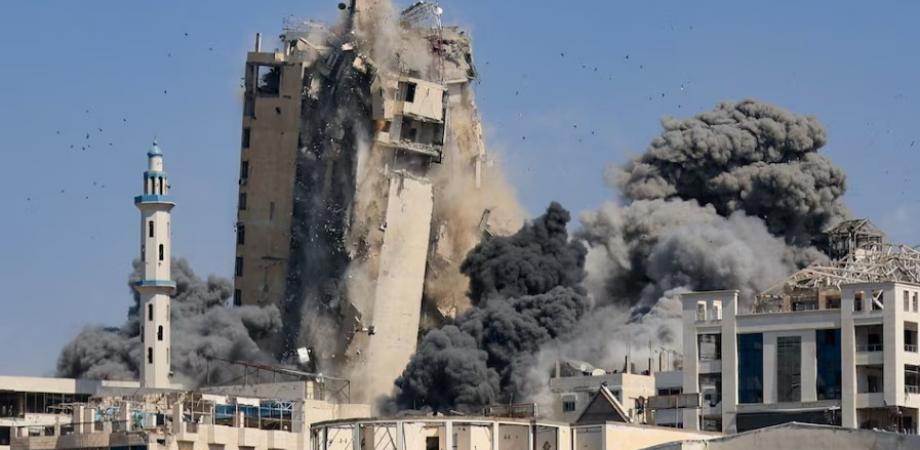
SAFA — Israel is escalating military and security operations in Gaza in an attempt to reassert its deterrence and impose new conditions on the Strip’s future, Palestinian political analysts say, warning that continued Israeli ceasefire violations could push Gaza toward renewed confrontation.
The analysts argue that the Israeli government is seeking to impose unilateral conditions regarding what it calls the “disarmament of the resistance” without offering reciprocal guarantees for an Israeli withdrawal or a lasting ceasefire.
They warned that continued Israeli attacks, coupled with the absence of binding international measures to restrain them, risk reducing the ceasefire to a fragile truce vulnerable to collapse.
The warnings followed an Israeli operation in the al-Katiba and Ansar areas west of Gaza City on Tuesday, where explosions, airstrikes and heavy gunfire were reported amid an apparent Israeli security operation.
According to local sources, the attack was accompanied by intensive flights of Apache helicopters and drones, while reports indicated that an Israeli special force had infiltrated the area, triggering clashes and exchanges of gunfire.
The Government Information Office in Gaza said an Israeli special force attempted to carry out a security operation in Gaza City but was exposed before the Israeli military launched a large-scale aerial intervention involving more than 10 warplanes and intensive strikes on the area.
According to local and medical sources, the Israeli attacks killed four Palestinians and injured others. Ambulance crews also faced difficulties reaching the targeted areas because of continuing airstrikes and gunfire.
Large numbers of displaced Palestinians, including families living in tents, were sheltering in the area at the time, causing widespread panic as the bombardment continued.
‘A Fully Fledged Israeli Operation’
Political writer and analyst Talal Okal described what happened in the al-Katiba and Ansar areas as “a fully fledged Israeli operation in its nature, objectives and decision-making,” even if Israel relied on local armed groups to carry out parts of it.
“Using a proxy does not absolve the main party of responsibility and does not change the fact that the Israeli occupation was behind the planning, direction and execution,” Okal told Felesteen newspaper.
Okal said the incident demonstrated once again that Israel does not treat the ceasefire or existing understandings as binding commitments.
Instead, he said, Israel continues its violations through “abductions, assassinations, sowing chaos and attempts at security infiltration,” before using air power to respond when such operations fail on the ground.
“We are facing systematic aggressive behavior, not an isolated violation or a limited security incident,” Okal said. “The Israeli occupation is trying to recreate an equation of fear and open the door to a new confrontation.”
He described the failure of the operation as “a security and political blow to the Israeli occupation,” arguing that its exposure reflected the ability of Palestinians on the ground to detect and thwart Israeli security operations before they achieved their objectives.
Okal called on mediators and guarantors of the ceasefire to take concrete action.
“Guarantees have no value if Israel is allowed to kill, abduct, assassinate and undermine Gaza’s security without accountability,” he said. “What is needed is a clear position and binding measures to stop these violations, not more statements of concern.”
Israel Seeks to Rebuild Deterrence
Israeli affairs expert Mohammed Halsa said Prime Minister Benjamin Netanyahu is using the escalation in Gaza in an attempt to restore Israel’s image of deterrence while strengthening his political standing domestically.
“Netanyahu is trying to present himself to Israelis as the leader capable of controlling the security situation and striking Israel’s opponents on more than one front without paying a direct political or military price,” Halsa told Felesteen.
He argued that the Israeli government is attempting to compensate for what it considers its failure to achieve broader objectives in Gaza by increasing pressure on Palestinians and expanding military operations.
Halsa said Netanyahu’s rejection of gradually restricting Palestinian weapons in parallel with Israeli steps exposes the central dispute over the future of the ceasefire.
“Israel does not want a process based on step-for-step measures,” he said. “Instead, it wants to extract what it calls disarmament all at once before offering any clear concessions on the ground.”
From the Palestinian perspective, Halsa said, reciprocal measures must go beyond a cessation of fire and include Israeli withdrawal, stable security arrangements and credible international guarantees.
Without those guarantees, he argued, Palestinian disarmament could leave Gaza exposed to continued Israeli military operations without any enforceable mechanism ensuring Israeli compliance.
“The equation Israel seeks to impose would, in practice, mean keeping Gaza trapped in catastrophe and turning the humanitarian tragedy into a political tool to pressure the population and push them toward displacement,” Halsa said.
Netanyahu’s Political Calculations
Halsa also linked the escalation to Israel’s domestic political calculations, arguing that Netanyahu could see an advantage in prolonging a state of attrition ahead of elections, particularly amid competition within the Israeli right.
He warned that the Israeli government could use any Palestinian response as justification for expanding military operations.
“The goal is not merely to manage the escalation, but to keep Gaza in a state of attrition that allows Netanyahu to regain the political and security initiative,” Halsa said.
He concluded that the growing influence of Religious Zionism within the Israeli government is increasing the likelihood of further hardline policies within Israel’s political and military establishment.
The analysts warned that without enforceable international guarantees capable of restraining Israeli violations, continued military operations risk undermining the ceasefire and preserving a situation in which Palestinians are pressured to make irreversible security concessions while Israel retains broad freedom to operate militarily inside Gaza.
Source : Safa News


