
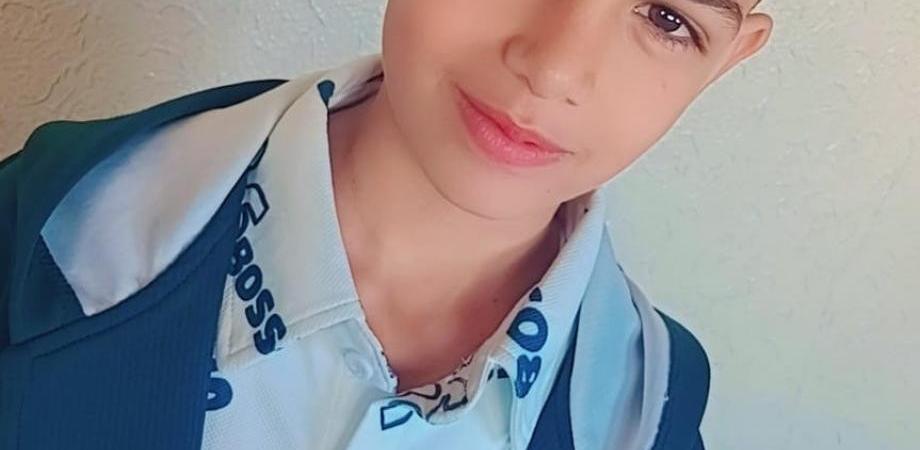
SAFA — Twelve-year-old Moayad Al-Tanani never imagined that stepping outside on the afternoon of Tuesday, August 25, to play football with his cousins would mark the beginning of a long journey through pain, fear and uncertainty.
At around 6 p.m., Moayad was doing what he loved most: playing football in the street behind Kamal Adwan Hospital in northern Gaza, where his family lives in a house near the so-called Yellow Line. As usual, he chased the ball until sunset drew near, when fear of shelling and gunfire forced residents of the area back indoors.
Then, without warning, an Israeli strike hit a nearby house. A piece of shrapnel tore into Moayad’s head and lodged behind his right ear. The football match came to an abrupt end, and another race began — this time to save him.
His mother, Sabreen, told Felesteen newspaper: “The shrapnel fractured his skull and lodged in a sensitive area where arteries and veins converge, making his condition one that requires highly delicate medical intervention.”
“The doctors were initially focused on stopping the bleeding. His blood count dropped to 5, and he had to receive units of blood. Now they are waiting for tissue to form around the shrapnel before deciding whether and when to operate, especially because of its location, which makes the surgery dangerous,” she said.
It remains unclear whether the operation can be performed in one of Gaza’s hospitals or whether Moayad will need to leave the Strip for treatment amid severe shortages of medical resources and equipment.
“I’m afraid of any deterioration in his condition,” Sabreen said. “Especially if the shrapnel moves and reaches his spinal cord, because that could leave him partially paralysed.”
She also fears that surgery could affect her son’s hearing or eyesight. Her hope is that he will be given the opportunity to receive treatment outside Gaza.
“Don’t Be Afraid for Me… I’m Alive”
Sabreen remembers the moment her son was injured as the most difficult of all. Moayad’s brother was carrying him as she stood beside them, crying and pressing against the wound in his head in a desperate attempt to stop the bleeding.
Amid the pain and fear, Moayad looked at her and said: “Don’t be afraid for me. I’m alive.”
Those few words have remained etched in his mother’s memory. In that moment, she was clinging to any hope that her child would survive.
After waking up in hospital, Moayad would sometimes speak to his mother and at other times fall silent, drifting into thought as he struggled with the psychological impact of what he had endured.
She recalls him saying: “I don’t know what happened to me. After I was injured, I started crawling on the ground, thinking I was walking. I didn’t hear the sound of the strike. If I had heard it, I would have run away.”
“It hasn’t been easy for him,” his mother said. “He is psychologically affected by what happened and keeps drifting off, lost in thought. He is a child who loves to play, and suddenly he is living with pain and fear, waiting for a dangerous operation.”
Moayad loved football and volleyball. He would join older boys in their matches and sometimes even take on the role of a sports commentator, delighting in narrating the action as it unfolded.
But the war had already narrowed the boundaries of his daily life, particularly because the family home stands near the so-called Yellow Line.
“Our lives in this area are almost completely paralysed,” Sabreen said. “We have to be home before the Maghrib call to prayer. After that, there is no movement. We cannot go out for any reason because we are afraid of shelling and gunfire.”
Since the injury, Moayad has struggled to sleep because of pain in his head and along the right side of his body, while his family waits for a medical decision on the operation.
“All I want is for my son to receive treatment and go back to playing like he used to,” his mother said. “I don’t want this piece of shrapnel to keep threatening his life, and I don’t want the operation to affect his hearing or his eyesight.”
Today, Moayad is no longer thinking about football matches. Instead, he is waiting for a delicate operation that could shape the course of his life.
His mother holds on to one hope: that her child will receive the treatment he needs and gradually return to the life that came to a halt at six o’clock on a Tuesday evening.
Source : Safa News