
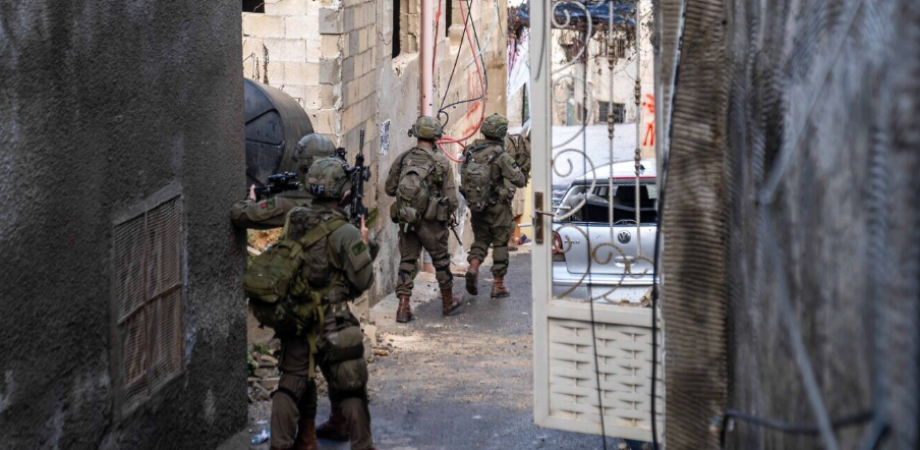
SAFA — Hundreds of Palestinian families returning to their homes and businesses in Hebron discovered smashed furniture, missing savings, damaged property, and devastated livelihoods following an 11-day Israeli military operation that forcibly displaced nearly 4,000 residents.
Testimonies documented by +972 Magazine reveal extensive destruction in the Jallad and Deir Baha neighborhoods, where Israeli forces occupied residential buildings, restricted movement, and ordered families to evacuate between October 23 and November 2.
According to the Hebron Follow-up, Support and Relief Committee, at least 619 Palestinian families, comprising approximately 3,971 people, were forced from their homes during the operation.
Residents were prevented from returning to their homes and workplaces for much of the military campaign. When Israeli troops withdrew, families discovered extensive damage to houses, businesses, vehicles, and personal belongings.
For many Palestinians, returning home brought another devastating experience of loss after days of forced displacement.
Families Return to Ransacked Homes and Missing Savings
Riham al-Muhtaseb, a mother of four from the Jallad neighborhood, was forced to flee with her children, leaving most of the family's belongings behind.
She described days of fear and instability as her family moved between relatives' homes, while her children struggled emotionally with displacement and separation from their familiar surroundings.
When the family finally returned, they found their home ransacked.
Furniture and electronic equipment had been smashed, while gold jewelry and savings boxes containing cash were missing.
Cabinets, drawers, bags, and personal documents had been searched and scattered throughout the house.
The damage extended to the family's sofa, table, refrigerator, windows, doors, laptop, and printer.
Another Jallad resident, who requested anonymity for fear of retaliation, told +972 Magazine that Israeli soldiers had entered his home and the shop beneath it.
He reported that surveillance cameras, shelves, and storage areas had been destroyed, while perfumes and cash from the register were missing.
The shop was left in disarray, adding financial losses to the family's experience of displacement.
Israeli Soldiers Turn Palestinian Apartments Into Military Positions
Other residents discovered that Israeli troops had occupied their homes during their forced absence.
Liqaa al-Muhtaseb, also from Jallad, received photographs from neighbors showing Israeli soldiers inside her apartment and other units in the same building.
She said soldiers used loudspeakers to order residents to evacuate, leaving families little time to gather their belongings.
When she returned on November 2, she found furniture from neighboring apartments mixed with her own possessions.
Her belongings had been moved into other units, while furniture belonging to her neighbors had been brought into her apartment.
For days, families had been unable to determine what was happening inside their homes or whether their belongings would remain intact.
Their accounts illustrate the consequences of Israeli forces occupying civilian residential buildings and converting them into military positions.
Hundreds of Vehicles Seized, Businesses Left in Ruins
The destruction extended beyond residential neighborhoods to commercial properties and businesses that provided livelihoods for dozens of Palestinian families.
In the Farsh al-Hawa area west of Hebron, seven businesses were forced to close during the military operation.
Some owners were given no more than three hours to evacuate their premises and remove their belongings.
The affected businesses included auto-parts shops, scrap yards, a tile and flooring showroom, and a café.
Business owners reported the seizure of vehicles, equipment, and merchandise, while two commercial properties were completely destroyed.
Iyad Qawasmi, who owns an auto-parts business, said his premises contained between 500 and 600 vehicles used in the spare-parts trade.
According to his account, Israeli forces initially requested access to surveillance camera footage before ordering him to clear the property within three hours.
Qawasmi called on neighbors and workers to help remove as many vehicles as possible.
However, Israeli forces arrived with a civilian contractor and equipment used to lift and transport cars.
Approximately 300 vehicles were seized, according to Qawasmi.
He said he was informed that the confiscations were carried out under a military order but had received no information about where the vehicles were being held or what would happen to them.
Another business owner, Suleiman Karameh, said he was unable to save any of his property.
His business contained 140 vehicles, along with substantial quantities of iron, copper, and equipment, but military road closures prevented him from removing the goods.
All seven businesses remained closed at the time of the report, with two completely destroyed.
Their owners estimated their combined losses at millions of shekels, while dozens of workers lost their sources of income.
Extended Families Forced to Flee Their Neighborhoods
The military operation also displaced extended families who had lived in the affected neighborhoods for generations.
Rafiq Hassan Amin al-Hanini, 50, said between 35 and 40 members of his extended family, living in five homes, were ordered to leave.
Israeli soldiers instructed them to take enough food, water, and clothing for seven days, along with identification documents, car keys, and mobile phones.
They were not given a clear date for their return.
The family initially stayed with relatives before renting an apartment during the final three days of displacement.
Other family members were scattered across different parts of Hebron.
When al-Hanini returned home, he discovered smashed drawers, displaced furniture, scattered belongings, and garbage and food left inside cabinets.
He told +972 Magazine that security camera footage showed Israeli soldiers carrying two electric fans while leaving the building.
The operation also prevented him from working at his auto repair shop beneath the family home, cutting off his income throughout the military campaign.
Israeli Military Defends Operation Despite Widespread Destruction
The Israeli military said the operation was intended to dismantle armed infrastructure and prevent future attacks.
However, +972 Magazine cited a report by the Israeli newspaper Haaretz stating that only four weapons had been seized during the operation.
The limited number of reported weapons seizures raised questions about the scale of the military campaign and its consequences for thousands of Palestinian civilians.
Responding to questions from +972 Magazine, an Israeli military spokesperson said troops had searched the area for weapons and related infrastructure.
The spokesperson maintained that soldiers had been instructed to protect residents' property and avoid unnecessary damage to homes.
The military also said an internal review had not identified complaints concerning property damage and that specific cases brought to its attention would be investigated.
These statements contrasted sharply with residents' accounts of missing money, seized vehicles, damaged businesses, and homes used as military positions.
UN Documents Mass Displacement and Damaged Homes
A November 5 report by the UN Office for the Coordination of Humanitarian Affairs (OCHA) documented the displacement of more than 3,000 Palestinians during the operation.
The UN agency also reported that families returned to damaged homes, with humanitarian assessments focusing on housing repairs and the provision of essential household items.
The findings reinforce concerns about the humanitarian consequences of large-scale military operations in Palestinian residential neighborhoods.
Although Israeli forces eventually withdrew, the effects of the operation continue to shape daily life for affected families.
Residents now face the financial burden of repairing damaged homes, replacing missing belongings, restoring businesses, and recovering from days of forced displacement.
For the 3,971 Palestinians forced from their homes, the end of the Israeli military operation did not mark the end of their suffering. They returned to damaged neighborhoods, shattered livelihoods, and the difficult task of rebuilding what had been lost.
Source : Safa News


