
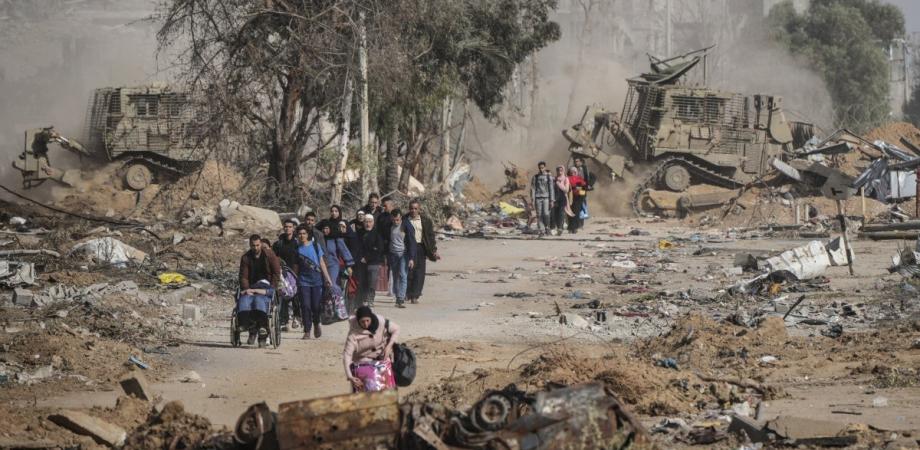
In Gaza, education has become less a pathway than a suspended promise. Hundreds of young people who secured places at universities abroad now find themselves trapped in a limbo where academic calendars continue elsewhere, but not for them. More than 1,500 students have been admitted to institutions outside the territory, yet their departure depends on access through crossings that remain tightly controlled amid a prolonged genocidal war, turning scholarships into fragile documents rather than guaranteed opportunities.
For many, the issue is not only administrative but existential. Amir Fawjo, one of the voices behind a student-led initiative known as “Between the Dream and the Crossing,” describes a generation standing at the threshold of adulthood without passage forward. The movement has emerged as an attempt to give structure to their appeals, as students repeatedly petition for safe passage through the Rafah Crossing and other exits, arguing that their right to education should not be indefinitely suspended by circumstances beyond their control.
Among them is Saeed Alaa Al-Din Barbakh, who achieved strong academic results and secured a place at the Egypt-Japan University of Science and Technology after a demanding selection process. Yet years of delay have forced him into improvised study inside Gaza, where intermittent electricity and limited digital access undermine any attempt at stable learning. What was meant to be a structured engineering pathway has instead become an improvised and incomplete substitute, with the risk of losing his scholarship entirely if travel remains impossible.
Similarly, Lujain Jihad Shaqoura, admitted through a scholarship route linked to medical studies, has seen her academic trajectory unravel under the weight of repeated displacement and the destruction of educational infrastructure. Even after investing financially and emotionally in securing her place, she now faces mounting penalties and the erosion of her opportunity. For her, as for many others, the priority has shifted from advancement to endurance, as survival increasingly eclipses study in daily life under conditions shaped by displacement and instability.
Across these individual stories runs a shared reality: education, once seen as the most reliable escape from uncertainty, is now itself trapped within it. Students continue to insist they are not seeking exceptional treatment, only the restoration of a basic academic right that should not be held hostage to political and military paralysis.
Source : Safa News


