
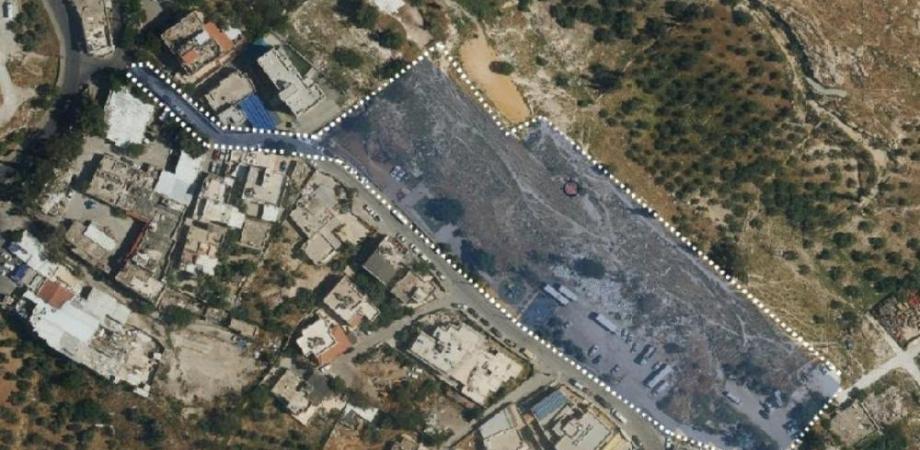
SAFA - The Israeli-approved settlement plan in the Palestinian neighborhood of Umm Lisoun, southeast of occupied East Jerusalem, will add some 450 housing units for over 2,000 Israeli settlers in what will be one of the city’s largest settlement projects planned within a Palestinian neighborhood.
Located between Jabal al-Mukaber and Sur Baher, Umm Lisoun is a densely populated Palestinian neighborhood of around 800 homes. The project forms part of Israel's broader settlement expansion policy in occupied East Jerusalem, which Palestinians and rights groups say aims to increase the Israeli presence inside Palestinian neighborhoods and reshape the city's demographic and geographic landscape.
The neighborhood is also home to the archaeological site of Khirbet Umm Lisoun, which contains the remains of a small Georgian Christian monastery dating to the Byzantine period. An ancient Georgian inscription discovered there in 2002 is considered among the oldest known Georgian inscriptions found in the Holy Land.
Municipality Clears the Way for Settlement Construction
The plan, approved by the Israeli District Planning and Building Committee, includes the construction of residential towers reaching up to 10 stories.
The proposal was first submitted by private company Topodia in 2022, but it stalled for more than two years after planning authorities requested the expansion of the access road to the site, Israeli rights organization Ir Amim said.
The private developers did not own the public roads that their plans affected, and therefore they could not file the plans, and the approval process could not proceed. The project advanced only after the Israeli municipality joined as the official applicant, enabling the road expansion to be incorporated into the broader settlement scheme.
Jerusalem affairs researcher Fakhri Abu Diab told Safa News Agency that settler organizations had been attempting for more than six years to establish a settlement in Umm Lisoun, but implementation was delayed because the land is surrounded by privately owned Palestinian property and lacked access roads.
"Recently, the Israeli municipality became an official partner with the settlement organization, taking responsibility for removing obstacles, constructing roads, and providing the necessary infrastructure, paving the way for the project's implementation," Abu Diab said.
He said the development would include around 450 settlement units in large residential buildings and towers of up to 10 floors, housing more than 2,000 settlers.
The project is the biggest settlement project of its kind planned inside a Palestinian neighbourhood of Jerusalem, larger than the Ma’ale Zeitim settlement compound in Ras al-Amud, Silwan, which has some 120 apartments, said Abu Diab.
Demographic and Urban Transformation
Abu Diab said Umm Lisoun is currently characterized by a quiet, semi-rural environment where most Palestinian homes are simple one- or two-story buildings. The planned high-rise settlement, he said, would dramatically alter the neighborhood's skyline and demographic composition.
He warned that establishing a large settlement inside the neighborhood would require a permanent deployment of Israeli police and security forces to protect settlers and secure access roads.
"This will increase the restrictions imposed on Palestinian residents, intensify security measures, and lead to harassment and attacks against local residents because of the settlers' presence," Abu Diab said. He added that the resulting pressure could gradually force Palestinians from their land by making daily life increasingly difficult.
Further Pressure on Palestinian Neighborhoods
Abu Diab said the project comes as Palestinians in Jerusalem continue to face severe obstacles in obtaining building permits, which he described as part of discriminatory Israeli planning policies.
He warned that the impact would extend beyond the initial 450 housing units, creating a settlement foothold that could expand further in the future through additional construction and a growing settler population.
The project, he said, would fragment Palestinian neighborhoods, weaken their geographical continuity, and restrict their natural urban expansion. He also warned that the area could effectively become a heavily secured zone due to the permanent presence of settlers and Israeli forces.
Israeli occupation forces are also expected to confiscate additional Palestinian land to build roads linking the settlement to West Jerusalem and other Israeli settlements in occupied East Jerusalem, increasing pressure on nearby Palestinian communities.
Abu Diab notes that the settlement would have an impact on locals politically, socially, culturally, and security-wise, especially since it would ignore neighboring Palestinian neighborhoods like Jabal al-Mukaber.
He also stresses that the Israeli municipality plays a central role in supporting settlement expansion by facilitating projects, demolishing Palestinian homes, restricting building permits, and limiting Palestinian urban development.
"In this specific project, without the intervention of the Israeli municipality, the settler organizations would not have been able to obtain the roads and infrastructure required to establish the settlement in Umm Lisoun," Abu Diab said.
He added that with the municipality now formally backing the project, the remaining planning procedures are expected to move more quickly, ultimately leading to the issuance of construction permits and the start of building work.
Source : Safa News


