
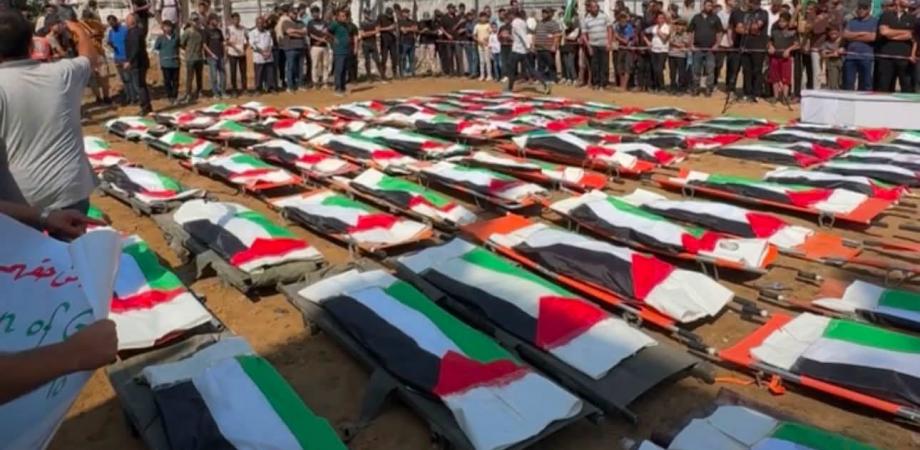
SAFA - More than two and a half years after an Israeli airstrike reduced an entire residential block in Gaza City's Al-Sabra neighborhood to rubble, Palestinian civil defense crews have concluded one of the most difficult recovery operations since the start of Israel's genocidal war on Gaza, retrieving the bodies and human remains of 112 victims from the Abu Sharia and Al-Hasayna families. Dozens of others are still believed to be buried beneath the debris.
On 22 November 2023, Israeli airstrikes leveled a densely populated residential block in Al-Sabra, south of Gaza City, causing buildings to collapse on their residents and erasing much of the neighborhood. Since then, the victims had remained trapped beneath the rubble as ongoing military operations and the lack of heavy equipment prevented rescue and recovery efforts.
Seventeen Days of Recovery Operations
Civil defense teams began recovery operations on 14 July 2026 and concluded them on 1 August, using a single excavator rented through the International Committee of the Red Cross (ICRC).
Mohammad Al-Mughayyir, director of humanitarian support and international cooperation at the Palestinian Civil Defense in Gaza, said the operation lasted 17 consecutive days under extremely difficult conditions.
He said each recovered victim would be individually shrouded, wrapped in the Palestinian flag, and buried in a collective cemetery designated for the Abu Sharia and Al-Hasayna families.
Rescue workers encountered scenes they described as among the most harrowing of the war. According to Al-Mughayyir, the recovered remains included children, women, elderly people, and men, many of whom were in advanced stages of decomposition. Some victims were identified through their clothing or personal belongings, including jewelry still worn by women.
Recovery teams found remains trapped between reinforced steel bars, embedded within massive concrete slabs, or preserved only by fragments of clothing. In some cases, only scattered bones remained.
Among the most heartbreaking discoveries was the body of a young child still lying in her mother's arms as she had been breastfeeding her when the building was struck.
Only One-Third of the Victims Recovered
Civil defense estimates indicate that the massacre claimed the lives of approximately 308 Palestinians, including 44 children under the age of 16, 37 women, and more than 10 people with disabilities.
Despite the completion of the recovery operation, only 112 bodies and human remains were retrieved, roughly one-third of those believed to have been killed.
Al-Mughayyir said there remains a significant gap between the estimated death toll and the number of victims recovered. He noted that more than 40 bodies may have completely disintegrated due to the intensity of the bombardment and the extreme heat generated by the explosions, while others remain trapped inside massive concrete blocks that crews were unable to dismantle.
Limited Equipment, Impossible Conditions
Civil defense teams faced severe operational challenges throughout the mission, often removing rubble and cutting through reinforced concrete and steel by hand because of the acute shortage of heavy machinery.
Al-Mughayyir stressed that access to adequate equipment could have reduced the operation from weeks to only a few days. He renewed calls on international humanitarian organizations to pressure for the entry of the machinery and equipment needed to enable rescue teams to recover the thousands of Palestinians who remain buried beneath the rubble across the Gaza Strip.
The Abu Sharia and Al-Hasayna family massacre has become one of the deadliest massacres of Israel's war on Gaza, not only because of the scale of the killings, but also because many of the victims remained buried beneath the rubble for 965 days before recovery efforts could finally begin.
Although recovery operations at the site have now ended, the tragedy remains unresolved. Dozens of victims are still missing beneath the destroyed buildings, while the devastated Al-Sabra neighborhood stands as a stark testament to one of the most devastating humanitarian tragedies witnessed in Gaza during the genocidal war.
Source : Safa News


