
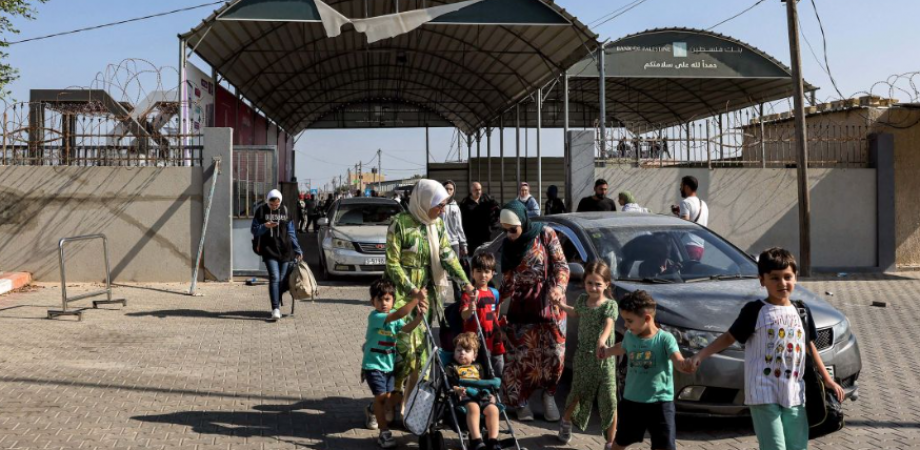
SAFA- The Gaza Human Rights Center expressed serious concern over the continued policy of the Israeli occupation authorities to deny Palestinian civilians, including women, children, the elderly, and patients who have finished medical treatment outside the country, return to the Gaza Strip.
In a statement issued on Wednesday, the center said the practice reflects an escalating policy aimed at restricting Palestinians’ right to return to their homes, deepening family separation and reinforcing conditions that amount to forced displacement. In recent weeks, the group says it has documented an increasing number of testimonies from Gazans who were refused permission to return through what Israeli forces describe as a “security rejection” process.
The center explained that Palestinians seeking to return to Gaza must first register through the Palestinian Embassy in Cairo or a private coordination company. Their names are then submitted to Israeli authorities for security screening before approval is granted, a process that can take days or even weeks.
It said the cases it documented show that rejections are often sudden, repeated, and issued without explanation, affecting women, children, and elderly people alike. The organization argued that there is no effective legal mechanism to challenge such decisions, effectively turning the right to return into a privilege dependent on Israeli approval.
Personal Testimonies
The center documented several cases of women who have remained stranded outside Gaza for months or even years after being denied permission to reunite with their husbands and children. It also reported cases of patients who completed medical treatment abroad but were unable to return home, leaving them in severe humanitarian and psychological hardship.
One woman, identified only by her initials M.M., 34, told the center she left Gaza for medical treatment several months after the war began, leaving behind her husband and most of her children.
“I recently decided to return and traveled to Egypt from the country where I had been receiving treatment,” she said. “I thought only a few hours separated me from my children, but suddenly I was informed that I was not permitted to return. I don’t know why. I am in shock, and my heart is broken because my children have been waiting for me for nearly two years.”
Another woman, Aisha, 42, said she had spent months separated from her husband and children.
“Despite the danger, death and hunger in Gaza, I decided to return to reunite with my family, who have already lost several relatives,” she said. “Instead, I was told my name had been rejected. Why does returning to my destroyed home require approval from the occupation? Our lives are suspended by decisions whose reasons and timing we do not know.”
The center also cited the testimony of Abdul Aziz, 68, who traveled abroad for medical treatment expecting to return after completing his care.
“I registered to return but was surprised that the occupation rejected my request,” he said.
“What hurts me most is my loneliness away from home and my constant worry about my children and grandchildren. I only want to return so we can be together in our homeland, whatever the circumstances.”
Abuse and Detention at Border Crossings
The group said forcing Palestinians to undergo mandatory security checks and wait for Israeli approval turns a basic right into a conditional privilege. It stated that this practice violates freedom of movement and the right to return, rights that should not be subject to arbitrary administrative or security decisions.
The center further stated that even Palestinians who receive approval often face lengthy and degrading security procedures while crossing, including prolonged searches, repeated interrogations, and the confiscation of personal belongings.
It also documented cases in which individuals holding prior approval were arrested upon return, while others, including women, were reportedly subjected to physical assault, ill-treatment, threats, and coercion during crossing procedures.
The accumulation of these practices, the organization says, is a sign of a systematic Israeli policy that goes beyond declared security concerns. It stressed that the measures are intended to create conditions that discourage Palestinians from returning, weaken family and social ties, and impose arbitrary restrictions on the right of return as part of broader policies that contribute to forced displacement and demographic change in the Gaza Strip.
The center said these practices constitute serious violations of international humanitarian law and international human rights law.
It warned that using control over border crossings and freedom of movement to prevent Palestinians from returning to their homes, while prolonging family separation, cannot be viewed in isolation from broader Israeli policies that, it said, seek to reduce the Palestinian presence in Gaza by creating conditions that either keep residents outside the territory or obstruct their return.
The organization called on the United Nations, the International Committee of the Red Cross, and UN Special Rapporteurs, as well as the wider international community, to take urgent action to ensure the unconditional return of all Palestinians stranded outside Gaza.
It also urged international actors to end arbitrary restrictions on return, establish humane crossing procedures that respect human dignity, and hold those responsible for violations against travelers accountable.
The center concluded by stressing that the rights to return to one’s homeland, freedom of movement, and family unity are fundamental rights that cannot be suspended at the discretion of an occupying power. It maintained that any policy preventing Palestinians from returning to Gaza or forcing them to remain outside their homes forms part of a broader system of forced displacement and demographic engineering, calling for urgent international action to end the alleged violations and ensure accountability.
Source : Safa News


