
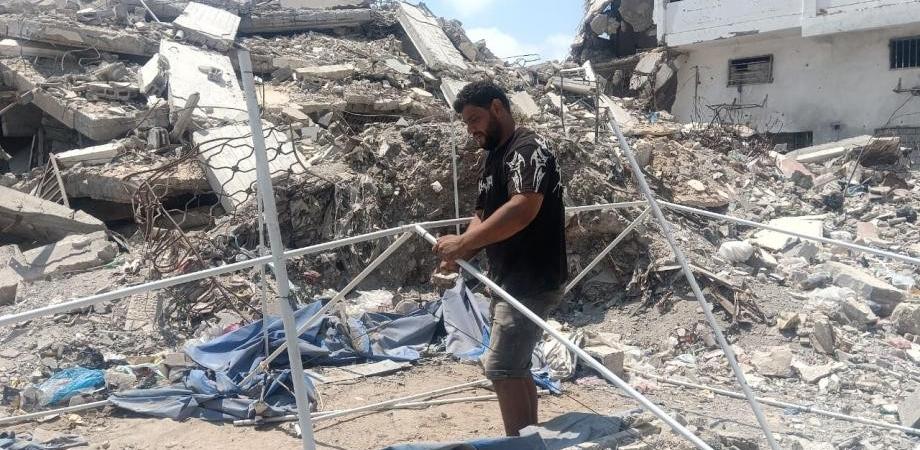
SAFA- Salman Assaf, 30, struggles under the blazing midday sun as sweat pours down his face, adding to the strain of his work. With his cracked hands, he carefully removes an old aluminum piece from the frame of his tent on a street in Gaza City.
The tent has not deteriorated from the sun alone. It has become worn out after being repeatedly dismantled and relocated, reflecting the exhaustion of the young man, who now finds himself talking to himself in the street out of extreme helplessness.
“Kind people gave me this tent, and as you can see, it’s worn out,” Salman told Felesteen newspaper while cutting away torn pieces of torn fabric. Speaking with a voice filled with despair, he added, "This tent came with me to Rafah during my displacement at the beginning of the genocide. It’s no longer usable. I’ll have to replace the torn fabric with pieces of a blanket.”
A Journey of Forced Displacement
Before the genocide that began on October 7, 2023, the 30-year-old worked as a taxi driver for 14 years and lived a modest life with his family in Jabalia, northern Gaza. Today, he finds himself caring for his four daughters, his eldest is eight years old, while the youngest are 16-month-old twins, without work due to the shortage of fuel and motor oil. He now depends on charity kitchens and a handful of bread to survive.
This marks the tenth stop in Salman’s displacement journey, stretching from Beit Jabalia in northern Gaza to Rafah in the south. After his home, located behind what is now known as the “Yellow Line,” was destroyed and with no possibility of returning, he was forced to erect his tent temporarily on a public street in central Gaza following the ceasefire that took effect in October 2025. However, the site proved unsuitable, forcing him to begin yet another search for shelter.
As he dismantles what remains of his tent, Salman says: “I can’t afford to hire a cart to move my belongings. I’m carrying my tent and everything I own on my shoulders as I walk toward the port area.”
Crowded Into Just 30% of Gaza’s Area
Salman’s story reflects not only his personal suffering but also the severe overcrowding across the Gaza Strip. As Israeli occupation has not implemented the first phase of the latest ceasefire agreement, including allowing the entry of tents and essential shelter supplies, more than two million Palestinians remain crowded into just 30% of Gaza’s total area of 365 square kilometers.
At Salman’s new displacement site along the seashore, this overcrowding means each tent occupies no more than a 5-by-4-meter space. Worn-out tents are packed tightly together, leaving virtually no room for privacy or dignified living conditions.
“The only place I could find is a 5-by-4-meter plot. It’s covered with rubble, and I’ll have to spend two days clearing it just to make it suitable for my family,” he says.
Salman’s struggle does not end with finding a place to stay. At night, his tent becomes a battleground against insects and rodents, whose numbers and size have increased amid the growing piles of rubble and waste.
Fearing for his daughters, Salman says: “Living next to the rubble is unbearable. Large rodents and rats are everywhere, day and night. I no longer sleep because I have to watch over my girls. Yesterday at the camp, a large rodent bit a man on the finger, and he suffered poisoning. They’re as big as rabbits now.”
A Daily Search for Infant Formula
Alongside the lack of proper shelter and the extreme heat that leaves little ventilation, Salman faces the daily challenge of securing infant formula for his twin daughters. Every day, he visits health centers and under-resourced clinics in search of a can of formula. When none is available, the twins must rely on breastfeeding from their mother, who is herself suffering from malnutrition and the physical strain of repeated displacement.
As he removes the last aluminum piece from his tent frame, Salman concludes with an appeal to the National Committee for Gaza Administration, humanitarian organizations, and the international community: “Stand with us and see this tragic situation. It’s beyond what anyone can bear. We have no strength left. I’m exhausted and can’t take it anymore. All we want is a place where we can shelter our family.”
Between a worn-out tent and piles of rubble surrounding him from every direction, Salman continues his journey of forced displacement, hoping to find just a few square meters to protect his family from the summer heat and the threat of rodents. In Gaza today, even securing a tent to shelter a child has become an almost impossible task.
Source : Safa News


