
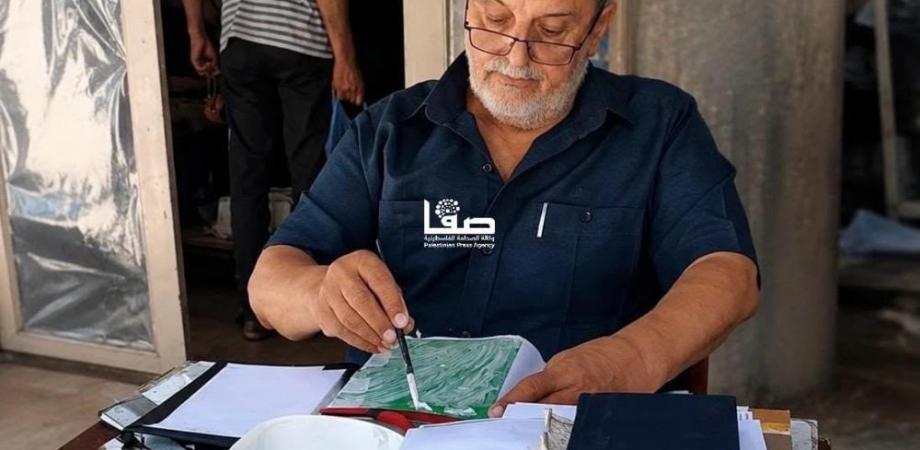
SAFA - At a worn wooden table, warm glue runs between Jamil Miqdad’s fingers as he carefully works along the edges of a Quran scorched by fire and torn apart by shrapnel.
The beloved translator and printer leans over the table, gently turning its damaged pages as though tending to wounded bodies rather than sheets of paper. At times, he pauses and stares into the distance.
“When I hold the Quran, I feel like I am holding a soul,” Miqdad told Safa. “It feels as if I am repairing my own life from nothing.”
Amid Israel’s genocidal war on Gaza, the destruction has extended beyond homes and infrastructure to places and objects of religious significance. Printing presses have been burned, mosques and public libraries destroyed, and places of worship targeted, leaving thousands of Qurans buried beneath the rubble or reduced to ashes.
The crisis has been compounded by Israel’s restrictions on the entry of new Qurans and paper and printing supplies into Gaza, even as demand for the holy book continues to grow. In overcrowded shelters and tents, Quran memorization circles have become a source of comfort for children and adults seeking solace amid bombardment and repeated displacement.
Loss Gives Birth To A Mission
For Miqdad, repairing Qurans is no longer simply a craft. The work emerged from personal loss.After spending two months displaced, he returned to Gaza’s Beach refugee camp to discover that his workplace had been devastated.
“We used to repair torn and worn-out Qurans after the war,” he recalled. “When we returned after two months of displacement, we found that our library and printing press had been burned. Most of the papers, books, and Qurans inside had also been burned.”
The destruction came with enormous financial losses. Miqdad said his printing business in the Beach camp had contained hundreds of Qurans, books, and notebooks.
“My losses exceeded $200,000,” he said. “More than 70 percent of the goods and Qurans were completely burned. Nothing was left.”
Before the destruction, his printing press played an important role in supplying Qurans and religious books to local residents and institutions.
“Many citizens and institutions relied on me to provide Qurans and books,” he said. “We distributed them to Quran centers and people who had memorized the Quran, especially during Ramadan and at mourning gatherings. People also bought them as charitable donations for the souls of their martyrs and loved ones.”
“The fire did not destroy only a printing press,” he added. “It destroyed a lifeline that supplied Quran schools and centers.”
Saving Pages From The Ashes
Although his printing press was reduced to ruins, the growing shortage of Qurans pushed Miqdad to find another way to serve his community.
“The idea came because no new Qurans are entering Gaza to replace the damaged ones,” he said. “So we decided to repair whatever we can and restore these Qurans so people can read and memorize from them again.”
Working with scarce supplies, including cardboard, fabric, and glue, Miqdad carries out the repairs almost entirely by hand. The prolonged restrictions on goods entering Gaza have made even basic materials increasingly difficult to obtain.
He explained that when pages are torn beyond repair, he uses a similar Quran to reproduce the damaged section, cuts it to the required size, and carefully incorporates it into the damaged copy.
“We were taught in our faith as Muslims to be people with a message,” he said. “That is why I restore these Qurans.”
But the process is labor-intensive, and supplies are running out.
“The available materials are cardboard and fabric, and many of these materials have started to disappear,” Miqdad said. “Glue is almost nonexistent, and cardboard is also becoming scarce. Everything we do is manual because we have no machines.”
A Source Of Comfort For Gaza
For those bringing damaged Qurans to Miqdad, the restoration offers more than a repaired book. It provides a tangible connection to faith at a time when displacement, destruction, and grief have disrupted nearly every aspect of daily life.
“People are happy,” he said. “They are happy to find a way to have their Quran restored, beautiful and organized again, without paying anything.”
At his modest worktable, surrounded by damaged pages and dwindling materials, Miqdad continues to remove the dust and ash from the verses of the Quran.
His work has become a small but deeply meaningful act of preservation amid Israel’s genocidal war on Gaza, preserving books, memories, and a sense of continuity for people struggling to hold on to what remains.
“I hope safety, security, and peace return to our land,” Miqdad said. “I hope we can rebuild what has been destroyed, our homes, our mosques, and our lives.”
Source : Safa News


